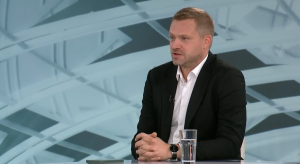
The Independent Journalists’ Association of Serbia (IJAS) considers it deeply problematic that Branislav Klanšček, the current Chair of the RTS Management Board, has been accepted as a “regular” candidate for the position of Director General of the public broadcaster — and this by the very same Management Board that decides who will be appointed to that position.
The Law on Public Media Services explicitly refers to the application of regulations on the prevention of conflicts of interest that apply to members of management boards, in accordance with the Law on the Prevention of Corruption. According to Article 25, paragraph 3 of the Law on Public Media Services, a person who cannot be a member of the Management Board cannot be appointed Director General. At the same time, the law stipulates that a person who is in a conflict of interest cannot be elected as a member of the Management Board. From these provisions, it clearly follows that the rules on preventing conflicts of interest apply directly to the procedure for electing the Director General.
In a situation where the Chair of the Management Board submits a candidacy for a position that is appointed precisely by that same Board, the question of a potential conflict of interest is clearly raised, since this is a relationship in which the candidate may have personal benefit or influence over the decision-making process, even indirectly through the position they currently hold. We believe it is unacceptable for this candidacy to be treated as unproblematic without a prior, clear position of the competent institutions — primarily the Agency for the Prevention of Corruption and REM — on whether the candidate’s position does or does not constitute a conflict of interest. If a conflict of interest is established, such a person cannot be a member of the Management Board, and therefore cannot be a candidate for Director General.
We remind that the amendments to the Law on Public Media Services entered into force on June 25, 2025, and that RTS and RTV have a six-month deadline to harmonize their bylaws with the law. This does not mean that the competition is prohibited until then, but it does mean that RTS is obliged to conduct the competition and selection process in full compliance with the amended law, and to disregard all statutory provisions that are in conflict with it — including those that effectively “overlook” or downplay conflicts of interest.
Article 30 of the Law on Public Media Services stipulates that the Statute shall more closely regulate the internal organization, the manner of operation of the public media service and its bodies, the adoption of general acts, authorizations regarding the disposal of operational funds, the procedure for appointing the Director General, the procedure and conditions for the appointment and dismissal of editors-in-chief and media directors, as well as other issues important for the operation and functioning of the service. The same article prescribes that the Statute must be approved by the REM Council — which has not existed in its full composition since November 4, 2024. The competition for the RTS Director General did include the minimum requirements prescribed by Article 25 of the new Law on Public Media Services, but the real question is whether the selection criteria are aligned with the new standards of independence and accountability, and whether the decision on the appointment of the Director General will be explained and made available to the public, as now explicitly required by Article 19, paragraph 1, item 7, and Article 24.
We also recall the decision of the RTV Management Board to annul the already announced competitions for Program Director and Editors-in-Chief, adopted on October 7, 2025, based on the opinion of the Ministry of Information and Telecommunications dated August 15, 2025. In that opinion, the Ministry stated that the “decisions announcing the public competitions must be annulled” because, after their adoption, a new law entered into force that changed the rules for selecting program directors and editors, and the new text of the law does not provide guidance on how ongoing competitions should be completed. This position was used to annul the competitions at RTV, invoking the principle of the prohibition of retroactivity, while in the case of RTS the same authorities have so far remained silent on the numerous dilemmas surrounding the competition for Director General.
Such practice creates the impression of double standards and further undermines public trust in the management of public service broadcasters. On the one hand, formal legal logic dictates that public broadcasters must immediately implement the law and harmonize their acts within the prescribed deadline; on the other hand, the Ministry, through its opinion, influences the annulment of competitions at RTV, while in relation to RTS there is no clear and consistent interpretation of the same provisions.
For all these reasons, we consider it necessary for RTS and RTV to publicly explain how they are applying the new Law on Public Media Services in the procedures for selecting their leadership, and for the Management Boards to ensure strict adherence to conflict-of-interest rules and full transparency of the competitions. Public service broadcasters cannot be reformed or made genuinely public if key decisions are made in an environment of legal uncertainty, political pressure, and inconsistent application of the law.
Without resolving these issues, any election of the RTS Director General will remain permanently burdened by doubts about its legality and legitimacy, and the public broadcaster will move even further away from its statutory role — to be independent, professional, and accountable primarily to the citizens, rather than to political centers of power.
Independent Journalists’ Association of Serbia
Belgrade, December 2, 2025