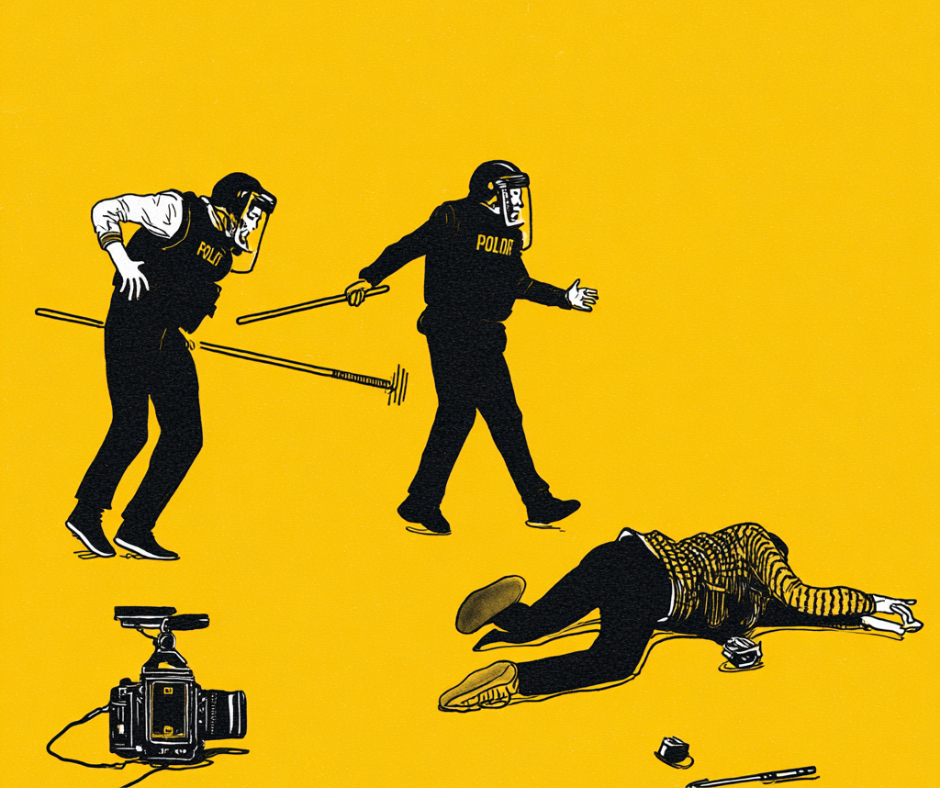
In November, the Independent Journalists’ Association of Serbia (NUNS) recorded a total of 30 incidents. Once again, there has been a rise in actual attacks on journalists, especially during public gatherings organized across Serbia, along with an alarming pattern of inadequate responses by police officers in cases involving attacks on journalists, including instances of direct police involvement or failure to intervene. A total of 21 physical attacks were recorded, five of which were committed by the police. Additionally, there were five recorded death threats and threats to the physical safety of journalists, three other threats against journalists and one threat against media outlets and organizations and attack targeting media and media organizations.
Attacks on Journalists During Protests: Police Continue With Repression
Insajder journalist Nataša Mijušković was attacked on 2 November while reporting from the gathering near the National Assembly of Serbia. She was assaulted by a group of unidentified men in civilian clothing who refused to identify themselves. After she entered the improvised camp – showing her press ID – and took a few photos, the group surrounded her, grabbed her arm, and forced her to show the recorded material, threatening “to break all her bones.” They called her “a traitor of the Serbian people working for Insajder TV.” Unknown individuals followed the journalist to a police cordon, where a police officer “friendly” advised her not to enter the camp again. When she asked, “Is this occupied territory?”, she was told to report the incident by calling 192.
Later that evening, during the protests near the National Assembly, police officers acted unlawfully toward Danas journalist Vojin Radovanović. Commander of the Gendarmerie, Marko Kričak, checked his ID in Resavska Street, even though Radovanović was wearing a yellow vest clearly marked “press” and repeatedly stated that he was a journalist, saying: “You were filming the police action, so let’s see.” Police officers demanded that he open his backpack, and Kričak photographed his ID card. When the journalist asked whether it was standard practice for police to check journalists’ identities, the officers answered “no” – which makes the incident even more serious.
At the same event, photojournalists from Radio DIR (Ruma) were surrounded by a group of unmarked men who demanded that they delete recordings from their equipment and then slapped them on the head. During the incident, the female photojournalist’s camera lens was torn off, and her colleague’s press ID was removed and confiscated. The lens was later returned, but the press ID was not.
FoNet reporter Marko Čonjagić was physically attacked on 3 November in Kosovska Street in Belgrade while reporting from a gathering in support of Dijana Hrka. According to witnesses – colleagues and citizens – four men (three of them masked) tried to drag him into a fenced-off area, then knocked him down and kicked him. Čonjagić was clearly identified as a journalist and wore a vest marked “press.” When he reported the attack to plainclothes police officers who were present, they told him he had to go to the Stari Grad police station to file a report because “they were there for another purpose.”
During a gathering of Serbian Progressive Party (SNS) supporters in Belgrade on 5 November, several individuals insulted the KTV Zrenjanin crew and Nemanja Šarović, then hit him on the arm, kicked his microphone out of his hand, and threw pyrotechnics in his direction. A police cordon stood nearby, but despite shouts from citizens and journalists, the police did not intervene. Insajder journalist Stefan Miljuš was physically attacked and prevented from doing his job while interviewing a woman attending the gathering. Two unidentified men approached, grabbed him by the arms, and dragged him aside, refusing to identify themselves. When he asked whether he would be allowed to return to his team, they told him: “Don’t cause unnecessary problems. Just stand here.” Police officers present at the scene did not react. At the same event, an unidentified security officer from the tent settlement threatened InMedija journalist Verica Marinčić and demanded that she move away from the area directly in front of the National Assembly, calling on colleagues to intervene against her.
Also, while reporting on SNS members from Stara Pazova traveling to the rally in Belgrade, Pazovačke.rs journalist Stefana Budimirović- despite identifying herself as a journalist – was pushed from behind, insulted, and prevented from filming by SNS supporters and members.
SNS supporters attacked a Beta agency correspondent and a journalist from the Subotičke.rs portal on 11 November during a gathering in front of the party’s offices in Subotica. Men dressed in black forbade the journalists to photograph the gathering; one of the attackers crumpled the Beta reporter’s press ID worn around her neck, while another attempted to take the portal journalist’s phone.
While reporting from a civil protest in Novi Sad on 17 November, police officers attacked journalist Žarko Bogosavljević, editor of the Razglas News portal. During the pushing of citizens who were peacefully protesting in front of the building of the Government of the Autonomous Province of Vojvodina, a member of the Intervention Unit forcefully pushed Bogosavljević as he was reporting live, despite his clearly marked press vest. Bogosavljević shouted that he was a journalist and that the officer was breaking the law by physically attacking a journalist, demanding that he identify himself so a report could be filed, but the officer refused. The attacked journalist then approached a senior officer – unmasked, with a visible badge reading “Vasović”- requesting that the officer who pushed him be identified and provide information for the report, but the senior officer also refused.
At the same event, a police officer struck the camera of a Blokada INFO videographer as he was filming another officer hitting peaceful protesters without cause. The videographer was clearly marked and wore a press vest. Police also pushed N1 journalist Sanja Kosović, despite her press coat and visible press ID.
On 20 November, an N1 TV crew – journalist Maja Nikolić and cameraman Ivan Pavlović – was attacked while filming the improvised tent settlement near the Serbian Parliament. A man approached the N1 team, demanded that they stop filming, then grabbed their camera, threw it onto the ground multiple times, and heavily damaged it. Police officers nearby did not react during the attack and approached only after the perpetrator had left. After this failure to act promptly, members of the Intervention Police Unit called plainclothes inspectors, who notified the competent public prosecutor, who initially refused to order further action. Following additional pressure and intervention by on-duty prosecutors and journalistic contact points, the prosecutor finally ordered an on-site investigation.
Attacks and Obstruction of Journalists During Local Elections on 30 November in Negotin, Mionica, and Sečanj
Photojournalist Gavrilo Andrić was attacked while documenting events in front of a polling station in Negotin on 30 November. A group of people on quad bikes assaulted him: one quad ran over his foot, and the passenger on that vehicle grabbed his phone from his hand while he was recording the incident. Although Andrić located his phone and asked the police to accompany him to retrieve it, the officers reportedly refused. He eventually went to the location himself, accompanied by several people, and found the phone in a parking area—where two inspectors were already present.
In the same town, reporter Katarina Golubović, who was preparing to go live for Nova S TV’s news program near SNS premises, was obstructed by members of the party who shoved her, insulted her, and made inappropriate remarks. She was forced to move away in order to continue her work professionally.
Also in Negotin, journalists tried to record what was happening near a car where a commotion had broken out. During the incident, a reporter from the student outlet Blokada INFO was attacked, his phone was taken and destroyed, and he was punched in the nose. A Mašina portal journalist who witnessed the attack and tried to film what was happening had her press accreditation torn off, was hit in the shoulder, and was verbally abused by the attackers.
Additionally, Za media journalist Milena Ilić and NG portal journalist Suzana Mihajlović Jovanović were attacked while reporting on the elections. Ilić was struck hard in the shoulder, pushed, and insulted, while Mihajlović Jovanović was hit in the back. After the incident, hooded individuals entered a bus with Belgrade license plates and left the scene.
On the same day, a Mašina journalist was asked to show identification by police in Sečanj while filming events on the street, even though he had a visible “press” label and repeatedly identified himself as a journalist. Instead of intervening against those disturbing public order, the police detained him until they checked his data. Also that day in Mionica, police for unclear reasons obstructed and prevented Mašina journalist Marko Miletić from doing his job.
Continuation of Threats Against Journalists
In November, several new threats against journalists were recorded. First, on 2 November, N1 journalist Tatjana Aleksić received a threat via an Instagram comment from the account “Goran Savić”: “crush the scum… you especially, onto the hood.” Shortly afterward, on 5 November, a social media user, Zoran Cvijanović, sent threats to another N1 journalist, Sanja Kosović, writing: “Read this, the Black Hand has marked you, watch out, friend.”
A Radio Free Europe reporting crew was covering events on 2 November in front of the entrance to an improvised camp near the Presidency, but security personnel ordered them to stop filming and leave the area. One of the assembled individuals stated, in response to the journalist’s question, that the area “leads to the Presidency, where people enter and exit.” When asked whether they were police officers, the security personnel did not respond, and the journalist was subjected to serious insults and even threats.
The Emblema Association, publisher of the Far portal, received an email on 15 November from an individual identifying himself as Rastko Zlatić, directly addressing editor Slaviša Milanov. The message contains serious and unfounded accusations, claiming to possess “evidence” of an alleged attempted murder and announcing that charges would be filed. It also alleges involvement by the FBI and the arrest of third parties, while threatening imprisonment, financial damages, and asset seizure. The message pressures Milanov to “get in touch to make arrangements,” and includes intimidation about alleged arrests by Serbian and Bulgarian police. Given the content, tone, and manner of communication, the newsroom considers the message a threat directed at Slaviša Milanov. The baseless accusations, intimidation, and pressure exerted on the journalist are perceived as direct endangerment of his safety.
The Epicentar Press portal received a threatening message on 20 November via the inbox of its official Facebook page. The message states, among other things: “…You should be crushed wherever you appear if you don’t start reporting as neutral and unbiased, instead of as servants of the government and the opposition…”
N1 TV journalist Mladen Savatović received two threats on the social network X on 24 November. First, an unknown person wrote: “You have no idea what kind of beating you’re going to get somewhere because of your faggotry and everything you’ve done and are still doing. Someone will put makeup on you nicely. If I had done what you do, I’d be going everywhere with bodyguards. Watch out, man, you’ve gone too far.” X removed the threat as part of its national content moderation, after which the author posted a new threatening message: “The truth hurt Savatović. Puppy, you’ll be on a leash sooner or later,” accompanied by an image of the removed threat.
Media Campaigns
Tabloid Informer continues to publish obscene video materials targeting journalists. The latest target is journalist Nusreta Brunčević from Novi Pazar, who was falsely portrayed in the featured video as a “promoter of the claim that Serbs committed genocide in Srebrenica,” even though it is clear that her statement refers to the ruling regime, which promotes convicted war criminals. In this way, Informer dangerously targets the journalist, putting her at risk of potentially very serious consequences such as threats, physical attacks, hate speech, and similar incidents that may be triggered by such targeting.
Hacker Attacks on Journalists and Media
In November, coordinated attacks on journalists and media outlets occurred on social networks. The Instagram account of photojournalist Irena Radosavljević was targeted by a coordinated “spamming” campaign carried out by fake accounts. Within just two hours, several thousand “followers” began following her. During the same period, several other accounts on the platform were also targeted (Students in Blockade, Kreni-Promeni, and others). Additionally, on 26 November, the Instagram account of N1 Serbia was taken down following a coordinated hacking attack. The N1 newsroom immediately contacted Meta support, after which the account was restored. However, the attack itself illustrates the extent of pressure being exerted on media outlets that report critically.
Attacks on Journalists by High-Ranking Officials
The Minister of Information and Telecommunications, Boris Bratina, in appearances on Informer and Pink television channels, accused journalists from N1 and Nova S of being “to blame for many things,” while labeling Radio Free Europe as “dangerous because of its anti-Serbian programming.” He stated that N1 and Nova “should not exist on the airwaves within the territory of the state,” announcing amendments to regulations that would prevent them from broadcasting in Serbia.
Irregularities in the Procedure for Selecting the Council of the Regulatory Authority for Electronic Media (REM) Once Again
The procedure for selecting the REM Council still has no conclusion, even though the regulator has been without a Council for more than a year. After conducting public interviews with 18 candidates, the Committee on Culture and Information sent a report and a list of candidates to the parliamentary procedure under an urgent procedure on 4 November. However, on 12 November, MPs elected eight out of nine members of the REM Council. The ninth member, proposed by the national councils of national minorities, was again not elected, and it is precisely within this group of nominators that problems and legal violations had occurred in the previous period. The ruling majority abstained from voting for both candidates, Muhedin Fijuljanin and Ljumturije Ameti, so neither received the required majority.
Afterwards, four elected members of the REM Council (Rodoljub Šabić, Ira Prodanov Krajišnik, Mileva Malešić, and Dubravka Valić Nedeljković) addressed the public and announced their resignations, stating that they would only refrain from resigning if a new vote on the ninth group of candidates was held. They emphasized that the actions of the ruling majority had rendered the process meaningless and resulted in selective staffing of institutions to suit the needs of those in power. They stressed that under such circumstances they do not wish to participate in a process “in which politics is placed above the law,” arguing that the majority’s decision reflects an understanding of institutions as tools for achieving personal rather than public interests.
In the repeated urgent procedure, the Committee for Culture and Information of the National Assembly of Serbia, at its session on December 5, did not adopt the list of candidates for the ninth member of the REM Council from among national minorities, because the proposer was requested to submit additional documentation for one of the proposed candidates – Sreten Jovanović – within the given deadline. The other proposed candidate in this repeated procedure is Ištvan Bodžoni, who was also a candidate in the previous procedure. Additionally, the Committee Chair announced that the objection submitted by the Civic Initiatives would be discussed at the next committee session.
Competition for the Selection of the New Director General of Radio Television of Serbia (RTS)
In November, the competition for selecting the new Director General of Radio Television of Serbia (RTS) was completed. Seven applications were submitted, and it was determined that three candidates had complete documentation. The accepted candidates are Branislav Klanšček, Stanislav Veljković, and Dejan Stanković. The acceptance of Branislav Klanšček’s candidacy is considered problematic, given that the amended Law on Public Media Services clearly refers to the application of conflict-of-interest rules from the Law on the Prevention of Corruption, which apply to members of management boards and are also applicable to the selection of the Director General (Article 25, paragraph 3). When the current Chair of the RTS Management Board submits a candidacy for the position of Director General—who is appointed by that same Management Board—it raises serious concerns about a potential conflict of interest, as this is a situation in which the candidate may derive personal benefit or influence the decision-making process, even indirectly, through the position he holds.
The amendments to the Law on Public Media Services entered into force on 25 June 2025, and RTS and RTV have six months to harmonize their internal acts with the law. This does not prevent the competition from being conducted, but it obliges RTS to implement it strictly in accordance with the new law, without relying on statutory provisions that conflict with it – including those that ignore or downplay conflicts of interest. The law stipulates that key procedures, including the appointment of the Director General, are to be regulated by the Statute, which must receive approval from the REM Council – whose mandate expired on 4 November 2024. Although the RTS competition formally included the minimum requirements set out in Article 25, questions remain as to whether the selection criteria are aligned with new standards of independence and accountability, and whether the final decision will be accompanied by a transparent explanation, as required by Article 19, paragraph 1, point 7, and Article 24 of the law.
Legislative Framework
The Ministry of Information and Telecommunications has initiated the process of amending the Law on Public Information and Media, the Law on Electronic Media, as well as the drafting of a new Media Strategy. However, a group of credible journalistic and media associations and unions is demanding the immediate suspension of this process until transparent, inclusive, and expert working conditions are ensured. Of the eight invited organizations, only two are considered credible, and the Independent Journalists’ Association of Serbia (NUNS) has already declined to participate. The organizations warn that the current political and institutional context does not guarantee that the proposed changes will improve media freedom, journalist safety, or alignment with European standards.
They identify key problems such as the dominance of GONGO organizations in the working groups, the exclusion of the most significant professional associations, the repetition of previously unsuccessful practices, the growing number of attacks and pressures on journalists, the lack of evaluation of the current Media Strategy, and the political instrumentalization of the process. The Ministry refers to the Reform Program and the European Media Freedom Act (EMFA), but the obligations arising from them pertain to consultations with the European Commission and alignment with the EU acquis, not to ad hoc processes launched in this manner. The organizations call for the immediate suspension of the initiated amendments and the opening of a genuine, professional public dialogue on the future of the media system.