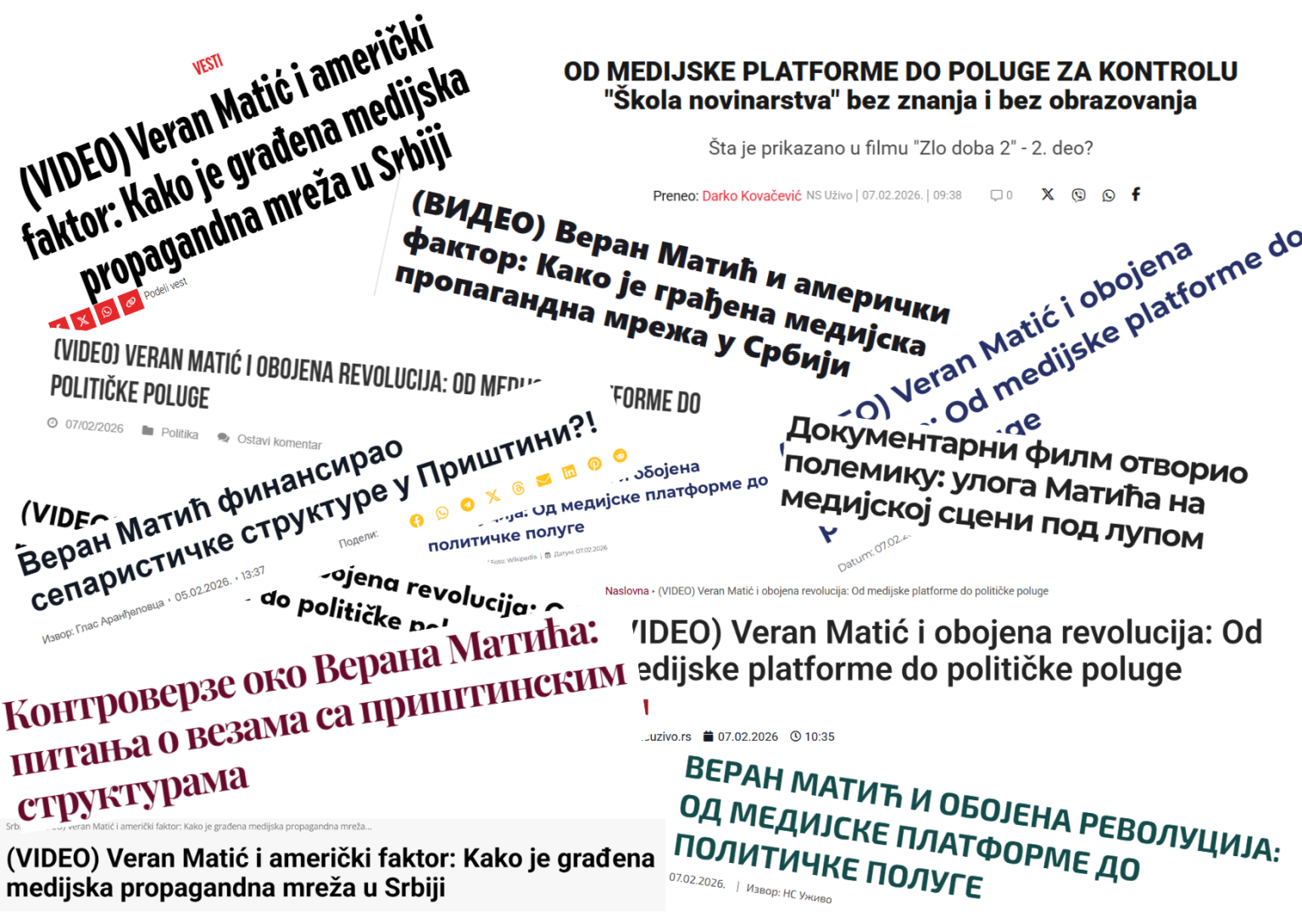
The Code of Journalists of Serbia received a new point due to the appearance of identical or almost identical texts that appear in a short period of time on several portals, and which are aimed at individuals who criticize the government and have no interlocutors, sources and are not signed
Identical or almost identical texts that appear in a short period of time on several portals, aimed at individuals who criticize the government, and have no interlocutors, sources or signatures are the reason for the new provisions in Serbian Journalists’ Code of Conduct, the Independent Journalists Association of Serbia (NUNS) announced today.
In the announcement NUNS states that such contents have become almost everyday, especially since the beginning of the protests after the fall of the canopy at the train station in Novi Sad, when 16 people died and one person was seriously injured.
That pattern was recognized by the Appeals Commission Press Council deciding on complaints about tabloid texts, which is why a new provision was introduced into the Code of Journalists of Serbia, which prohibits this type of “journalism”.
In the new Code of Journalists of Serbia, a new point has been included (point 3 of Chapter 5) which states that journalists are obliged “to respect the principle of not harming the reputation and dignity of individuals and not to participate in spreading untruths or continuously maliciously damage the reputation of the persons they report on”, according to NUNS.
“Once again, the simultaneous publication of texts with exactly the same content in several media is noticeable, which indicates the influence on the editorial policy from one external center,” the report states.
More than 100 violations
Last year, the Appeals Commission registered 59 cases, out of a total of 110 violations, in which point 3 of Chapter 5 of the Code was violated, Gordana Novaković, general secretary of the Press Council, told NUNS.
“The decision about what to publish in their media is solely up to the editors. They are also responsible for everything they published, regardless of how the specific content was created. The explanation, we only conveyed and indicated the source, which we receive from certain newsrooms, are simply not acceptable,” said Gordana Novaković.
The author of the report and former member of the Complaints Commission of the Press Council, Bojan Cvejić, told NUNS that it is characteristic of such texts that they generally have no interlocutors, sources, are not signed and cannot be classified in any form of journalism that is studied in the theory of journalism.
“We are talking about a kind of pamphlets in which the facts are twisted and put in a negative context or comments and guesses are stated, all of which are contrary to the Code of Journalists of Serbia, but also to all other civilizational standards. Such texts are clearly spreading propaganda, which is positive towards the activities of the authorities and ruling structures, but also negative towards everyone who thinks differently and expresses their critical attitude in public”, stated Cvejić.
Source: Vreme