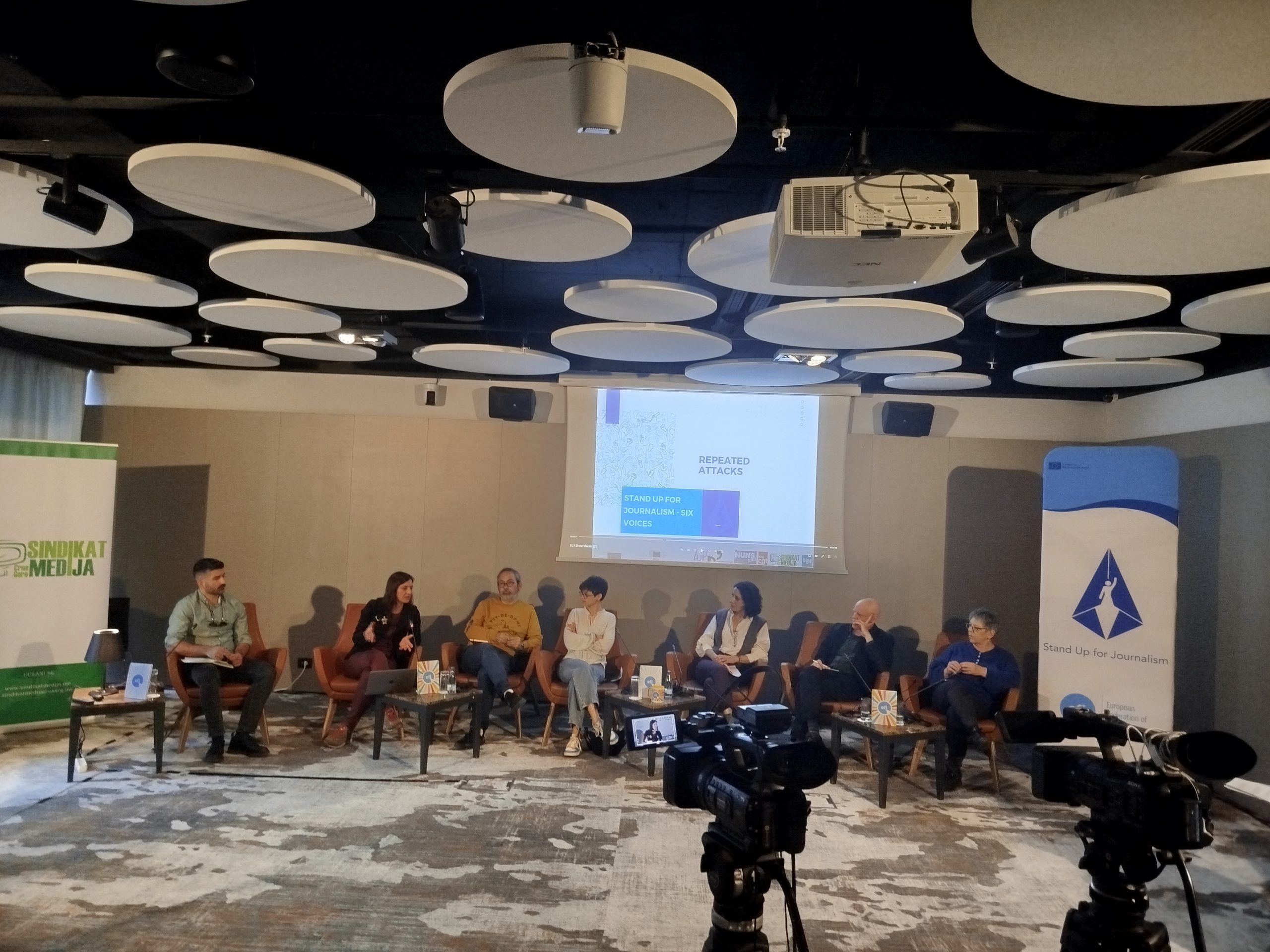
The European Federation of Journalists (EFJ) concluded its Stand Up for Journalism (SUJ) project with a final conference co-organised by the Trade Union of Media of Montenegro (TUMM) on 26-27 March in Podgorica. Nearly 50 journalists and journalists’ representatives gathered to build on the project’s achievements and look ahead.
The conference placed the younger generation at its heart, giving center stage to their voices and perspectives. Young journalists openly discussed their visions for the future of the profession, as well as the challenges they face in today’s working conditions. A particular focus was placed on journalists from the Balkan region, beginning with a ‘coffee talk’ between Lea Jajaš, a Croatian journalist and ‘Zagorka’ mentee, and Ivana Vlaović, coordinator of the TUMM Youth section. Their conversation centered on the challenges facing journalists in the region.
“The expectations of employers should be more realistic and they should give better conditions to young people to stay in the profession,” said Ivana. They mention how today there is no time to do things slowly. “Our generation knows our needs and we know how to balance them with our passion for our profession,” said Lea.
The participants also engaged with journalism students from the Faculty of Political Science. The students shared their deep concerns about the future, with one explaining the challenges ahead: high workloads, poor wages, mental health risks, and safety concerns threats inherent in the field. In response, EFJ members encouraged the students to stay connected with the national union TUMM, emphasising the importance of entering the profession with good working conditions and ensuring that future generations remain in journalism.
The evolving relationship between journalism and AI was explored by young journalists Morena Pinto (freelancer), Adam Smeták, (editor-in-chief at Heyfomo), and Henri Malmberg, (journalist at Uusi Juttu). While they raised concerns that the increased efficiency brought by AI could lead to higher productivity demands with negative effects on journalists’ mental health, the speakers expressed careful optimism about its potential. They suggested that AI can help empower young journalists, freelancers and small media houses.
“Smaller media houses and freelance journalists have a disadvantage against big publishers, and the usage of AI can help reduce that gap,” Pinto noted. By delegating technical tasks to AI, such as transcription and grammar checks, journalists can dedicate more time to producing high-quality content that resonates with their audience and building their trust.
The participants also received training from Jahkini Bisselink, Next Generation Keynote Speaker at Whetston, Former UN Youth Representative from the Netherlands. She concentrated on strategies to draw young talent into unions and associations with a specific focus on AI. She presented the defining features of Gen Z, how to incorporate AI-uptake in youth strategies, and how to support the mental wellbeing of young members.
“We see a major concern among young people thinking: if AI makes us more efficient and quicker at work, our bosses will not give us less work but will only give us more,” said Jahkini. “60% of Gen Z report that mental health resources are an important factor when selecting an employer. While talking about mental health can sometimes be difficult, we see that this comes quite naturally for the new generation. Taking care of one’s mental health has become almost as important as taking care of one’s physical health,” she added.
The mental wellbeing of journalists is recognised as a cornerstone for improving working conditions, maintaining the attractiveness of the profession and retaining the talents. Christian Moos, EESC member, presented his contribution to an own-initiative opinion urging immediate action to strengthen labour rights for journalists and media professionals across Europe, including their mental health.
Emma Thomasson, author of “Stronger Minds, Stronger Media: Why protecting journalists’ mental health is essential for journalism’s future” highlighted a deeper challenge: the journalists’ own perception of their role often hinder progress in addressing mental health issues: “There is a tendency to blame employers, she noted. “But journalists are also part of the problem. Our vocational passion makes solving the issue more difficult.” Thomasson attributes the origin of the problem to a widespread (but wrong!) idea: the expectation that journalists act like superheroes.
In addition, participants received in-depth training by Elodie Vialle on the Tech 101 for journalists’ representatives on how to use existing European legislation to better protect journalists against online harms. The training comes from the report she authored “Ending the Silence on Online Harassment of Journalists” as part of this project.
In an innovative new format, SUJ partners opened up about their real-life playbook, how, through this project they built stronger organisations and empowered journalists to navigate the challenges of crumbling politics, a rapidly evolving media landscape, and emerging threats.
“Over the past two years, we have shown that collective action, exchange of experiences, and mutual support bring real change and strengthen our community. Solidarity is what keeps us together and gives us strength to continue. Our shared, determined work is also a response to attacks and pressures, a commitment to quality journalism and journalists’ rights, because we know how essential journalism is for every democratic society,” said EFJ President Maja Sever during her “Live Show”.
The participants of the workshops shared that, since joining our activities, they expanded their efforts to involve young people, organised national activities focused on mental health and resistance, and deepened their understanding of EU legislation, among other things.
The Stand Up for Journalism project ran from April 2024 – March 2026 and allowed EFJ members (TGS – Turkey, TUMM – Montenegro, NUNS – Serbia, SNJ-CGT- France, AJP – Belgium, DJ- Denmark) to conduct National Capacity-Building Activities over the last two years.
The SUJ project will continue for another two years, from October 2026 to September 2027 with new partners (FNSI – Italy, Union of Cyprus Journalists – Cyprus, UJF – Finland, SJ – Portugal, MUOSZ – Hungary, and SSNM – North Macedonia).
Stand Up for Journalism is a 18-month project led by the EFJ and implemented with its partners: Independent Journalists’ Association – NUNS (Serbia), Trade Union of Media of Montenegro – TUMM (Montenegro), Danish Journalists’ Union – DJ (Denmark), Turkish Journalists’ Union – TGS (Turkey), Syndicat National des Journalistes – SNJ-CGT (France) and Association des Journalistes Professionnels – AJP (Belgium)
 This project is co-funded by the European Union. Views and opinions expressed are however those of the author(s) only and do not necessarily reflect those of the European Union. Neither the European Union nor the granting authority can be held responsible for them.
Source: EFJ