During 2025, women journalists in Serbia were exposed to a serious increase in attacks, threats, online harassment, misogynistic and sexist insults, as well as physical violence, including assaults and police failure to respond while they were reporting from protests and other high-risk events. The study “Safety of Women Journalists and Media Workers – Serbia Brief 2025” prepared for Independent Journalists’ Association of Serbia (NUNS) and the SafeJournalists Network by NUNS lawyers Marija Babic and Rade Djuric, shows that institutions are not responding quickly or effectively enough, further undermining women journalists’ trust in the protection system.
The safety of women journalists in Serbia during 2025 has ‘deteriorated dramatically,’ according to one of the key findings of a report analyzing patterns of attacks, institutional responses, and the consequences for the work and psychological well-being of women employed in the media.
The authors state that Serbia’s legal framework does not recognize the specific risks faced by women journalists. Although the Criminal Code provides a higher level of protection for persons performing duties of public importance in the field of information, there are no specific provisions addressing gender-based risks. The problem, however, lies not only in the laws themselves, but above all in their implementation.
Threats, Campaigns, and Physical Attacks Marked 2025
During 2025, a huge increase in the number of cases was recorded. In that period, public prosecutor’s offices opened 140 cases related to incidents targeting journalists. Official records show a large number of attacks against women journalists (50 cases), while in the online sphere there were more cases involving female journalists as victims than male journalists. Of the 103 individuals targeted in attacks, 55 were men (53.4%) and 48 were women (46.6%). Out of that number, the Special Department for Combating High-Tech Crime opened 71 cases involving 46 individuals, of whom 20 were men (43.48%) and 26 were women (56.52%).
Data from the SafeJournalists database show that women journalists in 2025 were targeted by 16 different forms of so-called “other threats,” including hate speech, verbal attacks by government representatives, tabloid campaigns, and messages portraying women journalists as enemies of Serbia and the Serbian people. In some cases, individuals posing as officials approached women journalists and demanded their identification documents, while threats in local multiethnic communities were assessed as particularly dangerous.
Even more alarming are the data concerning serious threats. In 2025, women journalists received threats to their lives and physical safety in 26 cases. The threats were delivered directly, on the street and during events they were covering, but also through social media, emails, comments on news portals, and websites. They were threatened with murder, burning, hanging, rape, other forms of violence, as well as attacks against their children and family members.
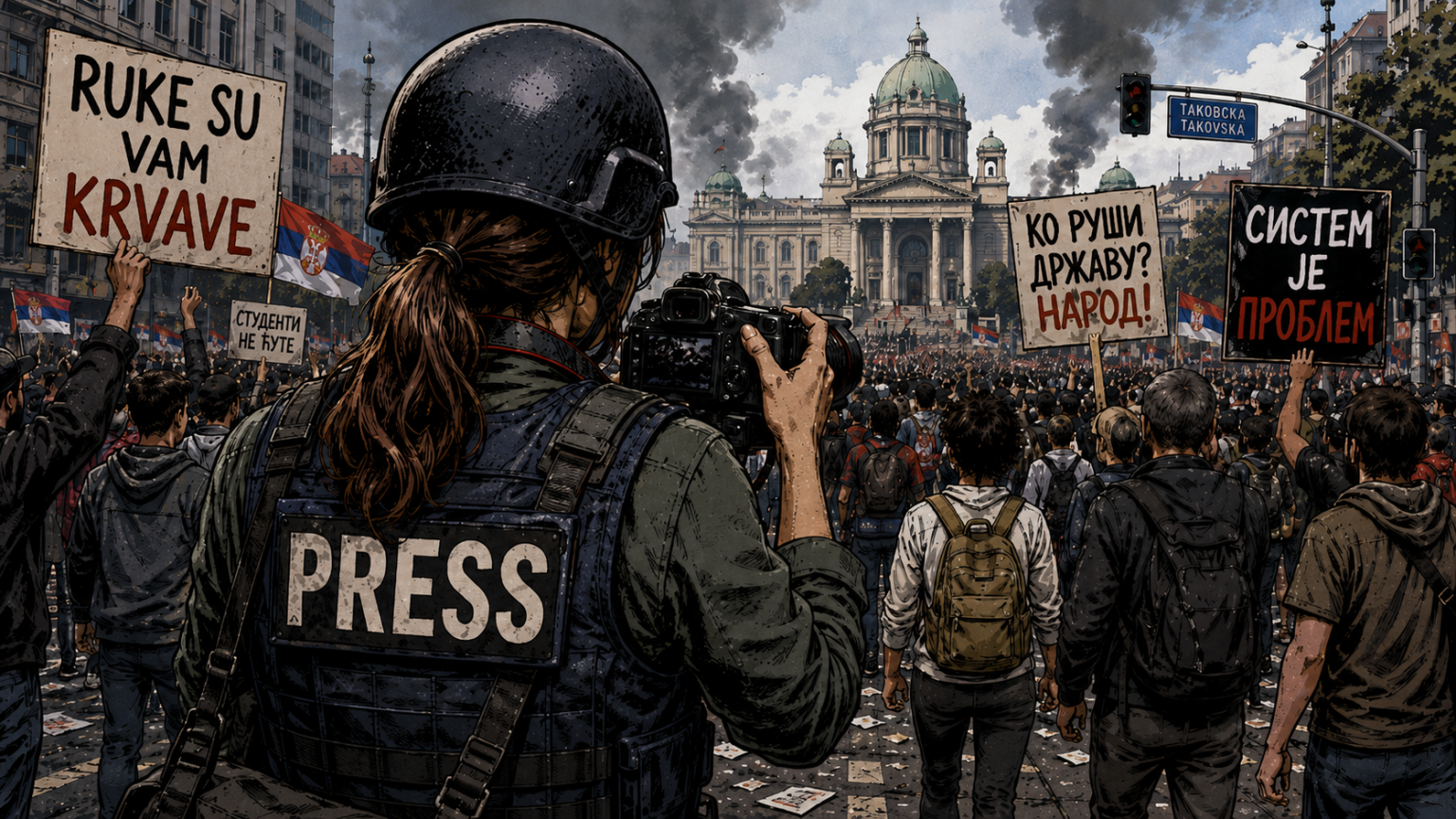
Women journalists were physically attacked at least 30 times during 2025. The most dangerous attacks occurred while reporting from student and civic protests, as well as during rallies and election days in local municipalities across Serbia. The report states that some of these attacks were carried out by police officers, and that women journalists were physically obstructed in their work. Particularly concerning are cases in which police officers witnessed the attacks but refused to intervene or provide assistance to the assaulted journalists.
From Online Violence to Institutional Failure to Understand the Gender Context
Online violence against women journalists was one of the most prominent problems. Women journalists reported death threats, threats of rape and physical violence, insults, defamation, trolling, cyber violence, impersonation, and sexual harassment. There were also recorded attempts to take over accounts, attacks on the portals and websites of local media outlets run by women journalists, as well as attempts to install communication surveillance software. One particularly serious case involved an attempt to install communication-monitoring software targeting women journalists from BIRN.
The report points out that the vast majority of online threats contain elements of gender-based violence and are accompanied by misogynistic and sexist insults. Such attacks, the report states, affect not only the psychological well-being of women journalists, but also their professional work.
When it comes to the institutional response, the findings are extremely unfavorable. Of the 140 cases recorded by prosecutor’s offices during 2025, women journalists were the injured parties in 50 cases, while only three convictions were issued overall, and in one case the mechanism of deferred criminal prosecution was applied. In the cases involving women journalists, only one resulted in a conviction – the case of journalist Verica Marincic. In 12 cases, criminal complaints were dismissed or official notes were issued stating that there were no grounds to initiate criminal proceedings; in three cases indictments were filed, while 34 cases are still ongoing.
The authors conclude that investigations into attacks against women journalists are neither swift nor effective. According to the report, judicial authorities fail to consider the broader context of threats and attacks, instead relying on narrow legal qualifications. Insufficient consideration is given to the broader socio-political context, the topics covered by the journalist, the identity of the person issuing the threats, and the gender dimension of the case.
A particular problem is the attitude of institutions toward women journalists exposed to stalking, sexualized threats, and the psychological consequences of violence. The report states that institutions fail to recognize the fear of sexual violence, as well as the lasting effects such threats can have. In some cases, instead of linking the stalking to the journalist’s work and safety, authorities examined whether there had been a prior romantic relationship between the victim and the perpetrator.
Attacks by the Police and Failure to Respond
NUNS recorded 77 cases of police attacks on journalists, unjustified detentions and identity checks, as well as failures by police to intervene when present at the scene, between March and the end of December 2025. Of that number, 26 cases involved women journalists. According to the report, such conduct directly contributed to a sense of insecurity and a further decline in trust in institutions.
Women Journalists Between Fear, Exhaustion, and Professional Persistence
The consequences for women journalists are manifold. They face feelings of insecurity in the field, psychological pressure, burnout, and mental and physical exhaustion. Poor working conditions, low pay, financial insecurity, pressure, threats, and reporting on traumatic events all contribute to stress and burnout syndrome, which often remains unrecognized or underestimated within newsrooms.
For some women journalists, constant fear and pressure lead to avoiding certain topics, self-censorship, and even considering leaving the profession altogether, particularly in smaller communities. Nevertheless, the report also records the opposite response: many women journalists refuse to let fear define them, continue reporting from high-risk events, and insist on carrying out their work professionally.
Support from newsrooms remains insufficient and inconsistent. Legal assistance is available mostly in larger media organizations, while in smaller local media outlets it is almost entirely inaccessible. Psychological support is even rarer, forcing women journalists to rely primarily on journalists’ and media associations. In some cases, the report notes, newsrooms use attacks against women journalists to highlight threats to the outlet itself, while the individual journalists are left without genuine support.
Recommendations: Consistent Enforcement of Regulations and Stronger Newsroom Support
The recommendations emphasize that amending the law is not currently a priority, since the existing legal framework already provides a basis for protection, but is not being applied consistently. Institutions are urged to act urgently and effectively in cases involving attacks against women journalists, to implement the mandatory instructions issued by the Supreme Public Prosecutor’s Office, to improve police responses, and to conduct proceedings in cases involving abuse of authority by police officers.
Media companies and newsrooms are advised to develop internal mechanisms for preventing security risks, educate employees about discrimination and forms of gender-based violence, and provide legal and psychological support to women journalists. Particular attention is drawn to the need for such support to also be available to women journalists in smaller communities.
The report concludes that the safety of women journalists in Serbia deteriorated during 2025 in nearly all aspects: from the number of attacks and threats, to institutional inefficiency and impunity, as well as the psychological consequences and lack of support within newsrooms. Under such circumstances, women journalists continue to work in the public interest, but increasingly without adequate protection from the institutions that are supposed to guarantee their safety.
The full publication can be found here.