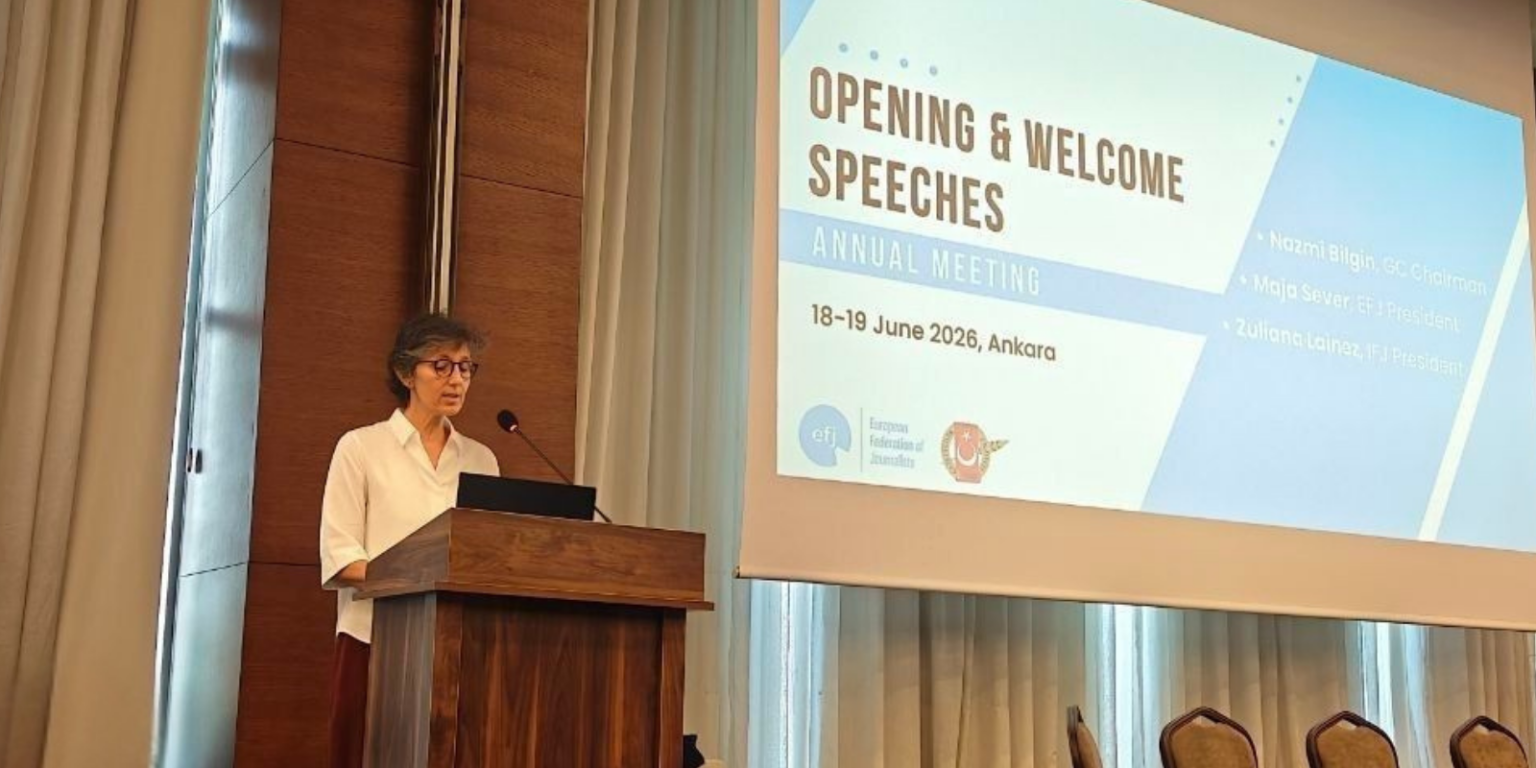
Speech by EFJ President Maja Sever in Ankara, Turkey – 18 June 2026
It seems to me that every year, when I stand before you at the opening of our annual assembly, there are new threats, new reasons for concern, and new examples of democratic standards being eroded across Europe. Yet every year also reminds us why journalism matters. Because when freedom and democracy come under attack, journalists are the first to defend them.
Every time we think we have reached the limits of political polarisation, social distrust, and open attacks on the media, reality proves us wrong and shows us that the space for freedom can shrink even further, that the threshold of acceptable violence against journalists can be raised even higher, and that those who build their power on manipulation and fear always find new ways to weaken precisely those who – ask questions, verify facts, and seek answers.
The data we have today are not only statistics; they are a precise diagnosis of the state of democracy in Europe and around the world. According to the latest data from the Media Freedom Rapid Response, nearly 1,500 violations of media freedom were recorded across Europe over the past year, exposing thousands of journalists to threats, physical attacks, strategic lawsuits, and online abuse. Particularly alarming is the fact that digital harassment and coordinated campaigns against journalists are among the fastest-growing threats, demonstrating that old methods of suppressing media freedom are now being carried out through new technological means.
We are witnessing not only a rise in threats against journalism but also a profound shift in the balance of power within the information space, where, alongside political actors, global technology companies are assuming ever greater influence. These companies are accountable neither to voters nor to democratic oversight, yet through their algorithms and business interests, they determine which information reaches citizens, which disappears into digital noise, and what shape public debate in our societies ultimately takes.
When Mark Zuckerberg decides that journalism is less valuable than content designed to generate emotion and polarisation, local media lose audiences and revenue.
When Elon Musk, under the banner of absolute free speech, weakens the safeguards of public discourse, it is not Silicon Valley billionaires who bear the consequences, but journalists on the ground, our citizens, and democracy itself.
And when artificial intelligence companies use millions of journalistic texts to train their models without consent or fair compensation, we are faced with a question that is not onl economic but profoundly democratic: can a society survive if it systematically exploits those who produce verified information while failing to create the conditions necessary for that work to endure?
Journalists across Europe continue to be blamed for everything while remaining underpaid, precariously employed. Society expects high-quality journalism while failing to provide journalists with dignified working conditions is slowly giving up its own right to be informed.
That is why our responsibility today goes beyond professional interests and trade union demands. We are not only defending jobs or newsrooms; we are defending citizens’ right to know. This is why we fight for the full implementation of the European Media Freedom Act, for the protection of sources, for dignified working conditions, for fair compensation for our content, and for a stronger European public sphere in which the public interest is not subordinated to political or economic power.
Gathered here in Turkey, a country whose journalists have too often paid a high price for defending freedom of expression, we know that the struggle for free media has never been only about one profession; it has always been about society’s right to know the truth about itself. That’s why We advocate for a stronger AgoraEU programme with a dedicated line for media and journalism, including the allocation of at least 20 percent of its budget to quality and independent journalism;
for the full and effective implementation of the European Media Freedom Act not only on paper but also in practice;
for robust protection of journalists against SLAPP lawsuits, political pressure and digital violence;
for the protection of journalistic sources and editorial independence;
for transparent media ownership and independent public service media;
for fair pay and decent working conditions for journalists across Europe;
and for a fair digital ecosystem in which major platforms and AI companies are required to disclose transparently how they use journalistic content, provide fair compensation for it, and return part of the value they currently extract from Europe’s media landscape
We stand with our colleagues reporting from wars and crisis zones, from Ukraine to Gaza and beyond
It is important that we are meeting here in Turkey, where our colleagues continue to fight every day for independent journalism. Their courage in the face of pressure, censorship and uncertainty reminds us that media freedom can never be taken for granted and that solidarity among journalists across borders remains one of our strongest tools.
Therefore, I am glad that we have gathered here from all parts of Europe, and also that the President of the IFJ, Zuliana Lainez, has joined us, having come from Peru for this conference.
I would also like to express our sincere gratitude to our hosts, the Association of Journalists, for their warm hospitality and for the excellent organisation.
As long as there are journalists willing to ask questions, investigate power, and defend the public interest, there will be hope for democracy.
As long as we have the strength and the heart for a common struggle and solidarity, there are no threats that we cannot overcome.
We will not give up on journalism.
Source: EFJ