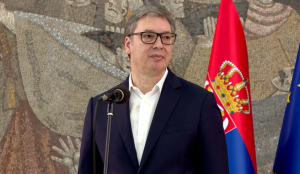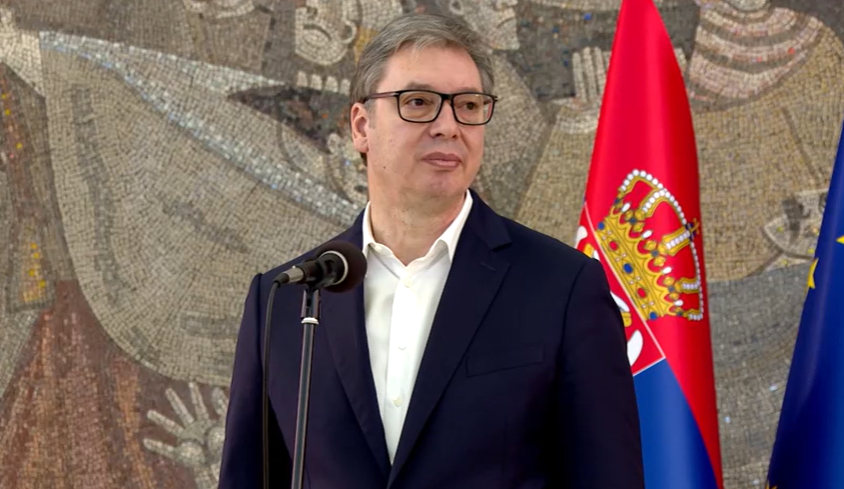
Aleksandar Vucic received 78 percent of the total airtime dedicated to political actors across five major television channels between September 11 and September 30, shows the latest media monitoring report released by the Bureau for Social Research (BIRODI).
Across RTS 1 (Serbian public broadcaster’s main channel), Pink TV, Prva TV, B92 TV, and Happy TV, six monitored political figures accumulated a combined total of 4,682.5 minutes of airtime. Out of this total, Vucic alone accounted for 3,650.5 minutes.
Vucic’s ruling Serbian Progressive Party (SNS) received 585.5 minutes (13%), followed by the Student List with 291 minutes (around 6%). The Socialist Party of Serbia (SPS) was given 65.5 minutes, the Authentic Right received 51 minutes, and the opposition European Serbia coalition trailed with just 39 minutes.
Vucic and the SNS occupied 4,236 minutes, capturing roughly 90.5% of the total airtime tracked for all six political actors, compared to the Student List, which stood at just 6.2%
BIRODI highlighted that Vucic’s individual screen time was more than 12 times greater than that of the Student List.
Out of Vucic’s 3,650.5 minutes, 1,296 minutes were broadcast on Pink TV, 868.5 on RTS 1, 711.5 on Prva TV, 649.5 on B92 TV, and 125 minutes on Happy TV.
The disparity was even sharper on the state broadcaster, RTS 1, where Vucic received 868.5 minutes, the SNS got 106.5 minutes, and the Student List received 24.5 minutes. This means Vucic received roughly 35 times more airtime than the Student List on public television.
BIRODI clarified that its data strictly measures screen time and visibility rather than the quality, tone, or specific substance of the reporting, which is why this total volume of minutes cannot automatically be classified as deliberate political promotion.
However, BIRODI emphasized that such the concentration of media exposure serves as a crucial indicator for evaluating media pluralism and determining whether a level playing field exists for the public trying to learn about different political actors during an election campaign.
Ultimately, BIRODI noted, the key issue raised by these findings is not merely how much airtime each individual or party received. Rather, it raises the question of whether Serbian citizens actually have access to a diverse enough range of political information during the campaign to form an independent, well-informed decision at the ballot box.
Source: N1