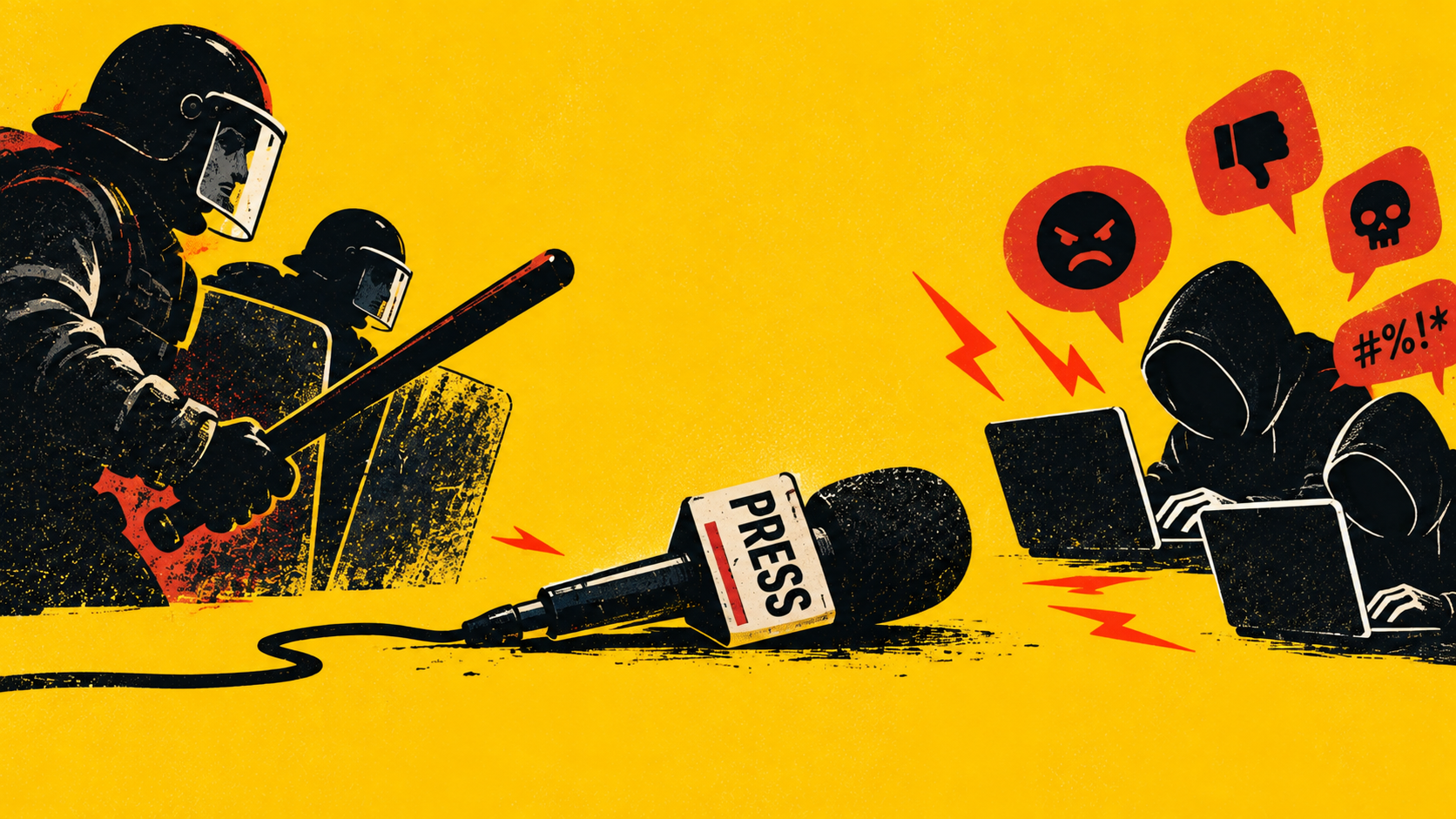
In September 2026, the Independent Journalists’ Association of Serbia (NUNS/IJAS) recorded a total of 24 incidents involving journalists and media workers. These included five physical attacks against journalists, four attacks against media outlets and media organisations, 12 cases of death threats and threats to journalists’ physical safety, and three other threats against journalists. The trend of serious threats and intimidation against journalists continued throughout the month. September also saw cases of physical assaults and obstruction of journalists reporting from public gatherings, particularly while covering political party activities related to the early parliamentary elections. These incidents demonstrate the continuation of a worrying trend of attacks against journalists covering events of public interest, which has seriously endangered and hampered journalists’ work in the field for an extended period.
Continued Threats Against Journalists in September
Former commander of the Army of Republika Srpska and convicted war criminal Ratko Mladić was buried on 7 September. Journalists who critically reported on or publicly commented on the event and Mladić himself were subjected to threats and insults.
Danas journalist Safeta Biševac received threats following her appearance on N1 television to discuss Ratko Mladić’s funeral. A comment posted on the N1 website referred to visiting the journalist at her “home address” and contained vulgar threats of sexual violence: “Said Salveta, the circumcised wh**e. I hope the loyalists and heroes visit you at your address and f**k everything that moves. If you are smart, you will leave Serbia, you circumcised AIDS-ridden third-rate creature… You are not even human, but a genetic failure. Watch out, you have a circumcised name, Safeta… Shame on you, may Alija f**k you.”
TV Nova presenter and editor Marko Novičić received threats and disturbing messages over a post on his personal Instagram account concerning the broadcast of Ratko Mladić’s funeral. The messages expressed wishes for his death, called for a confrontation and threatened physical violence. The most explicit message stated: “When we get our hands on you… We will tear you to pieces.”
Following his appearance on N1 television to discuss the cancellation of the satirical programme 24 Minutes with Zoran Kesić, previously broadcast on TV Nova, the programme’s host Zoran Kesić received a threat. In the comments section of an N1 article titled Kesić: “I Feel Worried, Angry, Disappointed”, a user identified as “Luka” wrote: “You need to be beaten with a stick.”
On 9 September, Kesić also received threats through the Facebook page of the Independent Journalists’ Association of Serbia following a post about him. The threatening message read: “I am donating my amount for candles and incense for this wretch… With faith in God, very soon… Miserable sc*m.”
Journalist and writer Marko Vidojković received another threat on Instagram. On 10 September, a person using an Instagram profile under the name Zoran Kosorić sent Vidojković the following message: “Just keep barking, you filthy dog, you’ll end up in a manhole.” This message is a serious threat against the journalist’s life and physical integrity, requiring a swift and effective response from the authorities.
A journalist from Istinomer received insulting and intimidating messages from an anonymous number. The sender had deliberately obtained her private phone number in order to intimidate her and make her believe she was under unlawful surveillance.
In addition, on 16 September, Žig Info editor Željko Matorčević once again received a threatening message via Viber from Bojan Pitulić, former deputy president of the Grocka municipality. Alongside insults and accusations that the journalist had attacked his child, Pitulić wrote: “And especially you, when I see you, you sc*m. Then you won’t have to make up stories about Pitulić beating you.”
On 16 September, the editorial team of the IN Medija news portal received a threatening message stating: “A campaign against you is about to begin.” The same individual also wrote, “Delete the comment, since you keep doing that to me,” indicating that this was not the first time the person had sent threatening and insulting messages to the newsroom.
Threats Against Journalists Following Serious Targeting Campaigns
N1 journalist Predrag Popović was subjected to a serious targeting and smear campaign by pro-government media over a legitimate journalistic inquiry addressed to the Higher Public Prosecutor’s Office in Belgrade. Several media outlets portrayed him as a “self-hating Serb” and a “Serb-hater” who was allegedly “calling for the arrest of Serbs”. The campaign began after N1 published an article about the lack of institutional response to the glorification of Ratko Mladić and the crimes committed in Srebrenica during the latest football derby between Belgrade’s two major rival clubs. The outlets Informer, B92, Politika, Novosti and Kurir subsequently accused Popović and N1 of demanding the arrest of football supporters, or “Serbs”.
However, the journalist had merely asked the Higher Public Prosecutor’s Office whether proceedings had been initiated against one or more individuals in connection with the events at the stadium, taking into account provisions of the Criminal Code concerning the public approval, denial or gross trivialisation of genocide, crimes against humanity and war crimes. Asking questions of competent institutions is a fundamental part of journalism, not a demand for anyone’s arrest. Turning a professional journalistic inquiry into an alleged call for the “arrest of Serbs” constitutes serious targeting of a journalist, manipulation, nationalist labelling and an attempt to portray the journalist and his newsroom as enemies of the state and the people. Such reporting is not intended to inform the public, but rather to discredit the journalist because of the subject he is investigating and discourage other journalists from asking questions about institutional accountability. This directly endangers his safety.
Particularly concerning is the fact that some media outlets published the exact contents of an email that had not appeared in the N1 article. This raises serious questions about how they obtained the journalist’s correspondence with the Higher Public Prosecutor’s Office and whether it was provided to them by the institution itself. If official correspondence was forwarded to media outlets to be used in an attack against the journalist, this would constitute a serious abuse requiring an urgent and independent investigation.
In this context, on 8 September, N1 published an article titled “Letter Sent by N1 to the Higher Public Prosecutor’s Office Published in Tabloids”. Following its publication, N1 journalists received threats through comments on the website. A user named “Milisav” wrote: “After the elections, you will be fleeing to Sarajevo and Zagreb. How is that not clear to you??” Another user, “Jahac”, wrote: “The campaign won’t be directed against just one of your journalists. There will be a witch-hunt against all of you at N1. We are just waiting for the signal. We have had enough of Ustashas and Ustasha ideology in Serbia. You should be hounded everywhere, all the time, tarred and feathered.”
Also on 8 September, Predrag Popović became the target of further attacks following the smear campaign launched against him by tabloids. A new threat was posted on X, warning that Popović would have to look over his shoulder while walking through Belgrade and claiming that “they know where he lives”.
Attacks and Threats Against Journalists During the Election Campaign
Serbia is currently in the midst of an election campaign marked by heightened tensions among political actors, with journalists increasingly becoming targets. September saw numerous attacks and incidents of obstruction involving journalists covering election gatherings, as well as serious threats and targeting campaigns.
On 18 September, Magdalena Kostić, a journalist with the Media and Reform Centre Niš, was reporting on election campaign activities at a local market where both the Student List and the Serbian Progressive Party (SNS) had set up stands. When she attempted to interview citizens gathered near the SNS stand, four men prevented her from doing so. They surrounded the journalist, demanded that she leave, questioned who she was and why she was filming, and accused her of “provoking” them. Their behaviour continued even after she showed her press credentials. Due to their aggressive conduct and intimidation, including getting into her face, Kostić said she feared for her safety and was unable to complete her reporting assignment.
On 19 September, a manipulated video was published on an X account used by former Speaker of the Serbian National Assembly Ana Brnabić. The video portrayed representatives of the Student List in the context of negative comments about supporters of the Serbian Progressive Party (SNS). The video selectively extracted the words of journalist Miloš Milić, “the stupidest parts of our society”, presenting them in a misleading manner and out of context. During an interview with Jovo Bakić, a professor at the Faculty of Philosophy in Belgrade, on the programme Kvaka 23, Milić had actually quoted Bakić’s earlier statement about SNS supporters and asked him the following question:“I have to ask you something. Earlier, and I wrote this down, you used the phrase ‘the stupidest parts of our society’ when referring to supporters of the Serbian Progressive Party who, in your assessment, will not change their views. Doesn’t that term you used actually provide the authorities with an argument about how the other side views supporters of the Serbian Progressive Party?” This malicious editing and removal of the original context constitutes an attempt to discredit the journalist and represents serious targeting.
On 19 September, Glas Zaječara journalist Đorđe Đorđević was prevented from reporting on an SNS gathering in Veliki Izvor, near Zaječar. The event was attended by local officials, while residents had announced that senior party figures Ana Brnabić and Miloš Vučević were also expected to appear. Neli Nikolić, deputy president of the SNS local branch in Zaječar, approached Đorđević, told him he was not welcome and demanded that he leave the gathering immediately.
On 20 September in Kraljevo, while attempting to obtain statements from SNS supporters gathered in a public area, LiKVidno editor Nenad Simović was approached by an unidentified man who forcefully grabbed his right arm. Despite Simović visibly displaying his press accreditation, the man told him: “Come on, get out. You don’t have accreditation. This is a registered gathering.”
On 20 September, Miloš Ljiljanić, a journalist with the local news portal Kovinske info, reported to the police a verbal attack and threat he had experienced at a market in Kovin while covering election campaign activities. Ljiljanić had approached the stand of the organisation “Ćale, ovo je za tebe”, led by political activist Petar Đurić, to obtain a statement about the movement’s programme, its campaign activities and the planned opening of an office in Kovin. While recording the conversation with Đurić, Ljiljanić was subjected to insults and inappropriate remarks coming from a group of SNS activists, including the president of the Kovin municipality, her deputy and members of the local assembly. When he turned his camera towards those making the remarks, one of the individuals gestured with his finger for the journalist to stop filming, accompanied by a profane remark of a threatening nature. After completing his assignment, Ljiljanić reported the incident to the Kovin Police Station. Part of the incident was recorded during a live broadcast from the market. IJAS expects the police to identify everyone involved, examine the available footage and establish their responsibility.
On 21 September, Bečejski mozaik journalist Kristina Demeter Filipčev received threats in comments posted beneath her report on an SNS gathering in Bečej. The messages contained threats of sexual violence, explicitly misogynistic and sexist insults, and language inciting hatred against members of the Hungarian and Croatian ethnic communities.
On 25 September, N1 News Director Branislav Šovljanski received threats on X after publishing a post about an election debate on N1. One comment contained the following threat: “F**k your traitorous mouth, you fat horse, and your debate too. And you will be f**ked on 26 October as well.”
On 29 September in Novi Sad, journalist Stefan Kostić was reporting on events near two campaign stands, one attended by supporters of the Student List and the other by supporters of the Serbian Progressive Party (SNS). He recorded an attack by SNS supporters against citizens who had come to support the Student List. After posting the footage on his Instagram profile, it was shared by a page whose identity was unknown to him, and the video soon received more than half a million views. Shortly afterwards, the journalist received a threatening message stating: “… now we know what you look like.”
Other Physical Attacks Against Journalists
While reporting live for N1 television’s Novi dan programme on a meeting of the Serbian Progressive Party’s Main Board in Niš, journalist Nenad Božović was surrounded and subsequently subjected to verbal abuse and harassment. SNS supporters approached him and began shouting “Ustashas, Ustashas”. Two men then approached the reporter. One began swearing at him, while the other asked Božović “why he was selling out the country”. He also asked: “Why are you turning your back on your homeland, Mother Serbia? Why don’t you follow the four S’s? Our flag has had the four S’s since time immemorial.” The situation was extremely tense and distressing. Later, as the reporting crew was moving towards the National Theatre, water was thrown over them.
On Sunday, 20 September, Aleksandar Blanuša, editor of the Volim Zrenjanin news portal, was physically assaulted while covering a promotional event for the EXPO exhibition in Zrenjanin. While carrying out his reporting assignment in Dr Zoran Đinđić Square, a man approached him, got into his face and then pushed him over a refrigerator next to a nearby kiosk. Blanuša injured his elbow and back and subsequently sought medical assistance. According to his account, the same individual had attacked him previously, leaving him feeling unsafe.
Attacks on News Websites and Instagram Accounts of Media Outlets and Media Workers
September saw renewed attacks against news websites and Instagram accounts belonging to media outlets and media workers. This trend was first observed earlier in the year, ahead of local elections in 10 Serbian cities and municipalities, and has now re-emerged in the run-up to the parliamentary elections. The trend is particularly concerning because social media platforms represent an important source of information for a large number of citizens, especially given the high degree of control over traditional media. Such attacks directly affect not only the visibility of media outlets but also citizens’ access to information and, consequently, media freedom, particularly at such a sensitive moment for Serbian society.
On 22 September, Blok Radio, an online radio project and media platform, was targeted by a DDoS attack. In a post on its official X account, the outlet reported that its website was under attack and that the attacks were continuing. At one point, it recorded as many as 3.18 million visits.
On 25 September, the VranjeNews news portal was targeted by a cyberattack after reporting on the arrival of a student cycling tour in Vranje. Editor Dejan Dimić told ANEM that the website remained accessible to readers, but the newsroom was unable to publish new articles, while internal tools experienced significant disruptions due to the attack on the server.
On 26 September, the Instagram account of the Mašina news portal gained approximately 10,000 followers suspected of being fake within a short period. Fearing that the account could be restricted or suspended, the newsroom encouraged its audience to follow its backup account, @masina.video. However, it soon reported that the backup account had also been subjected to the same type of attack. The outlet experienced three such attacks within a short period. On the same day, photojournalist Gavrilo Andrić’s Instagram account was also targeted by a bot attack. His account experienced a sudden and massive influx of followers from a large number of suspicious accounts. Subsequently, IJAS also received reports of bot attacks targeting the Instagram account of the weekly magazine Radar.
In late September 2026, the local news portal Kovinske info was targeted by coordinated cyberattacks, involving direct technical hacking attempts against the website. The newsroom told ANEM that attackers were uploading files, changing login credentials, inserting links to betting websites, and creating or registering non-existent pages.
The Massimo Moratti Case: A Blow to Media Freedom
Massimo Moratti, a researcher with the Italian media freedom organisation OBC Transeuropa (OBCT), had his application for a residence permit rejected. He was notified of the decision on 4 September, seven months after submitting his application. He was ordered to leave Serbia within 15 days and was subjected to a one-year entry ban. The decision stated that he represented an “unacceptable security risk to the country”, without providing any further explanation of the facts or circumstances underlying that assessment. IJAS expressed concern and stressed that such a measure could be interpreted as an attempt to prevent independent monitoring of media freedom in Serbia. Any restriction of this kind must have a legal basis, be clearly justified, proportionate and applied without discrimination, while fully respecting freedom of expression and media freedom as guaranteed under Article 10 of the European Convention on Human Rights. International organisations also described the case as a serious threat to media freedom posed by the Serbian state. Following an appeal and considerable pressure from the domestic and international public, the order was withdrawn and Moratti was granted residence.
Cross-Border Concentration of Power in Media, Distribution and Telecommunications in the Western Balkans and Pressure on the Nova.rs Newsroom
Telekom Srbija, a majority state-owned company, is expanding into markets across the region through telecommunications services, television channel distribution, media content production and the development of its own media brands. This cross-border concentration enables the company to operate at different stages of the media value chain, from content production to distribution to audiences, raising questions about its impact on competition and the distribution of media power in the region. At the same time, the sale of Adria News Network, which includes media outlets such as N1, Nova, Danas and Radar, raises questions about changes in ownership control over major sources of news and information in the region. These developments require close attention, as they may affect the distribution of media power across countries and markets, as well as media pluralism and editorial independence.
On 1 October, Ratko Femić, the now former deputy editor-in-chief of the Nova.rs news portal, informed the public about a previous conversation with Brent Sadler, Executive Director of Programming at Adria News Network (ANN). According to Femić, Sadler came to the meeting with a list of journalists from pro-government media outlets who were to be hired by the portal for a three-month period. Femić described this as unacceptable interference in editorial policy. Femić also stated that, on 22 September, the budget for promoting the portal’s content on social media had been completely eliminated, directly reducing the online visibility of its articles. At the same time, according to a statement issued by employees, management had introduced advertising opportunities for participants in the upcoming parliamentary elections at prices that the newsroom suspected only the ruling Serbian Progressive Party could afford.
REM Council President Elected, Disagreements Over the Regulator’s Work Continue
At the fourth constitutive session of the Council of the Regulatory Authority for Electronic Media (REM), held on 22 September, Stevica Smederevac was unanimously elected President of the Council, while Ira Prodanov Krajišnik was elected Deputy President.
On 10 September, REM began monitoring media content during the election campaign, with round-the-clock monitoring of 11 television channels: RTS 1, RTS 2, RTV 1, RTV 2, Pink, Prva, B92, Happy, N1, Nova S and K1. At the Council meeting on 22 September, the question of expanding the list of monitored media outlets was raised. However, no agreement was reached on including TV Informer in the monitoring process. Some REM Council members, Dubravka Valić Nedeljković and Rodoljub Šabić, publicly pointed out that all eight Council members had previously stated in writing that Informer should be included in the monitoring, but four members had subsequently changed their positions. At the next Council meeting, held on 28 September, no agreement was reached and the proposal was not adopted. Four independent Council members voted in favour of expanding the list, while the remaining four voted against it. One of the main reasons cited was the excessive workload of REM’s professional staff. However, the newspaper Danas reported that the materials prepared for the latest meeting included a decision containing a reasoned proposal for the criteria to expand the monitoring list, as well as a decision to include TV Informer and Newsmax Balkans in regular monitoring. The same document stated that the Broadcasters’ Programme Monitoring and Analysis Department had submitted Information No. 1154/2026 concerning the possibility of increasing the number of media service providers monitored during the media campaign for the 2026 early parliamentary elections. Nevertheless, the expansion of monitoring did not take place.