The Association of Independent Electronic Media (ANEM) said on Friday that 2025 saw a drastic deterioration of the media landscape in Serbia across several criteria, despite the fact that media freedoms in the country have already been at a concerning level for years.
“The year 2025 was quite stressful for all media workers, and so far there are no indications that it will be better or different in the new year, considering the upward trajectory of the negative trend regarding the safety of journalists, freedom of speech, project co-financing of media content, independent work of regulatory bodies, and competent institutions,” ANEM said.
Among the five key developments that defined the Serbian media scene in 2025, ANEM highlighted a record number of threats, pressures, and attacks on journalists; the project co-financing of media content marked by a series of controversial decisions; a full year without a Council for the Regulatory Authority for Electronic Media (REM); protests against the Serbian public broadcaster (RTS); and “turbulence” within and around the company United Media.
Regarding threats and attacks on journalists, ANEM said that all evidence points to 2025 being a record-breaking year for incidents involving threats, pressure, and physical violence against journalists, cameramen, photographers, and other media professionals. The database of the Independent Journalists’ Association of Serbia (NUNS) recorded over 370 cases of incidents endangering the safety of media workers.
“Furthermore, this is not the complete picture, as a large number of threats and attacks go unreported due to fear and a lack of trust in institutions. As of late November, 117 cases had been opened in prosecutor’s offices – a 112 percent increase over 2024. Only two convictions have been handed down so far. In 50 cases, prosecutors are still waiting for police reports before they can proceed,” the Association noted.
According to ANEM, media workers were not only attacked by unidentified individuals; in several dozen cases, they were also targeted by police officers who “beat them or otherwise prevented them from performing their duties in public spaces.”
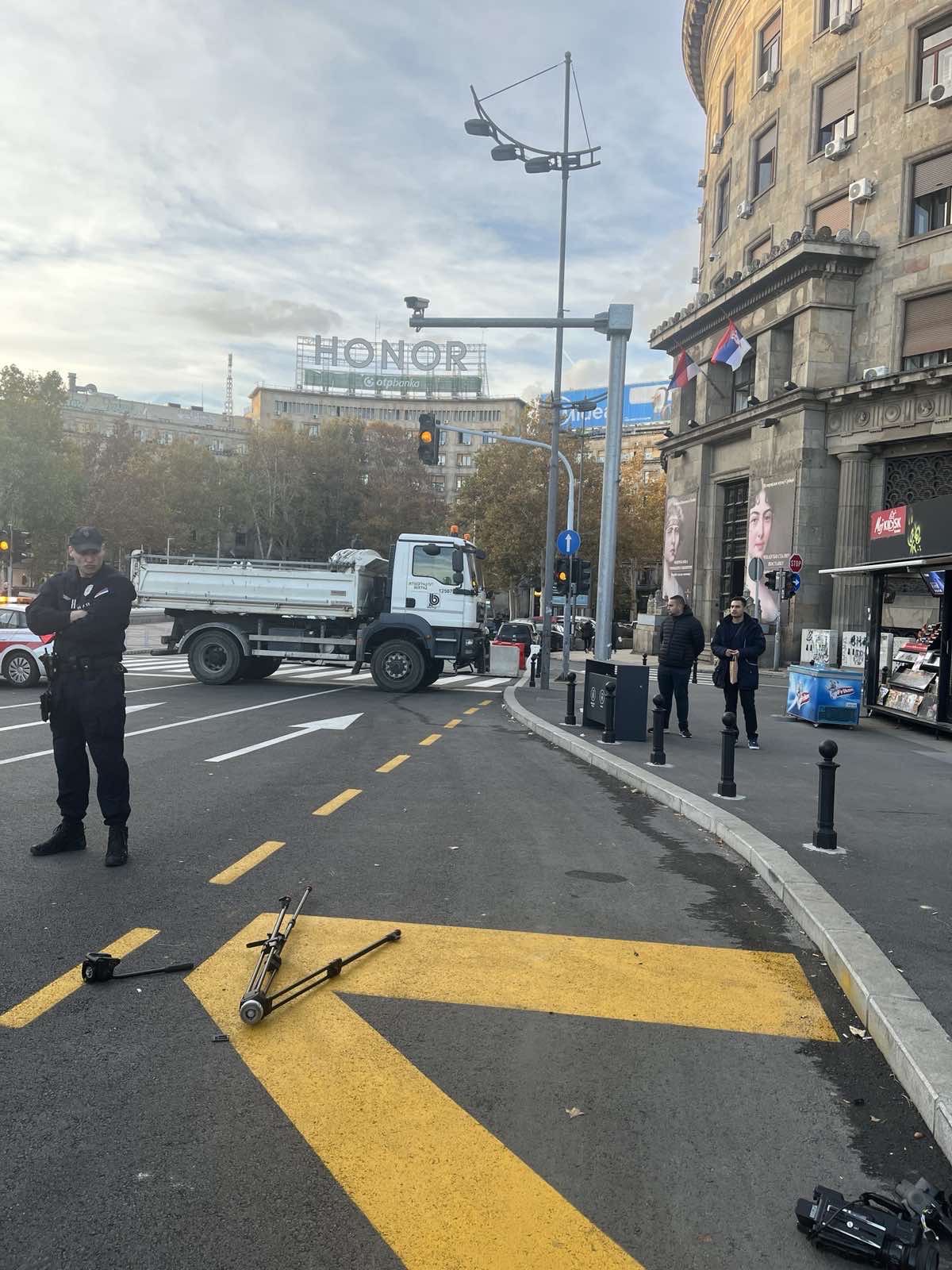
“The police stood by passively while others attacked media workers, obstructing them at rallies held by the ruling Serbian Progressive Party (SNS). Similar incidents occurred in the area between the National Assembly and Pioneers’ Park, where cameras were broken… The police not only failed to intervene but also protected the perpetrators within this cordoned-off and occupied space,” ANEM said.
The report added that, in most cases, these threats and attacks followed public targeting and inflammatory rhetoric from high-ranking state officials, most notably Serbian President Aleksandar Vucic.
Regarding the state project co-financing of media content, ANEM noted that the system has drawn criticism for years due to irregularities, a lack of transparency, and the allocation of funds based on “political affiliation.” In 2025, the Association said, “this trend not only continued but the entire process, judging by the results, was rendered almost meaningless.”
“A number of media outlets, primarily those that did not cover student protests, received significant funding, often across multiple competitions. Meanwhile, those with a critical editorial stance were generally denied state support. Compliance with the Serbian Journalists’ Code of Ethics was clearly not a priority, as some winners included publications with numerous recorded violations of ethical and professional standards,” the Association said.
ANEM also emphasized that Serbia has lacked a Council of the Regulatory Authority for Electronic Media (REM) since November 2024. Two attempts were made over the past year to form the body, but currently only four of the nine members have been confirmed. ANEM noted that these elections were “marred by numerous irregularities and clearly influenced by political pressure.”
The Association also addressed the protests against the public broadcaster. Many believe that RTS failed to provide adequate, objective, and timely reporting on major events and the ongoing societal crisis. This led dissatisfied citizens to protest multiple times outside the broadcaster’s headquarters, including a blockade of the building that lasted several weeks, it said.
ANEM emphasized that, at the beginning of the year, President Vucic announced for November the shutting down of media outlets operating within United Media, which has not happened, but said that numerous events and turbulence have raised concerns for this media company.
“SBB was sold to Yettel, the SportKlub television channel was shut down, and rights were sold to Telekom Srbija. The management of the company dismissed Dragan Solak and the director of United Group due to disagreements, leading to legal disputes. Stan Miller was appointed as the new director of United Group, and the public was stirred by a recording in which the director of Telekom Srbija, on behalf of Aleksandar Vucic, demands the dismissal of United Media director Aleksandra Subotic,” ANEM said.
Source: N1