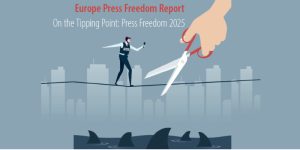
The Council of Europe Platform to promote the protection of journalism and safety of journalists, designed as an alarm system for serious threats to journalists, recorded a series of incidents in the Western Balkans this year, with a particularly high number of reports from Serbia (33).
The Platform records serious threats to the safety of journalists and to media freedom across Europe, with the aim of strengthening the Council of Europe’s response and increasing the accountability of member states.
According to data from the Platform relating to the Western Balkans, 59 cases of threats to journalists’ safety were recorded this year in Western Balkan countries, to which the SafeJournalists Network and its members responded.
Five cases were recorded in Albania, three in North Macedonia, five in Montenegro, seven in Croatia, six in Bosnia and Herzegovina, and 33 in Serbia.
The Independent Journalists’ Association of Serbia (NUNS), which monitors the situation in Serbia, warns that the data point to an alarming situation: this year alone, NUNS recorded as many as 344 cases in its database documenting attacks, pressure, and threats against journalists—the highest number since NUNS began keeping these records. NUNS stated that a large share of the incidents is linked to reporting on anti-government civic and student protests that have lasted for more than a year, sparked by the collapse of a canopy at the Novi Sad railway station, which killed 16 people and led citizens to demand accountability.
The SafeJournalists Network expressed gratitude to the Platform’s partners and to the Council of Europe for monitoring cases of threats and violence against journalists in the Western Balkans, noting that the international visibility of these cases increases pressure on institutions to respond. In addition to international visibility, when the Council of Europe Platform records serious violations of media freedom through alerts, it officially calls on the competent institutions of the member state, through its mechanisms, to provide a response and information on the steps they have taken in the specific case.
Why is it important that the Council of Europe records these cases?
The Platform for the Safety of Journalists is a public space that helps collect, process, and share information about serious concerns related to media freedom and the safety of journalists in the member states of the Council of Europe. Its aim is to improve the protection of journalists, enable more effective responses to threats and violence against media professionals, and strengthen early-warning mechanisms and response capacities within the Council of Europe. The Platform allows the Council of Europe to be alerted to cases in a timely and more systematic manner, so that it can take prompt and coordinated action when necessary. It also helps the Organization identify trends and propose appropriate public policy measures in the field of media freedom.
These data also serve as input for broader international assessments of the state of media freedom and freedom of expression. Specifically:
- The Council of Europe (together with the Platform’s partner organizations) publishes annual assessments/reports on the state of media freedom and the safety of journalists in Europe, based on the Platform’s findings and the work of partner organizations.
- The European Commission, in the methodology for its Annual Rule of Law Report, lists the Council of Europe Platform as one of the relevant sources in the section on media pluralism and media freedom.
- The European Parliament also uses the Platform as a reference for describing and documenting serious threats to the safety of journalists.
In practice, this means that recording cases on the Platform does not remain merely at the level of “statistics,” but becomes part of a broader system of international monitoring and assessment, which can influence recommendations, public positions, and political pressure on states to improve the protection of journalists and the prosecution of attacks against them.