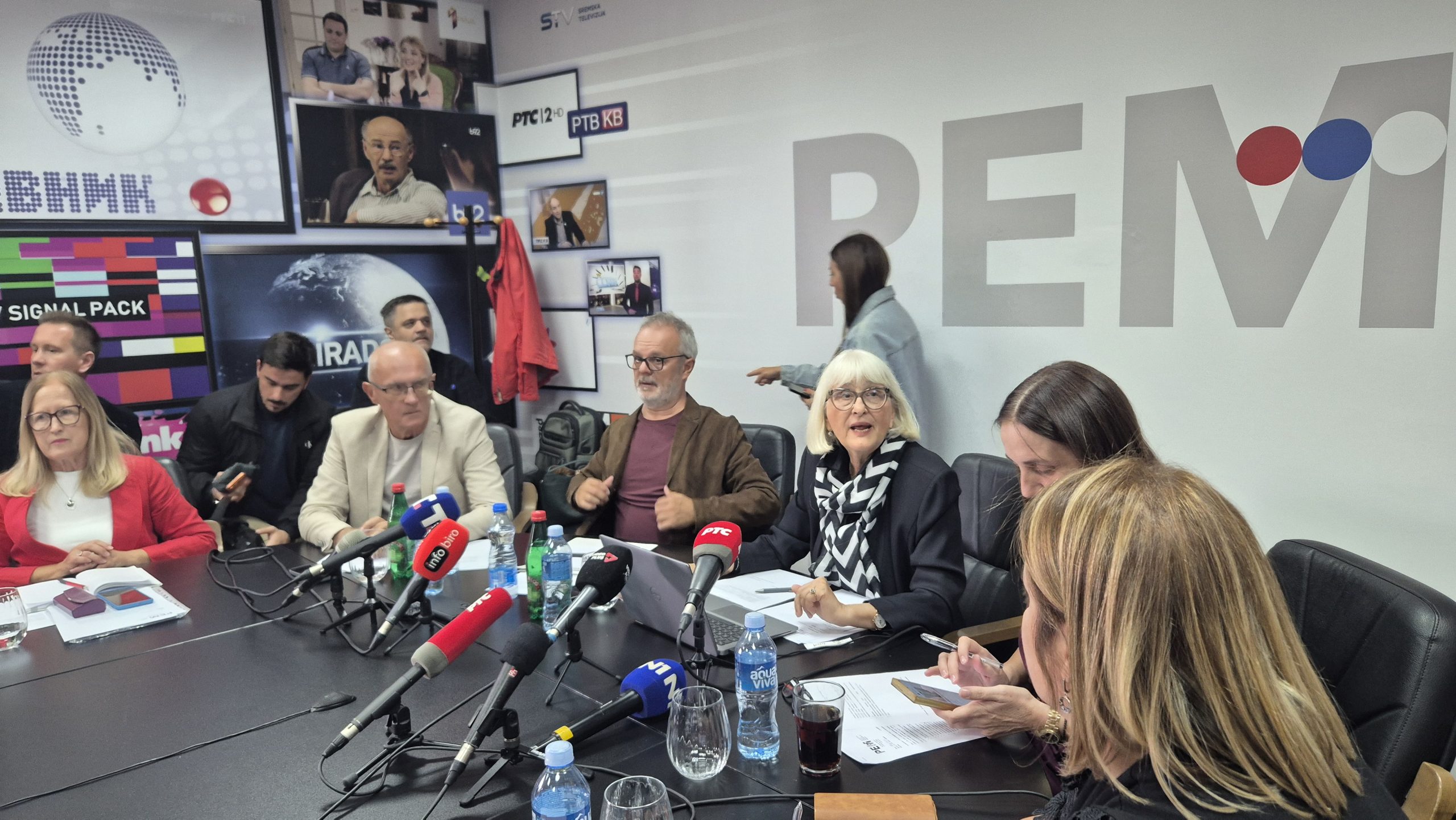
Four members of the Regulatory Authority for Electronic Media (REM) Council – Dubravka Valic Nedeljkovic, Ira Prodanov Krajisnik, Mileva Malesic, and Rodoljub Sabic – sent an open letter to the international community warning of direct political influence over the electronic media regulator. They called on the European Union (EU), OSCE/ODIHR, and other global actors to factor these developments into their upcoming evaluations of Serbia’s electoral process.
The letter was addressed to H.E. Andreas von Beckerath, Ambassador and Head of the Delegation of the European Union to the Republic of Serbia; Eoghan Murphy, Head of the OSCE/ODIHR Election Observation Mission to Serbia; H.E. Marcel Pesko, Head of the OSCE Mission to Serbia; Jan Braathu, OSCE Representative on Freedom of the Media; Marta Kos, European Commissioner for Enlargement; Tonino Picula, European Parliament Rapporteur for Serbia; Janos Babity, Head of the Council of Europe Office in Belgrade, and to relevant working bodies within the Council of the European Union and the European Commission, heads of missions of EU member states in Serbia, and the embassies of the United States, the United Kingdom, Norway, and Switzerland.
The full text of the letter follows below:
Dear representatives of the international community,
We are writing to you as four members of the Council of Serbia’s Regulatory Authority for Electronic Media (REM) to draw attention to developments that directly affect the integrity of the current electoral process.
We returned to the Council despite serious concerns regarding the process through which the Council was elected, as well as documented concerns regarding the independence and potential conflicts of interest of several other members. We did so to prevent Serbia from entering the election campaign without a functioning media regulator. We believed it was our responsibility to exhaust every possibility of enabling REM to begin performing its statutory role.
The first substantive test came immediately.
On 10 September, before the Council was constituted, REM’s professional service began monitoring the election campaign using a sample inherited from the 2023 monitoring methodology. Eleven television channels are currently being monitored. TV Informer is not among them.
At the Council meeting on 22 September, Rodoljub Sabic proposed that Informer be included in the monitoring. The Council agreed that all members would submit proposals for expanding the monitoring sample within 72 hours.
What followed is extremely important.
All eight members of the Council subsequently stated in writing that Informer should be included in the monitoring sample.
Nevertheless, when a formal decision was due to be taken on 28 September, four members changed their position. The vote ended 4–4. No decision was adopted and Informer will therefore remain outside REM’s systematic monitoring of the election campaign.
The situation is particularly serious because the previously raised questions concerning independence and potential conflicts of interest are no longer abstract. Serbian law requires members of the REM Council not only to possess professional qualifications, but also to have a public reputation based on their commitment to freedom of expression, human rights, democracy and the rule of law, and prohibits conduct that calls into question the reputation, autonomy or independence of the Regulator.
These developments indicate direct political influence over four members of the REM Council and must also be viewed in light of the European Commission’s previous assessments.
In its July 2026 document, Information Note on Recent Developments in Serbia Relevant to Cluster 3, the Commission stated, in relation to the REM selection process, that “the authorities and the Parliament have taken a constructive approach and the necessary technical steps under their control.”
We believe that what has happened since then demonstrates the need to reconsider that assessment, because a clear distinction must be made between the formal constitution of REM and the existence of a functioning and independent regulator.
Our participation in the work of the Council should not be interpreted as confirmation that the problems surrounding its election have been resolved. Nor must our willingness to compromise in order to enable the institution to function be used as evidence that REM is functioning normally.
On the contrary, we entered the institution in order to determine whether it could perform its statutory role. The first substantive test has clearly demonstrated how difficult this is to achieve.
We therefore call on the European Union, OSCE/ODIHR and other international actors monitoring the elections in Serbia to formally record these developments and take them into account in all assessments of the electoral process.
The inability of the media regulator to apply objective monitoring criteria to a major broadcaster during an election campaign directly undermines media pluralism, equality among electoral contestants, a level playing field and the ability of citizens to make a free and informed electoral choice.
This pattern cannot be treated as an internal disagreement within REM. It must be taken as evidence that the conditions for free and fair elections have not been met.
We will continue to use every legal mechanism available to require REM to perform its statutory duties. We will also make public every instance in which the Council is prevented from doing so.
Our participation must not be used as evidence of the democratic legitimacy of the elections.
Sincerely,
Members of the REM Council:
Dubravka Valic Nedeljkovic
Ira Prodanov Krajisnik
Mileva Malesic
Rodoljub Sabic
Source: N1