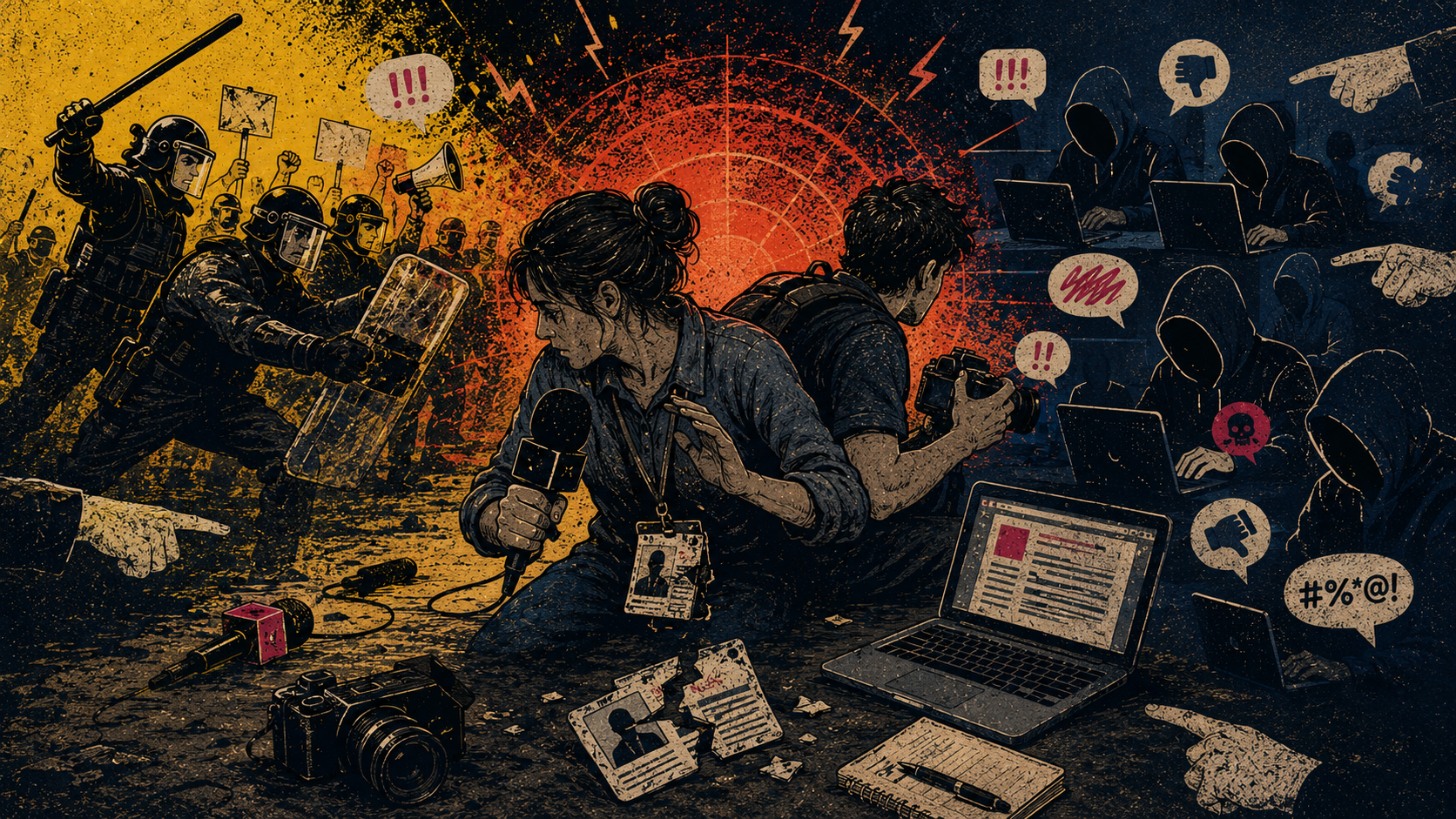
In August 2026, the Independent Journalists’ Association of Serbia (NUNS/IJAS) recorded a total of 29 incidents involving journalists and media workers. Four physical attacks against journalists and one attack against a media outlet were documented. In addition, 16 cases involving death threats and threats to journalists’ physical safety, two threats against media outlets, and six other threats against journalists were recorded. The trend of serious threats and intimidation against journalists continued this month. August also saw physical attacks and the obstruction of journalists reporting from public gatherings, including attacks by police officers. These incidents demonstrate the continuation of a worrying trend of attacks on journalists covering events of public interest, which has seriously endangered and hindered their work in the field for an extended period.
Serious threats and intimidation against journalists continue
A significant number of serious threats against journalists were recorded in August. Nenad Kulačin and Marko Vidojković were once again targeted. On 3 August, Marko Vidojković received threats on the Facebook page of the IN Medija news portal from Inđija following the publication of news that he had been shortlisted for the “Disturbing the Peace Award to a Courageous Writer at Risk”, presented by the New York-based Václav Havel Center. A comment read: “Scum, he should be killed, not rewarded.” On 16 August, Marko Vidojković and Nenad Kulačin received another death threat. Under a post on ANEM’s Instagram account concerning previous threats against the two journalists, the account @aleksandar.novitovic67 left the comment: “Kill them as soon as possible so they stop talking s**t.”
Serious threats against journalist and ANEM director Veran Matić also continued. Matić had already been subjected to numerous threats and attacks, as well as smear campaigns in the media and on social media. On 6 August, he received several threats and disturbing messages in Facebook comments. Under a Facebook post by Vukša Dragović containing a statement by Veran Matić taken out of context, the profile “Aleksandar Mosic” posted: “Hang the bastard and leave his carcass for the animals to tear apart.”
Threats posted by other profiles under the same post included: “You will be the first one we sacrifice” and “He will stop living soon”. Other comments included: “This stinking Ustasha piece of shit should be dealt with publicly” and “Where does he live? In Serbia? What are we waiting for?”. A threatening message also appeared under the same post on the social media platform X: “…he will be the first one we sacrifice.”
On 16 August, Nova ekonomija editor Biljana Stepanović received several disturbing and threatening Facebook messages from the profile “Deana Smith”. Among other things, the messages read: “Ma’am, we will meet… Because of your calls for the lynching of Serbian police officers and their families, we will meet. And now you are running to that same police force and asking for protection. You can write that you were drunk, ma’am. Because of this, ma’am. Belgrade, Circle 2, is small. Sooner or later. Ma’am. You don’t have lieutenants like Staša Zajović. Believe me, ma’am, we will meet.”
On 27 August, Forbes Serbia editor Ivan Radak received threats and insults in a comment on the N1 article “Radak: EXPO feasibility study does not inspire confidence – do we really need this luxury fair?” The person behind the profile “Orkan” addressed Ivan Radak with the words: “I’ll f**k your traitorous Ustasha mother, Radak; lying scum like you will be wiped out so that you never sprout again.” Later that day, after N1 reported on these threats, a person using the name “Nives” posted three new threats in the comments section of the N1 website. One was again directed at Radak: “We do not make threats; we will carry out the deed.” A second comment was directed at N1 journalists: “Threats? What do you do every day to people who disagree with you, you motherf**kers? I live for the day you start a rebellion so that I can legally destroy and eradicate you. You blockade scum.” In a third comment, threats were directed at IJAS President Željko Bodrožić under the article “Bodrožić: As a society, we have completely gone to hell”: “In the event of a rebellion and conflict, you will be our favourite toy.”
Zoomer journalist Darko Gligorijević received threats following his appearance on N1 television and the publication of an excerpt from the interview on Instagram. The person using the account “natasatrifkanovic” wrote in a comment: “People, do you believe this idiot? He is digging his own grave with these statements,” followed by: “How are you not ashamed to come to our town of Dubovac and then spread lies? Oh, just come again and see how you’ll fare.”
Dragan Todorović, editor of the Aranđelovac-based news portal eStvarnost, was also targeted with false accusations following the publication of a report about Radovan B. Milić’s book My Colony. Posts on several Facebook pages accused Todorović and Milić of being traitors and foreign agents. They alleged that “the Croatian secret service married the murderer Radovan Milić to Dragan Todorović, editor of the irrelevant website eStvarnost” and that “through this secret love affair, the Croatian service gained another of its agents, this time in Aranđelovac”. The posts were accompanied by manipulated photographs featuring Todorović and Milić.
Veselin Petrović, a journalist who runs the Instagram pages “Palilula info” and “Lutajući reporter”, was targeted on social media and in the tabloids after reporting on the dumping of material at Ada Huja and Milićevo Brdo and the creation of a construction-waste dump. A targeting campaign was subsequently launched on social media, including the publication of footage of his home. At the same time, posts accused him of being a “leader of the blockaders”, claimed that he was connected to criminal organisations and called for his arrest. Some of the social-media content was later republished by outlets including Informer, B92, Novosti and NS Uživo, further increasing the campaign’s visibility and intensity.
Threats against local journalists and media outlets
On 5 August, Enes Radetinac, editor of the Novi Pazar-based A1tv.net news portal, received threats after filming cracks in a bridge in Novi Pazar and publishing the footage on the portal’s Facebook page. Sulejman Durević, head of the Municipal Construction Land Sector at the Novi Pazar City Construction Directorate, posted a video in a comment under the post showing workers repairing a hole. In their conversation, they threaten the journalist and make misogynistic comments about a woman who works as a journalist for A1tv.net. At the end of the video, Durević turns the camera towards himself and “blows a kiss”. The following threats can be heard in the recording: “I’d hit that guy filming over there with a shovel, f*** him. That guy was filming us for A1… I almost caught that female colleague.”
On 10 August, threats were made against the newsroom of the Volim Zrenjanin news portal and its editor, Aleksandar Blanuša. The threats were initially posted in a comment under the article “Citizens’ assemblies: Beer Days boycott is producing results”. A person using the name “Dejan” left a threatening comment stating, among other things: “There is no cure for you, only a bullet.” Shortly afterwards, a man who gave his full name telephoned the portal’s editor. During the conversation, he made several threats and invited Blanuša to come to an address in Zrenjanin, which he dictated to him, threatening to “smash his head in”. He also made other vulgar threats and insults targeting Blanuša’s family.
The newsroom of the same portal received another threat on 30 August. Under an Instagram post sharing the League of Social Democrats of Vojvodina’s statement “People of Vojvodina on violence against citizens in Užice”, the account “vitofiziobgd” posted the message: “You should all be killed, f**k your Ustasha families.”
Attacks against journalists reporting from public events
The trend of attacks on journalists covering public gatherings continued. During the Pride Caravan in Kraljevo on 11 August, Glas Šumadije journalist Jovana Ristić and LiKVidno info journalist Nenad Simović were interviewing Bojan Lazić, a representative of the “Da se zna” association, when groups of people began throwing stones at them. Ristić told IJAS that three groups of men began throwing stones almost simultaneously and in a coordinated manner. One stone grazed her ear, although she was not injured. The men also threw eggs at those assembled, hitting both Ristić and Simović. Police officers standing in a cordon failed to react while the men were throwing stones at the crowd.
Only two weeks after the first attack, on 25 August in Kraljevo, Jovana Ristić and Nenad Simović were attacked again. During Serbian President Aleksandar Vučić’s visit to Kraljevo, they were physically obstructed and prevented from reporting from a public gathering in the Ribnica neighbourhood, despite having been properly accredited for the event and wearing clearly visible press credentials throughout. The journalists passed through a police security check and then underwent a further check conducted by individuals who were not wearing uniforms or any visible identification. While they were filming a report in the area designated for the gathering, an unidentified person grabbed the lens of Nenad Simović’s camera and demanded that the journalists stop filming. Several more men dressed in black T-shirts then approached them, pushed them, held onto the camera and forced them to leave the event. Because of the immediate pressure and fear for their safety, the journalists were forced to leave the gathering and move to a safe distance.
Attacks and targeting related to reporting from Užice
While reporting from a Serbian Progressive Party rally and a citizens’ gathering in Užice on 29 August, Mašina editor Marko Miletić was attacked by an officer of the Police Intervention Unit, even though Miletić was clearly identified by a press vest and accreditation and loudly identified himself as a journalist. The police officer first tightly gripped his arm, seized the mobile phone he was using to record and livestream the event, and then violently pushed him. Although the officer returned his phone, he continued pushing Miletić, forbidding him from filming and directing him towards a group of Serbian Progressive Party supporters.
At the same event, during the police operation to push citizens back in Užice, a Radio Television of Serbia cameraman was hit by a stone while filming.
Female journalists from Užice were also subjected to dangerous targeting. REC Media journalists from Užice Marija Vranić, who is also a Nova S correspondent, and Snježana Ostojić were targeted on the social media platform X. A profile under the name Ivan Antić, who presents himself as a Member of Parliament from Novi Sad, posted several false and dangerous accusations: “Nova S and N1 journalists/correspondents MARIJA VRANIĆ AND SNJEŽANA OSTOJIĆ led and directed the violent actions of imported pro-Ustasha elements against the people of Užice who attended a registered gathering in support of their president.”
Journalists targeted over reporting following Ratko Mladić’s death
Following the publication of news about the death of Ratko Mladić, the former commander of the Army of Republika Srpska who was convicted by a final judgment of genocide, crimes against humanity and war crimes, journalists, media outlets and other organisations received a series of threats, insults and intimidating messages. The media have a duty to inform the public truthfully, comprehensively and in accordance with established facts, and such reporting must not be used as a pretext for intimidating or endangering journalists. Responsible and professional journalism entails citing final judgments, judicially established facts, crimes committed and victims. Such reporting is neither a provocation nor an expression of political affiliation, but a journalist’s fundamental duty to the public.
Žarko Bogosavljević, a journalist and editor at the Novi Sad-based news portal Razglas News, was intimidated and threatened through anonymous social-media profiles with messages such as: “Let’s meet and see who the war criminal is” and “I’ll shove a cucumber up your a**.” Zoomer journalist Darko Gligorijević was also intimidated on Instagram under a statement of his published on the page of the Association of Independent Electronic Media (ANEM). The user behind the account “koprivicaanastasija” wrote: “The Ustasha Zoomer who claims that Ratko Mladić is a war criminal should be hit over the head with a shovel.” Female journalists reporting on the subject were subjected to gender-based harassment and misogynistic insults. Nova television journalist Sofija Vukajlović published a Facebook post about Ratko Mladić and received dozens of insults, eventually deleting the post. A user named “Zoran Kecman” wrote: “You are a wh**e, just like the mother who gave birth to you, which is why you don’t know who your father is,” while the account “Kafe Pauza Dorćol” commented: “The criminal is the mother who gave birth to you and didn’t smash you against the concrete… you stinking bitch.”
In addition, several media outlets, journalists’ and media associations and other non-governmental organisations received an email from a person signed as “Bojan Velimirović”, stating: “All honourable and honest Serbs can barely wait for the elections so that, for the 15th consecutive year, they can make it clear and unambiguous to the descendants of 20,000 Ustashas disguised in Partisan uniforms that their vast sums of money and cheap tricks will never work again. LONG LIVE RATKO MLADIĆ! SERBIA IS WINNING! BLOCKADERS ARE USTASHAS!”
Attacks against media outlets
On 26 August, the Instagram account of the Bez Cenzure news portal was suspended after what the newsroom described as a series of reports submitted over several days alleging copyright infringements, which the outlet claims were false and coordinated. Meta notified the newsroom that the account had been suspended for alleged violations of intellectual-property rules. The newsroom stated that, over several days, addresses linked to its accounts had received reports claiming that video content produced and published by the newsroom allegedly belonged to other individuals. The reports themselves came from suspicious and, according to the information available to the newsroom, fake email addresses. The newsroom also stated that the intensity of the reports and the manner in which they were submitted suggested a coordinated attempt to remove Bez Cenzure’s content from social media.
Judgment against the 021 news portal threatens freedom of expression
The Higher Court in Belgrade issued a first-instance judgment ordering Radio-difuzno preduzeće 021 and editor-in-chief Slobodan Krajnović to pay RSD 70,000 in compensation for non-pecuniary damage caused to Nemanja Šarović’s honour and reputation, as well as RSD 85,300 in legal costs.
Nemanja Šarović sued 021 over an article republished from the Radio Television of Serbia website under the headline “Brnabić: The opposition wants a civil war; the incident in Parliament was announced in advance”. The article reported Ana Brnabić’s reaction to disturbances that had previously occurred in Parliament. The disputed portion of the article was the passage in which Ana Brnabić described Nemanja Šarović as “Đilas’s mercenary”.
This judgment could have serious consequences, threaten freedom of expression and establish a dangerous standard for reporting statements made by public officials. It could also have a chilling effect on journalists’ work, particularly when they report on political events of public interest. It should be borne in mind that the 021 news portal neither independently produced nor presented the disputed claims concerning Nemanja Šarović. Instead, it reported the information while clearly identifying the source and the person who made the statement and placing the statement in quotation marks. In this case, the subject of the report was the publicly expressed claim itself, rather than its presentation by the media outlet as an established fact.
This judgment represents another blow to the media and imposes an obligation on them to establish the truthfulness of political statements before reporting them. This could result in journalists no longer being able to report statements by public officials, affecting not only the work of journalists and media outlets but also denying the public its right to receive information concerning matters of public interest.
It is particularly noteworthy that another court dismissed the lawsuit Nemanja Šarović filed against the Speaker of Parliament, who had made the statements subsequently reported by the media.
Concerns over Alpac Capital’s management changes at Adria News Network media outlets
IJAS, as well as other domestic and international organisations, is concerned about developments surrounding Alpac Capital’s acquisition of Adria News Network (ANN).
On 17 August, the former directors, legal representatives and some members of the management were replaced at United Media Digital, Adria News, Dan Graf and Adria News Nova S, the companies through which N1, Nova S, the Nova.rs news portal, the Nova newspaper, the Radar weekly and the Danas daily operate. They were replaced by Alpac Capital CEO Pedro Vargas David, even though the acquisition of Adria News Network had not yet received regulatory approval and the employees had not been notified in advance. Information and announcements concerning possible changes to editorial positions also emerged. Concerns were expressed on several levels, including uncertainty over job security and the future of the newsrooms, possible changes to editorial positions, potential interference with editorial policy and threats to editorial independence. It is particularly concerning that the management changes were implemented before the acquisition received regulatory approval. Potential dismissals and restructuring are also a concern, given Euronews’s experience following its acquisition by Alpac Capital, as well as the company’s previous experience and links with senior officials in certain countries and the Alpac Capital director’s openly acknowledged ties to the current President of Serbia, Aleksandar Vučić.
Of particular concern was the open letter sent by Minister of Information and Telecommunications Boris Bratina to Alpac Capital CEO Pedro Vargas David. IJAS and other organisations consider the minister’s conduct unacceptable and regard it as interference by a representative of the executive branch in questions concerning the ownership, management and future of N1 and Nova. It further confirms concerns about safeguarding their editorial independence. In his letter, the minister makes serious accusations against N1 and Nova, their journalists and their previous owners, portraying the outlets’ professional and editorial work as political activity directed against the government and the state. For this reason, journalists’ and media organisations called on the competent regulatory and competition-protection authorities to examine the legality of the transfer of control over ANN. They also called on the ownership structures to explain the circumstances surrounding the acquisition and provide guarantees that the outlets’ editorial independence would be preserved.
Alpac Capital CEO Pedro Vargas David responded to Minister Bratina. Together with the International Federation of Journalists (IFJ) and the European Federation of Journalists (EFJ), IJAS expressed concern over the response, stating that its wording raised further questions about the new owner’s approach to the newsrooms’ editorial policies.
The response states that journalists should be free to choose topics, ask any questions and investigate without restrictions. At the same time, however, it claims that media outlets are becoming “political forces”, that journalists use their platforms to “promote a particular agenda”, that there is a need for “serious, non-activist, Western-style journalism”, and refers to the “normalisation” of Serbia. This is particularly concerning when viewed in the context in which journalists at N1, Nova, Danas, Radar and other critical media outlets have worked for years, during which government representatives have targeted them and accused them of being political actors and “activists”. Particularly troubling is the claim that when media outlets become part of the political “game”, attacks by politicians, boycotts and aggression follow. Such a claim is unacceptable because responsibility lies exclusively with those who perpetrate violence, while critical reporting must never be used as a reason or explanation for political aggression against journalists.
Proposals to amend the system of project-based co-financing of public-interest media content
Journalists’ and media associations – the Association of Independent Electronic Media, the Independent Journalists’ Association of Serbia, the Journalists’ Association of Serbia, Local Press and the Media Association – sent the Ministry of Information and Telecommunications proposals to amend the process for the project-based co-financing of public-interest media content. This followed years of abuse of the system, culminating in 2026, when public funds were distributed throughout Serbia to pro-government media outlets that systematically violated the Journalists’ Code of Ethics, in complete contradiction with laws and bylaws. The proposals for amending legal acts and introducing specific changes to the project-based co-financing process are based on conclusions agreed during internal consultations with representatives of the aforementioned journalists’ and media associations and the Press Council, a self-regulatory body.
Also in August, ANEM filed a criminal complaint with the Special Anti-Corruption Department of the Higher Public Prosecutor’s Office in Novi Sad against Šabac Mayor Aleksandar Pajić and unidentified officials of the Šabac City Administration concerning the allocation of RSD 6.6 million to the macvatv.rs news portal in the 2026 call for the project-based co-financing of media content. The complaint was filed because public funds were awarded to a media outlet that had not published the basic information required in its imprint either when the call was announced or when the funding decision was adopted.
On 1 September, the Ministry of Information and Telecommunications launched public consultations on necessary media content, which will remain open until 2 October 2026, inviting experts and the wider public to submit proposals regarding the media content needed to serve the public interest in the field of public information. The analysis of necessary media content must draw on a variety of sources and elements, with public consultations constituting only one of them. It cannot be reduced to the mere formality of publishing a call for submissions. Instead, drawing on previous project co-financing processes, evaluations, research and consultations, the state should determine which types of media content are lacking and how public funds should be allocated to serve the public interest.
Furthermore, the consultations were launched with a number of shortcomings. Among other things, the Ministry did not simultaneously present the public with the analytical and documentary basis on which the future analysis will be founded. The consultation programme does not explain how the submitted proposals will be processed and evaluated, while the consultation form itself creates further uncertainty.