In September, the Independent Journalists’ Association of Serbia (NUNS) recorded a total of 31 incidents involving journalists and media workers.
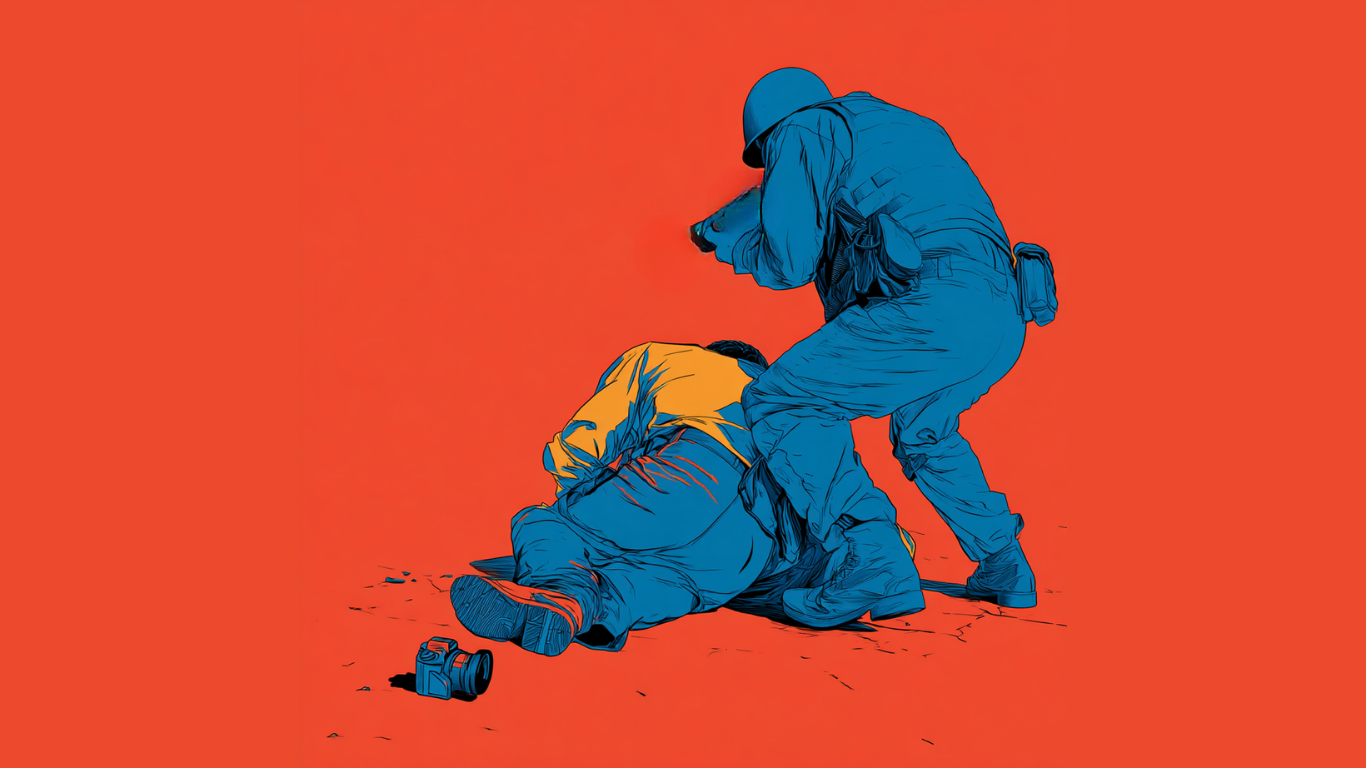
Although the number of recorded cases is slightly lower than in the previous month, their severity shows that the situation remains highly alarming. The largest number of attacks occurred during protests held across Serbia. A particular problem continues to be attacks by the police and inadequate treatment of journalists. There were 11 actual physical attacks, of which as many as 8 were carried out by the police. In addition, 8 death threats and threats to the physical safety of journalists were recorded, along with 8 threats against media outlets and organizations, three other threats, and one attack on media and media organizations.
Continued police brutality against journalists and media workers
On 1 September in Novi Sad, near the university campus, a police unit leader approached Beta agency journalist and photojournalist Božidar Milovac and violently snatched the phone from his hand. Milovac was asked to identify himself and present his press card, which he did. After a brief conversation and identification, the officer returned his phone. Moments before the incident, Milovac had filmed a video of a police cordon, and it is presumed that this footage was the reason for the officer’s approach and reaction.
In Novi Sad, during the 5 September protests, multiple attacks by police occurred. Journalist Emir Kahrimanović from the 021.rs portal was physically assaulted while covering the protest, even though he repeatedly stated he was a journalist and showed his press card. After he fell into the grass, a police officer kicked him. At the same protest, journalist Katarina Stevanović, from weekly Vreme, was physically prevented by police from doing her job and was forced to lie on the ground for about 15 minutes, even though she wore a press vest and said she was a journalist. Police first told her “that she must not record under any circumstances,” took her details, and only let her go after checking with superiors. The same day, a member of the Gendarmerie pushed Nemanja Šarović, who was reporting live for KTV, grabbed his microphone, threw it, and smashed it – an incident captured on video. During the protest, police repeatedly claimed that journalists and citizens were not allowed to record police conduct.
That same day, at the Rectorate of the University of Novi Sad, police forcibly entered the building, pushing back gathered citizens and students. Almost the entire team of the student media outlet Blokada.info was held inside the building, isolated from others because they were filming events. Their equipment was seized, and several editorial staff members were taken to a police station. All were released after giving statements to the police. Part of their equipment was returned, while the rest had not been returned even a month later.
During the 28 September protest in Belgrade, several incidents involving police were recorded. The most serious case was the detention of student-reporter Luka Pešić, despite his clearly showing a press card. Before being detained, Pešić was physically attacked by men in civilian clothes and uniformed police officers. At the police station, his equipment was seized, his memory card was examined, and one recording was deleted without his consent. He was also told that during the first four hours he could not contact a lawyer, and he was not informed why he was detained or what he was being charged with. Police tried to obtain a prosecutor’s order to seize his phone but failed. After the prosecutor assessed that there were no grounds to initiate proceedings, Pešić was released.
Police also did not allow journalists to attend the “Rally Against Blockades.” Puls generacije journalist Jovana Trošić was prevented by police from doing her job and was not allowed to pass through the police cordon into the area reserved for journalists. Later that evening, outside the police station in Majke Jevrosime Street, photojournalist Gavrilo Andrić was asked for his ID and checked by police without specific reasons, as he was reporting from a rally in support of detained students.
Other physical attacks on journalists and media workers pose a serious threat
On 5 September, N1 journalist Ksenija Pavkov and her cameraman were attacked and their movement restricted at an event in Novi Sad. She was prevented from filming even though she had a press card and was on public property. The cameraman was struck in the head; a serious injury was avoided thanks to his protective helmet.
On 7 September, while covering a protest rally in Čačak, N2 portal editor Nenad Nešović was physically attacked. Nešović was shouldered by journalist Gvozden Nikolić, owner of the Glas Zapadne Srbije portal, who was accompanied by his son. At that moment, Nikolić’s son said, “Is this the one who sued us? Let me remember him,” after which both of them walked away.
In Zaječar on 24 September, local assembly security forcibly took journalist Miljko Stojanović’s phone as he was recording a physical altercation between security personnel and MPs, returning it a short time later.
Alarming threats and targeting of journalists and media workers
Journalists and media were targeted by numerous threats, hate speech, and labelling. The N1 television has once again become a target. On 5 September, via comments on its website, one person sent several nearly identical threats: “N1 Ustaše, die,” “Ustaše, die,” “Ustaše N1, die.” The next day, another person wrote: “If only the police would break into N1 and arrest and, on the way, give a good beating to the traitors who work there!!! At least let the citizens go with the pitchforks.”
On 8 September, more threats followed. First: “I’m warning you seriously, if it happens here that the Expo gets cancelled, the building you work in will no longer exist, I guarantee it,” and “Tell your bots, admin, call the police freely, you’ve been warned.” Then, along with a string of insults and hate speech, the comment again called the journalists “Ustaše” and said: “We will destroy you, f*** your mother, fascists,” adding at the end “…we have prepared a dangerous surprise for you, the hunt for the Ustaše begins, you will experience it and see it, you trash.” That same day, another threat was sent: “If you don’t form an alliance against Estonia, we will f**k your Ustasha mom for everything, you monsters, and N1-journalists will hang.” From another person: “To the editor of the article: you’re on the list, write while you still have time.”
After the Vranje News editorial office blocked a profile for hate speech, the same person continued the harassment and, in a phone call, threatened physical violence, saying that the first time he saw editorial staff in the field he would approach, seize, and break their camera. Despite warnings that this was a threat and would be reported to the police, he replied: “Go ahead, report me.”
Journalist and University of Novi Sad professor Dinko Gruhonjić was also targeted. On 12 September, an unknown person tried to call Gruhonjić, and after he did not answer, a message arrived from the same number stating: “Aleksandre, send us the salads, there will be meat — we will slaughter the BLOODY Ustaše!!! Death to the Gruhonjić family!!!!!” On 14 September, a letter arrived at the faculty address signed “Greetings from Ratko Mladić.” The threatening letter said, among other things, that he is “an Ustaša filled with incurable hatred”, “I’ll f*** the b***t you first nursed,” “brain sick,” and “I’ll f*** everyone in your house”.
On 15 September, journalist, professor, and head of the Department of Media Studies at the University of Novi Sad, Smiljana Milinkov, received threats to the faculty’s official email including “the Black Hand has marked you.”
The same day, Danas journalist Vojin Radovanović received an identical threatening message from the same account, reading “the Black Hand has marked you,” the same message previously sent to Smiljana Milinkov.
On 23 September, Serbian Progressive Party Main Board member Siniša Vučinić insulted and defamed N1, Nova, Danas, and Vreme, as well as journalist Filip Švarm, on Instagram. In his posts, Vučinić labelled these outlets as “terrorist and fascist media” that “promote and incite evil,” called Švarm a “proven Ustaša and pedophile,” and urged “resistance to the blockers and the pro-NATO opposition,” branding them “traitors of the Serbian people, potential killers, Ustaše, and terrorists.”
On 29 September, BIRN journalist Radmilo Marković was threatened by Informer editor Dragan Vučićević, who wrote on X that “he feels like finding him somewhere and strangling him like a kitten and serving the time gladly.” The threats are part of an Informer TV campaign against Marković that has lasted a week, after he was earlier targeted over comments about Red Star fans.
On 30 September 2025, journalists Marko Vidojković, Dinko Gruhonjić, Ivan Ivanović, and Sanja Ignjatović Eker were targeted by anonymous leaflets distributed to mailboxes and in public places in Belgrade and other cities. The leaflets depicted them with “bloody hands,” accusing them of organizing a so-called “color revolution.” These threats are a consequence of months of false narratives spread by state officials, including Serbian President Aleksandar Vučić, additionally amplified by pro-government tabloids, with the aim of discrediting independent reporting on anti-corruption protests.
On 30 September, several more cases of threats and targeting were recorded. Južne vesti journalist Tamara Radovanović was targeted on Niš TV with threats that “very soon it will be known where her close and distant relatives work.” The threats were made in the “Guest Editor” show and in the “Editor’s Comment” segment, the day after Radovanović inspected documentation on the operations of the public utility “Naisus” and its ties to the local authorities. Radoica Radomirović, former deputy minister in the Kosovo government and a candidate for councilor in Leposavić, angrily berated a young journalist from the KoSSev portal over a question asked after an address by MP Miloš Parandilović. After editor Tatjana Lazarević sent a protest message, Radomirović insultingly accused the outlet of being a “branch of the criminal organization SL.” Glas Zaječara journalist Miljko Stojanović was targeted on the Facebook page “Zaječarski blok,” which posted a video with dangerous and insulting threats such as “no, he should be caught and quartered in the middle of the square.”
The Russian Federation’s Foreign Intelligence Service (SVR), on 15. September, issued a statement with a series of dangerous and baseless claims about the involvement of certain Serbian media and the European Union in protests in Serbia, alleging that they were “the product of subversive activities by the EU and its member states.” The SVR claims that media such as FoNet, RAM Network, Vreme, Južne vesti, and others receive financial support through NGOs linked to Brussels. Statements that insinuate foreign conspiracies without evidence directly endanger journalists and create an atmosphere of pressure, as confirmed by NUNS members who report fears for their safety. The President of Serbia thanked the SVR for the alleged information about an attempt to seize power by force and announced further contacts between Serbian security services and the SVR. NUNS sent a letter of concern to the Embassy of the Russian Federation in the Republic of Serbia, but we received no response.
Attacks on media
On 9 September, Marko Vidojković received notice that the password for the YouTube channel “Ućutati nećemo” (“We Will Not Be Silenced”) and the linked PayPal account had been changed, after which videos with instructions for hacking games were posted and much of the previously created content was quickly removed. There was no ransom demand or request to return the channel, which raises suspicion that the attack was related to their journalistic work.
New trends in SLAPP lawsuits and complaints against journalists
The Electric Grid of Serbia (EMS) filed a criminal complaint for “causing panic and disorder” against journalist Vuk Cvijić, director Mihailo Jovićević, and editor Vesna Mališić over an article published in the weekly Radar on 21 November 2024. The piece, which deals with the collapse of Serbia’s power system, is based on facts presented by PhD electrical engineer Bojan Ivanović, an expert with 26 years of experience in EPS, EMS, and EDS. Since publication, there has been no institutional response, even though the information presented is of public interest. Filing charges for spreading panic against journalists who point out problems in the course of their work is a worrying practice, certainly not aimed at protecting rights. This practice can have serious consequences for freedom of expression, as its goal is to pressure journalists and prevent them from reporting on certain topics. Such complaints have the characteristics of SLAPP suits, used as a tool to stifle media freedom.
Amendments to criminal legislation: Alarming proposals and lack of public debate
On 10 September 2025, the Ministry of Justice launched a public consultation on amendments to the Criminal Code, the Criminal Procedure Code, and the Law on Juvenile Offenders, without prior notice and consultations, leaving a minimal 20-day period for submitting comments exclusively by email. The debate was conducted without presenting draft texts and without public discussions. NUNS and other organizations of the National Convention on the EU warned that the Government of Serbia, amid a political and social crisis, lacks the legitimacy for such changes. The proposed amendments expand criminal repression, threaten the right to peaceful assembly, legal certainty, and victim protection—including shifting the burden of informing back onto the victim—expand secret surveillance, and reduce child protection, while some proposals are not aligned with international standards. Organizations demanded the immediate withdrawal of the proposals and the halt of this process, as well as the organization of a genuine public debate with the participation of experts and citizens, and the rejection of all proposed changes that broaden repression and undermine legal certainty. The proposed changes to certain articles and the introduction of new offenses have a direct impact on media freedom and freedom of expression, as well as on journalists themselves. Accepting these proposals would seriously endanger fundamental citizens’ rights, the right to freedom of expression, and media freedom.
The National Convention on the European Union (NCEU) Working Groups for Chapters 23 and 24 submitted to the Ministry of Justice a document entitled “Red Lines”, indicating the most harmful proposed changes to criminal legislation, while the NCEU website published the Consolidated Comment of the working groups on the drafts of the Law Amending the Criminal Code and the Criminal Procedure Code, as well as the draft Law on Juvenile Offenders.
SafeJournalists Network Conference and Declaration on Improving the Safety of Women Journalists in the Western Balkans
The SafeJournalists Network held a three-day regional conference “Journalism Under Attack: An Age of Repression and Resistance” in Belgrade. The conference presented a regional overview of the Journalists’ Security Index in the Western Balkans, as well as the state of safety for female journalists in the region. The topics of the conference covered the working rights of journalists in the context of repression and media shutdowns, the state of freedom of access to information in Serbia and the region, as well as the European Media Freedom Act and the lessons and recommendations for the Western Balkans. The final day of the conference was dedicated to key threats to media freedom: the impunity of attacks on journalists, SLAPP lawsuits that stifle public debate, and digital security, including surveillance and forensic tools that jeopardize sources and privacy.
The SafeJournalists Network adopted the Declaration on Improving the Safety of Women Journalists in the Western Balkans during the conference. The Network invites everyone who hasn’t yet signed it to do so here. The signing will remain open until November 25, the International Day for the Elimination of Violence against Women. Feel free to share the link with colleagues and partners.