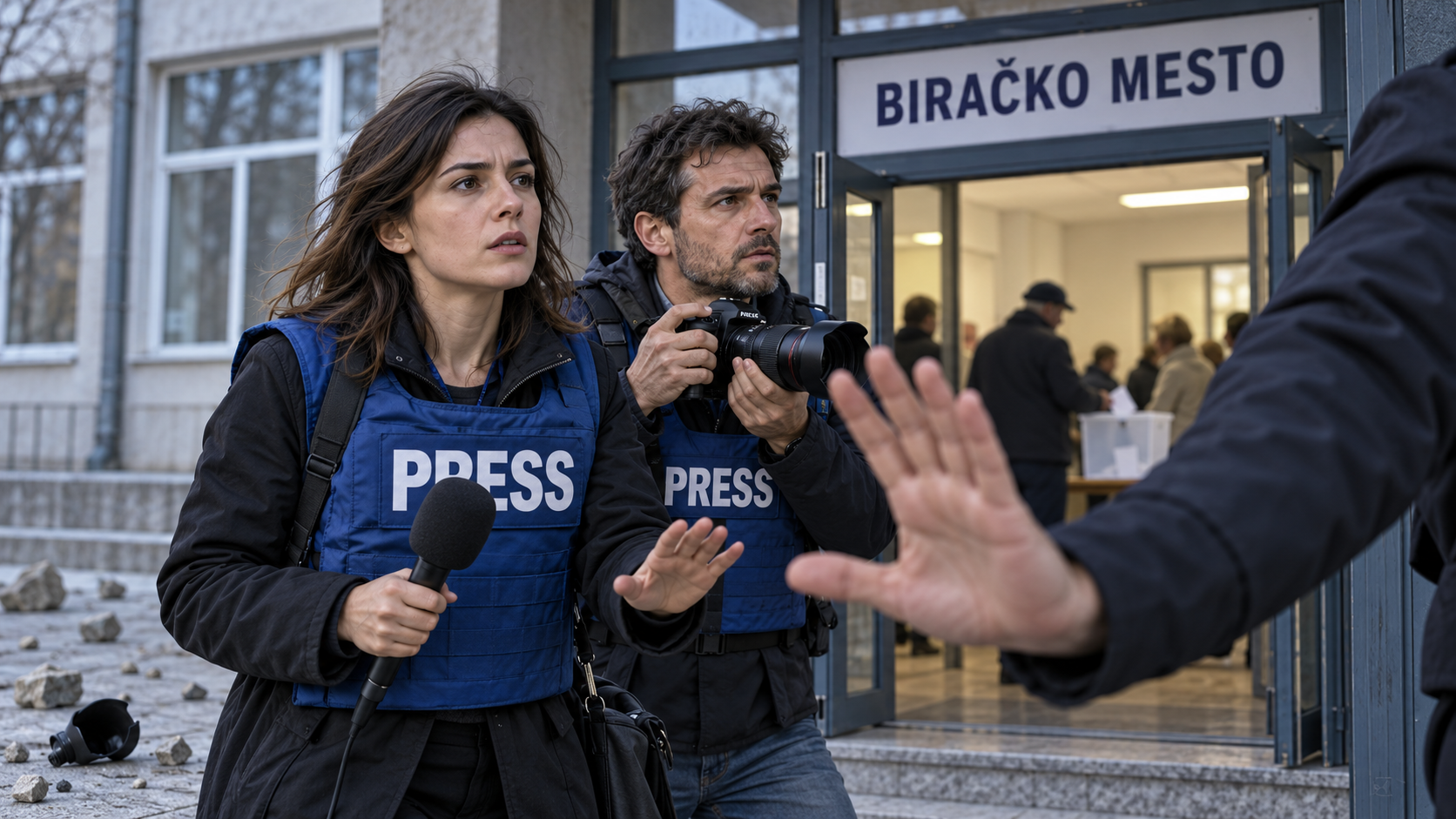
Belgrade, 25 October 2026 – Journalists’ and media organisations represented in the Permanent Working Group on the Safety of Journalists (PWG) protest against physical attacks on journalists and attempts to prevent reporters from covering voting at polling stations.
The journalist journalists’ representatives in PWG are calling on the authorities to urgently identify and punish those responsible for the attacks and ensure that journalists can report without obstruction.
A group of people gathered in the centre of the village of Pavlovac physically attacked InfoVranjske journalist Mihailo Stojković and Večernje novosti journalist Jelena Stojković as they attempted to film events in the village.
According to the journalists, the attackers threw stones at them, pushed and pulled them, leaving both injured. The attack was reported to the public prosecutor’s office and the police, who arrived at the scene and took statements from the journalists.
An Epicentar Press reporting team was prevented from filming at a polling station in Dr Dragiša Mišović Primary School in Čačak.
According to Epicentar Press journalists, the head of the polling station committee refused to allow the cameraman to report, even after he presented his press card issued by the Independent Journalists’ Association of Serbia (NUNS).
“Although we explained that accreditation from the Republic Electoral Commission (RIK) was not required to cover the voting, the head of the committee was rude and threatened to suspend voting. We managed to film a few shots before leaving. We informed the head of the Electoral Commission in Čačak about the incident,” said journalist Milena Gavrilović.
At a polling station in the Mechanical Engineering School in Pančevo, the head of the polling station committee prevented PANpress journalist Ivana Predić from reporting, even though she showed her the instructions journalists had received from the National Assembly of the Republic of Serbia, explicitly stating that accreditation was not required.
“I left the polling station and went to Jovan Jovanović Zmaj Primary School, where I was told that the electoral commission had not notified them of my visit and that I could not enter. I am now preparing to go to the Electoral Commission,” Predić said.
Antonije Kovačević, editor of the Chicago-based Serbian Times, was also prevented from filming today at the polling station in the Consulate General of the Republic of Serbia in Chicago.
“In the three months I have been in contact with the Serbian Consulate General in Chicago, no one ever told me that accreditation would be required to cover the election process. When I arrived, I was denied entry on the grounds that I was not accredited. I asked Consul Marko Nikolić why no one had informed us that accreditation was required, but he could not give me an answer,” Antonije Kovačević said.
He added that he had also requested a written explanation from the consulate as to why he had been prevented from reporting.
“I managed to get in to vote, but not to report. The only thing I can do is report from outside the consulate,” Kovačević said.
The journalist journalists’ representatives in PWG once again remind all those involved in the election process that, under the Law on the Election of Members of Parliament (as well as the relevant provisions of the Law on Local Elections), the work of election administration bodies must be open to the public.
All election administration bodies, including the Republic Electoral Commission, local electoral commissions and polling station committees, are legally obliged to ensure transparency in their work.
The journalist journalists’ representatives in PWG demand that the relevant authorities investigate the responsibility of those who denied journalists access and obstructed them in carrying out their professional duties, and that measures be taken without delay to ensure journalists can cover the work of electoral commissions freely and without obstruction throughout all stages of the election process.
We particularly warn that non-existent or inapplicable media accreditation requirements must not be used as a pretext for arbitrarily restricting journalists’ access.
We remind media outlets reporting from the field that the following emergency phone lines are available: ANEM’s Safe Line at 0800 100 115; the emergency numbers of the Independent Journalists’ Association of Serbia (NUNS) at 060 688 22 31 and 066 8822 008; and the numbers of the Journalists’ Association of Serbia (UNS) representative in the PWG and its lawyer, at 062 530 337 and 064 941 04 89, respectively.
We urge all journalists and media representatives to use these numbers to report any threats, pressure, attacks or other forms of obstruction or threats to their safety. All reports will be shared with the PWG members on call, who are also in contact with designated police and public prosecutor’s office representatives.
Association of Independent Electronic Media (ANEM)
Independent Journalists’ Association of Vojvodina (NDNV)
Independent Journalists’ Association of Serbia (NUNS)
Slavko Ćuruvija Foundation – Association of Online Media (SCF–AOM)
Journalists’ Association of Serbia (UNS)
Media Association (AM)