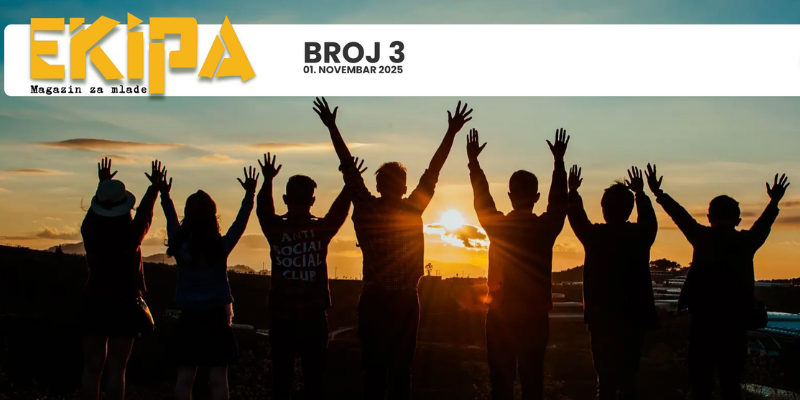
Ekipa (“crew” in English) is a new digital magazine created by the youth section of the Trade Union of Media of Montenegro (TUMM). After a year of activity and three published issues, the magazine – produced by 12 young journalists and journalism students – aims to give young people a voice. We spoke with Ivana Vlaović, coordinator of TUMM’s Youth Journalists and Freelancers Section, and a news reporter at TV Vijesti, one of the country’s most-watched television stations.
Can you tell us about the magazine and the mission behind it?
The Ekipa magazine, published by the Trade Union of Media of Montenegro, aims to promote topics that are relevant to young journalists and freelancers and that directly affect their social and economic status in Montenegrin society. Our main goal is to give young people a voice — to let them speak about their opportunities and challenges — and to approach all youth-related topics from a different perspective. However, we also cover issues of broader public interest that engage young professionals in this field. In the latest issue, we addressed topics such as labour rights, disinformation, young women journalists from minority communities, burnout, and artificial intelligence. The mission of the magazine is to bring together young journalists and freelancers in Montenegro and to ensure their voices are more clearly heard in society.
What gap did Ekipa seek to fill?
We want the magazine to serve as a bridge between journalists — regardless of which newsroom they belong to or what kind of editorial policy their outlet follows. The focus is on the rights of young journalists, the challenges we face, and our position within Montenegrin society. Our stories would not have been published anywhere else, because unfortunately, Montenegrin media are not open to such approaches, as they are often not seen as “attractive enough.”
How do you reflect on the magazine’s journey during its first year?
I believe we have achieved significant success. We initiated a story that is unique in Europe, united a number of young journalists, and considerably improved the quality of our articles. In the three issues published so far, we have covered some of the most important topics such as what young people should know before getting their first job, how we can protect ourselves in the workplace, how to use AI responsibly, and whether young people could become the new democratic force in Montenegro.
Is the younger generation of Montenegrin journalists aware of their rights and willing to fight for good working conditions, according to you?
I’m not sure that all young journalists are fully aware of their rights or feel motivated to fight for better working conditions. Some lack proper education on these matters, while others fear that such efforts could cost them their jobs. That’s why the Trade Union of Media strives to support young journalists and freelancers who want to shed light on these issues and finally speak openly about the poor working conditions that truly exist in Montenegro.
What kind of other initiatives does the union youth section focus on?
Educating young journalists and freelancers is another key goal for us. We aim to organise training sessions and workshops where experienced professionals share their knowledge in different areas — such as labour rights, journalists’ safety, and the use of AI tools. We also plan to start activities with high school students, as we have already established regular cooperation with all relevant university faculties where future journalists are being educated.
The Ekipa magazine received financial support from the European Commission (DG Employment), as part of the Stand Up for Journalism (SUJ) project.
Stand Up for Journalism is a 18-month project led by the EFJ and implemented with its partners: Independent Journalists’ Association – NUNS (Serbia), Trade Union of Media of Montenegro – TUMM (Montenegro), Danish Journalists’ Union – DJ (Denmark), Turkish Journalists’ Union – TGS (Turkey), Syndicat National des Journalistes – SNJ-CGT (France) and Association des Journalistes Professionnels – AJP (Belgium)
 This project is co-funded by the European Union. Views and opinions expressed are however those of the author(s) only and do not necessarily reflect those of the European Union. Neither the European Union nor the granting authority can be held responsible for them.