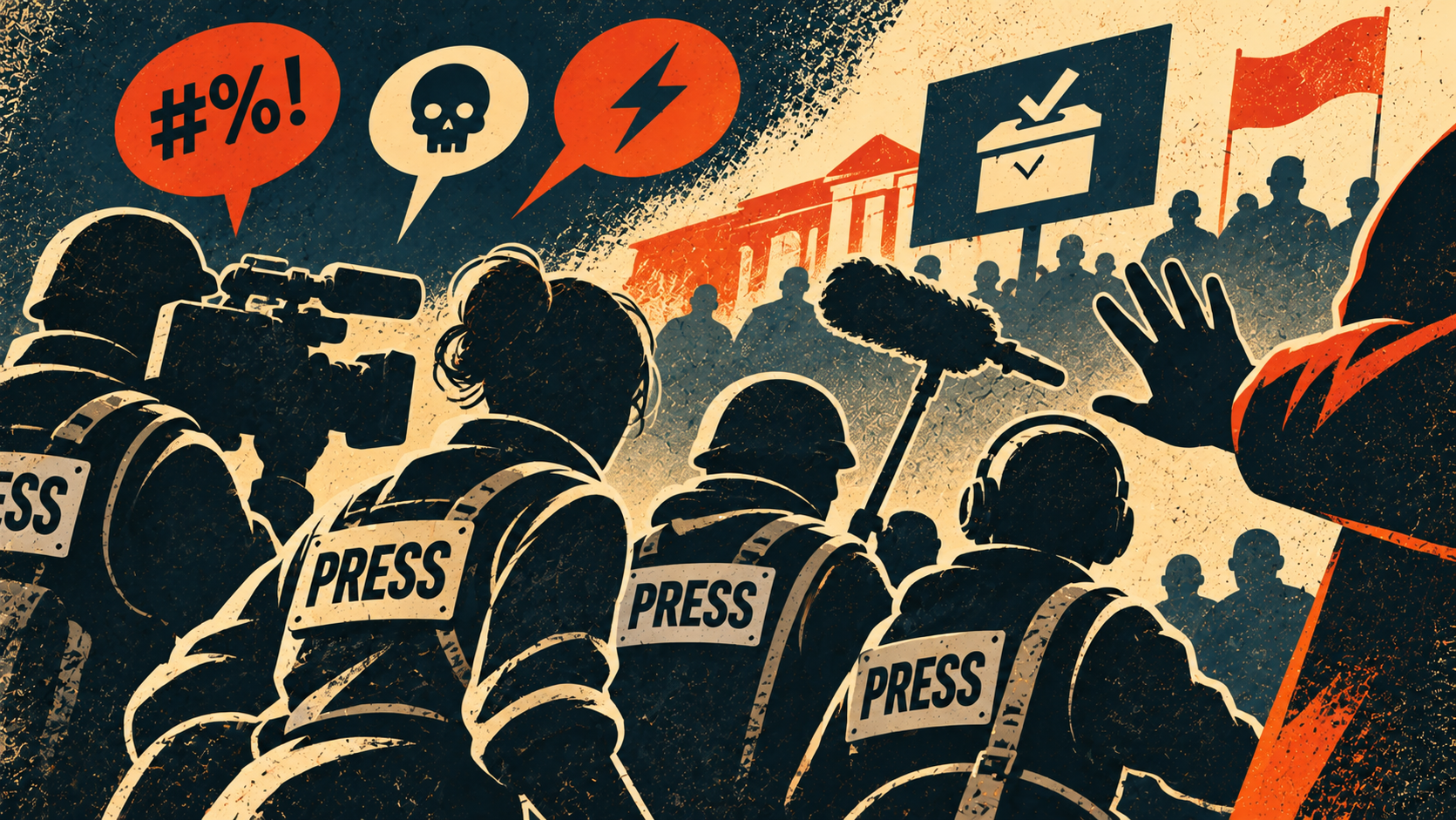
In October 2026, the Independent Journalists’ Association of Serbia (NUNS/IJAS) recorded a total of 42 incidents involving journalists and media workers. These included 18 physical attacks against journalists, four attacks against media outlets and media organisations, 12 cases of death threats and threats to journalists’ physical safety, two threats against media outlets and associations, and six other threats. October was marked by physical attacks against journalists during the election campaign, while covering political party activities, and on election day itself. In addition to physical attacks, numerous other forms of obstruction were recorded on election day, further undermining journalists’ ability to carry out their work in the field, which has already been seriously threatened and hampered for an extended period. The trend of serious threats and intimidation against journalists also continued throughout October.
Journalists faced serious threats in October
Journalists were targeted by serious threats in October. Particularly concerning is the fact that all of the journalists concerned had previously been subjected to attacks, indicating a continuing pattern of intimidation and threats to their safety.
On 2 October, N1 television journalist Mladen Savatović received threats in Nikola Pašić Square while waiting to go live. A man approached him and said: “You’re lucky I’m with my wife. Next time, I’ll smash your head in.” Shortly afterwards, the man approached him again and added: “I fought for this country, and you’re destroying it. Watch yourself.”
The editor-in-chief of the Žig Info news portal, Željko Matorčević, received threats of physical violence following the publication of an article about so-called “phantom voters” registered at the address of a funeral company in Grocka, where 47 voters were registered, raising concerns about possible irregularities in the electoral roll. According to Matorčević, he had spoken with one of the company’s owners while preparing the article. After its publication, he received a phone call from Vesna Dušić, the mother of the other owner, who threatened to physically attack and beat him in the street.
On 9 October, Bečejski mozaik journalist Kristina Demeter Filipčev received rape threats, misogynistic insults and ethnically motivated abuse on social media.
On 20 October, journalists Nenad Kulačin and Marko Vidojković, the hosts of the programme Dobar, loš, zao, as well as Kulačin’s wife, received threats through the social media platform X. The threats, sent from the account @TUCKOBUSICzett, included explicit references to sexual violence and warnings that the journalists and their family members would be targeted after the elections.
On 22 October, Radar journalists Vuk Cvijić and Milan Radonjić received threats in response to their article “Vučko sad naš brat, Andrej glavni, kume”. An unidentified individual posted comments insulting the newsroom, targeting both journalists by name and making disturbing references to torture, death and sexual violence against their children. The messages included: “Vuk and Milan, you scumbags, I’ll f*** your slaughtered children” and “Where is my comment, you fascist newsroom? May your children die in agony in your arms.”
Two days later, the Radar newsroom received further threats of violence in a comment posted under the article “Bait for the Elections in Serbia”, written by Jelena Petković.
The Južne vesti newsroom received numerous death threats and threats of physical violence in comments posted on its website. Some of the messages expressed a wish for the journalists to be crushed by a collapsing canopy, referring to the Novi Sad tragedy, while others explicitly threatened their deaths and contained extremely vulgar insults.
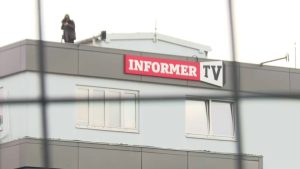
Following the publication of news about the submission of an initiative to revoke TV Informer’s broadcasting licence, two threats targeting N1 television were recorded on NUNS’s social media accounts, alongside numerous insulting comments. Under an Instagram post, the account “veljic.igor” posted a message stating that the television station would be destroyed, while a Facebook user named “Jovica LMijatović” wrote under the same post: “Then your N1 will be blown up.”
On 27 October, the Volim Zrenjanin news portal received insults and intimidating messages in comments under its article “Informer Facing Loss of Licence, Niš TV Sends Employees Home – What Will Happen to Zrenjanin’s Santos and News Portals?” The messages referred to murder and sexual violence against children. Journalists were described as “thugs and terrorists”, accompanied by disturbing references to their children and accusations that they wanted to send others to concentration camps.
The same initiative also prompted threats against the NUNS Secretariat by telephone. Four calls were received over two days, two of which were recorded. The callers repeatedly made horrifying and insulting statements, including extremely vulgar threats of a sexual nature, some of them directed at children, while calling NUNS staff “Ustaše”. Even after being informed that the calls were being recorded and that criminal complaints would be filed, the callers continued repeating the threats. One caller also stated that the rule of law no longer existed in Serbia and that NUNS staff would be imprisoned.
On 29 October, N1 television journalist Mladen Savatović received new threats on Facebook. A comment warned him to watch out if the person encountered him again, accompanied by numerous insults and accusations that he was “destroying Serbia”. After another Facebook user warned the individual about possible criminal liability, the person behind the profile reaffirmed the seriousness of the threats. Particularly concerning is the reasonable suspicion that the threats were made by the same individual who confronted Savatović in Nikola Pašić Square in Belgrade on 2 October. This suspicion is supported by the almost identical wording of the threats and a Facebook profile photograph matching the individual photographed by an N1 cameraman after the first incident.
Sport Klub television sports journalist Nikola Stamenić also received a death threat on X. On 29 October, the account @djipsiunchained posted the message: “Stamenić, we wish you good luck, a wooden coffin and a candle on top.”
Election campaign marked by attacks on journalists and obstruction of their work
Numerous incidents involving obstruction of journalists covering election campaign gatherings were recorded in October. These included physical attacks, threats and physical interference with reporting.
On 1 October 2026, police took Jovan Kerešić, editor of Radio DIR in Ruma, into custody and held him at a police station for four hours shortly before Aleksandar Vučić’s visit to the town. Police officers came to his home and served him with an order, issued at the request of the Basic Public Prosecutor’s Office in Ruma, requiring him to appear at the police station to give a statement as a citizen. Kerešić stated that his detention followed an incident in which he reported an unsafe electrical cabinet to a plainclothes municipal police officer while visibly wearing his press identification. He said he had not been aware of Vučić’s visit and had not provoked anyone.
As many as four incidents were recorded on 3 October. Glas Šumadije reporter Aleksandra Kostić was covering a gathering of Serbian Progressive Party (SNS) supporters in Kragujevac before their departure for Belgrade Arena. While reporting live and filming people gathered around buses, a man threatened to throw her phone onto a bus. When she asked him to repeat the threat on camera, he made sarcastic remarks about her press identification, told her to “get lost” and moved aggressively close to her face and phone.
The same day, Bečejski mozaik journalist Kristina Demeter Filipčev was attacked while filming a gathering of SNS supporters in Bečej. A man employed by a local public utility company took her phone and refused to return it, demanding that she delete the footage. When she refused, he placed the phone on a tree branch. The journalist eventually retrieved it with the assistance of police officers.
N1 television reporter Mladen Savatović was attacked in Kraljevića Marka Street in Belgrade while filming a building suspected of being used to register so-called phantom voters. Two men attempted to prevent him from filming. One of them introduced himself as a caretaker and was later identified as the father of the building’s owner, prominent SNS activist Vladimir Mandić. He insulted and threatened the journalist before moving towards him in an apparent attempt to physically attack him. Another man prevented the situation from escalating further.
Also on 3 October, Mejrema Nokić, a Radio Sto plus journalist and Beta news agency correspondent, was intimidated and obstructed while reporting from an SNS gathering in Novi Pazar. Dejan Belojica, director of the Novi Pazar Tourism Organisation and an SNS activist, followed her and conspicuously filmed her with his mobile phone, zooming in on her despite her clearly visible “PRESS” identification. Shortly afterwards, a young man whom Nokić believes to be a member of the security services approached her and asked her to leave, explaining that SNS officials regarded journalists filming the event as a provocation.
Bečejski mozaik journalist Kristina Demeter Filipčev was prevented from covering Aleksandar Vučić’s visit, as the lead candidate of the “United Serbia” electoral list, to a dairy farm in Bačko Gradište, although other media crews were allowed access. Two police officers prevented her from filming and reporting, while an unidentified man physically blocked her way and ordered her to move aside. She was only able to observe the event from approximately 20 metres away, while police continued to interfere with her work.
On 8 October, ZOOMER correspondent Aleksa Nikolić was attacked while covering a public gathering in Niš, where he was filming a stand operated by SNS supporters. After finishing his recording, he began crossing the street to document activities at a student stand. One of four or five heavily built young men standing on a traffic island in Vožda Karađorđa Street threw an oval ceramic-metal object at him, striking him in the temple. The attacker pulled up his hood to conceal his face, while another individual showed the journalist the middle finger and shouted homophobic insults. Police officers at the scene refused to intervene and referred him to the commander of the Medijana police station, where Nikolić experienced further harassment. A police officer assigned by the Ministry of Internal Affairs to assist Nikolić and accompany him to the Emergency Centre for medical examinations directed several insults at him, using aggressive and discriminatory language that further threatened and distressed the journalist. A similar incident occurred on 21 October, when police officers on duty insulted and belittled him while he was carrying out his journalistic work, using aggressive and discriminatory language. The public prosecutor was informed about the incident and subsequently contacted the police, after which a case was opened by the Internal Control Department of the Ministry of Internal Affairs in Niš.
On 11 October, police officers prevented a KTV news crew from Zrenjanin from covering an SNS election campaign gathering in the town centre. KTV presenter Nemanja Šarović, cameraman and editor-in-chief Danijel Radić, and assistant Milorad Malešev attempted to approach a public gathering supporting the United Serbia electoral list and its lead candidate Aleksandar Vučić. Plainclothes police officers initially warned them and then ordered them to withdraw. When the crew refused to leave, riot police formed a cordon and physically pushed them back, striking Šarović with shields, hands and feet, and pressing him against a pole with their shields. Plainclothes officers also pushed members of the crew, while attempts were made to obstruct filming and interfere with their equipment. The incident was broadcast live on KTV’s Bez cenzure YouTube channel.
At an SNS election campaign gathering in Zaječar on 13 October, event security personnel pushed, stopped and ultimately prevented Nova S television journalist Katarina Golubović and Glas Zaječara journalists Miljko Stojanović and Đorđe Đorđević from doing their jobs, claiming that they “posed a security threat”. Some security personnel struck the Glas Zaječara camera, while video footage shows an SNS supporter grabbing the arm of a Glas Zaječara journalist holding the camera. Security personnel claimed that the journalists lacked accreditation, even though they had duly submitted their accreditation requests. A police officer was also filmed telling journalists that their movement could be restricted due to a “potential threat to public order and peace”, instructing them to stand behind parked vehicles and film from there.
Several incidents of obstruction were recorded at an SNS rally in Novi Sad on 16 October. Security personnel roughly pushed and physically removed a Mašina reporter as she attempted to ask Aleksandar Vučić a question. Razglas News editor Žarko Bogosavljević was confronted by an SNS supporter who approached him aggressively, swore at him, demanded to know what he was filming and then struck his phone. The man left when the journalist attempted to report the incident to police. A contributor to the Pazovačke news portal was also removed from the gathering by plainclothes individuals identifying themselves as police officers. They searched his backpack and recorded information from his identity card. Footage of these incidents was published on the newsrooms’ social media accounts.
Cases of discrimination against journalists and media outlets were also recorded during the election campaign. These included a Mašina journalist being prevented from continuing to film at an SNS gathering in Surčin after recording several shots. Journalists from Bečejski mozaik and Webinfo were also denied access to a meeting between national and local officials and pensioners in Bečej, despite their newsrooms having received invitations and accredited their representatives. Another case involved Milena Gavrilović, journalist and editor of the Čačak-based Epicentar Press portal, whose name appeared on a list allegedly connected to the collection of so-called secured votes for the SNS. According to Epicentar Press, personal information concerning entire families, including addresses and telephone numbers, was publicly disclosed. Some names on the list were marked “AGAINST”, apparently indicating that those individuals would not vote for electoral list number one. People on the list were also labelled “blockaders”.
Search of Ljubomir Stefanović’s apartment – institutional powers used to exert pressure on journalists
On 17 October, officers from the Cybercrime Department of the Criminal Police Directorate forcibly entered the apartment of Ljubomir Stefanović, editor and host of the Slavija Info YouTube channel, searched the premises and sealed the door. Stefanović was not at home at the time, and his family and lawyers had no information about his whereabouts or the reasons for the police operation. The Higher Public Prosecutor’s Office in Belgrade subsequently announced that a police search had been launched for Stefanović on suspicion of committing the criminal offence of causing panic and disorder. The investigation was prompted by posts published on the Slavija Info account on X on 16 October, including the statement: “Vučić will shoot at citizens on election day.” The post was accompanied by a video featuring a digitally manipulated image of Miloš Medenica, alleging that a high-ranking member of Montenegro’s Škaljari criminal clan would open fire on Serbian citizens following alleged election fraud and the declaration of an SNS victory. NUNS responded through the SafeJournalists Network, calling on the Ministry of Internal Affairs and the prosecution to explain why the apartment had been sealed, what equipment, if any, had been seized, and why such measures were necessary. NUNS also demanded that Stefanović and his lawyers be granted access to the relevant documentation. All actions by the authorities must be lawful, justified and proportionate. Police and prosecutorial powers must not be used as instruments of pressure against journalists or to obstruct media work, particularly one week before elections.
Renewed attacks on media Instagram accounts and website disruptions
Several days before the elections, on 21 October, the Instagram account of the Beta news agency was targeted by a bot attack, gaining approximately 300 new followers believed to be fake accounts within just a few minutes. Similar problems were reported by the news portals 021, Cenzolovka, Razglas News, Vreme, Glas Šumadije, Autonomija and Kompas, as well as the civil society organisation CRTA.
On 24 October, the day before the elections, the Instagram account of Nova.rs was also targeted by a bot attack. Its follower count increased by 15,000 within half an hour, and the increase continued after the incident was reported.
On election day, the website of the newspaper Danas came under a cyberattack at approximately 8 p.m. The attack lasted for more than half an hour, preventing journalists from publishing news.
The website of the Journalists’ Association of Serbia (UNS) was also temporarily unavailable for unknown reasons.
Attacks on journalists and obstruction of their work on election day
Election day was marked by physical attacks against journalists and various forms of obstruction that made it difficult for them to carry out their professional duties. The most serious incident occurred in the village of Pavlovac near Vranje, where a group of SNS supporters physically attacked InfoVranjske journalist Mihajlo Stojković and Večernje novosti journalist Jelena Stojković as they attempted to film events in the village. The attackers threw stones at them, pushed and pulled them, causing injuries to both journalists.
In the Belgrade neighbourhood of Bežanijska Kosa, journalists from Blokada Info were attacked following a verbal confrontation with a group of citizens. One of the journalists, Boris Dojčinović, sustained a serious punch to the head.
Journalist and host of the Agelast podcast Galeb Nikačević was attacked outside Pionirski Park in Belgrade. A hooded man struck him while he was filming police allowing groups of men dressed in black to enter the park through a fence, while ordinary citizens were denied access.
Slobodna reč journalist Sanja Petrov was denied entry to the Vranje City Administration building by security personnel after presenting her press identification. A security guard struck her with a door that he forcibly slammed shut. Police officers present at the scene told her that they had no jurisdiction over the City Administration and had not witnessed the incident.
Kurir television broadcast an interview with Vukša Dragović, leader of the “Serbian Sovereigntists”, who directly accused the leaders of CRTA, the Slavko Ćuruvija Foundation and journalist Danica Vučenić of being “anti-Serbian and self-hating” and claimed that they “serve to push people into conflict and bloodshed”.
Attacks on journalists covering the protest outside Pink television
On 26 October, outside the Pink television building in the Belgrade municipality of Voždovac, Veselin Petrović, a journalist with the Lutajući reporter newsroom, was struck on the head with a police baton, while his phone was knocked out of his hand as he documented police actions against citizens.
During the same incident, Ana Mihajlovski, editor-in-chief of the Izlaz news portal, was also injured. Police officers sprayed her with pepper spray and repeatedly struck her with batons, causing physical injuries, despite her clearly identifying herself as a journalist. The officers did not respond to her identification.
Shortly afterwards, on 29 October, Veselin Petrović was attacked again, this time at the premises of the Palilula City Municipality. Municipal President Ivana Medić pushed him and attempted to seize his phone after he asked her about photographs of Aleksandar Vučić displayed in her office. Petrović had visited the municipality to seek answers concerning a disputed public procurement of books for schoolchildren.
Some foreign media crews denied entry to Serbia on election day
Two journalists from the Croatian news portal Telegram.hr, Denis Mahmutović and Marko Miščević, were denied entry to Serbia at the Batrovci border crossing on election day. They were turned back on the grounds that they allegedly posed a security threat. According to the journalists, they were also told that they had written critically about the authorities.
Adrian Kerimi, news director at North Macedonia’s national television broadcaster ALSAT TV, journalist Zekirija Haxhiu and cameraman Besim Shkreta were stopped by border authorities at the crossing near Preševo. After waiting for an hour and a half, they were refused entry into Serbia. The authorities requested accreditation, although the journalists explained that they did not intend to report from polling stations but rather to film events in the streets. They were not provided with any written decision explaining the entry ban.
Obstruction of journalists reporting on election day
The Epicentar Press news crew was not permitted to film at a polling station in the “Dr Dragiša Mišović” Primary School in Čačak, even though the cameraman presented his NUNS press identification. According to the media outlet, despite being informed that accreditation from the Republic Electoral Commission (RIK) was not required, the polling board chairperson behaved rudely and threatened to suspend voting. The journalists subsequently left.
At a polling station in the Mechanical Engineering School in Pančevo, the polling board chairwoman prevented PANpress journalist Ivana Predić from reporting, even though she presented RIK instructions clearly stating that accreditation was not required. Predić and Pančevo Si Ti journalist Nenad Živković went to the City Administration to seek clarification regarding the ban on entering and reporting from polling stations. The president of the City Electoral Commission, Todor Kužić, informed them that they could not obtain accreditation and could only report from outside polling stations. According to the journalists, security personnel expelled them from the City Administration building when they attempted to challenge the decision.
On election day, Serbian Times editor Antonio Kovačević, based in Chicago, was prevented from filming at a polling station inside the Consulate General of the Republic of Serbia in Chicago, allegedly because he lacked accreditation. When he asked Consul Marko Nikolić why the journalists had not been informed that accreditation was necessary, the consul did not respond.
Bezcenzure.info journalist Željko Bogojević was also denied access to the Municipal Electoral Commission in Srbobran, allegedly because he lacked accreditation. When he submitted a request, he was referred to RIK, while, according to Bogojević, another local media outlet had been granted accreditation. He was also prevented from reporting at several polling stations.
The Serbian Progressive Party denied journalists and representatives of N1, Nova, Danas and Radar accreditation to cover election night. The explanation provided was that their presence at the party’s election headquarters “was not an option”.
Another incident of obstruction related to election reporting was recorded after election day. Ivan Ranković, president of the Lazarevac Municipal Electoral Commission, refused to answer a question from a journalist working for the Pravo u centar news portal about reports of irregularities on election day, explaining that he did not have authorisation to do so. He specifically emphasised that he did not wish to give statements to that outlet. After the portal published an article about his conduct, the journalist received a message from the telephone number previously used in their communication, stating: “You should be ashamed of yourself, but that is not a problem because I record conversations.”
REM’s Work in October: From Decision-Making Deadlock to the First Sanctions Against Broadcasters
The Council of the Regulatory Authority for Electronic Media (REM) held four regular and two extraordinary sessions in October. The sessions addressed election campaign monitoring and proceedings against certain broadcasters. However, the Council’s initial sessions in October were marked by significant disagreements among members regarding broadcasters’ accountability and the imposition of sanctions. In some cases, proposals to impose sanctions failed to secure the necessary majority, while decisions on other cases were postponed. This slowed down, complicated and, in some instances, completely blocked decision-making and action by the Council. Following the elections on 25 October, a change in the Council’s approach became apparent, with new proceedings initiated against broadcasters. On 4 November, the first programme broadcasting bans were imposed for violations committed during the election campaign. TV Prva was sanctioned with a one-day ban on its Vesti news programme and a five-day ban on its morning programme, while TV Informer received a seven-day ban on broadcasting its Prva info programme.
On 27 October, media associations, civil society organisations, professors and researchers in journalism and social sciences from universities in Belgrade, Novi Sad and Niš submitted an initiative to REM calling for the revocation of TV Informer’s broadcasting licence. The initiative was prompted by years of violations of media laws and professional ethics, campaigns against critics and political opponents, and propaganda activities in support of the former government. The REM Council considered the initiative and requested that all previously submitted complaints concerning TV Informer be collected and compared with the allegations presented in the initiative.
REM also adopted a draft Rulebook on the procedure for appointing members of public service broadcasters’ management boards, along with a public consultation programme, scheduled to take place from 12 November to 2 December. Once the final Rulebook is adopted and published, the process of announcing a public call for the appointment of new members of the RTS Management Board can resume.
Another misuse of REM occurred ahead of the parliamentary elections. A document appeared publicly accusing N1 and Nova S of violating the election silence rules, even though the Council had neither discussed the matter nor adopted any decision. Four independent Council members confirmed that they had not participated in drafting the document, while the session at which such a decision could have been made could not take place due to a lack of quorum. The Coalition for Media Freedom stated that it considered this a serious violation of legal procedures and an unacceptable abuse of authority. The Coalition called on the competent prosecutor’s office to investigate the circumstances surrounding the creation and publication of the document, as well as the potential criminal liability of REM Council President Stevica Smederevac and other responsible individuals, including possible elements of the criminal offence of abuse of office.
On 19 October, on Supernova channel 596, which normally carries the programme of the independent Prijepolje-based broadcaster TV Forum, content bearing the “TV Prijepolje” logo and rebroadcasting TV Informer’s programming appeared instead of TV Forum’s programme. The incident occurred just days before the elections, particularly undermining citizens’ right to information, misleading viewers and damaging the reputation of the local media outlet. It was particularly concerning that “TV Prijepolje” was neither registered in the Media Register maintained by the Serbian Business Registers Agency nor licensed by REM to broadcast. The Coalition for Media Freedom demanded that Telekom Srbija disclose who was providing the programme, on the basis of which document and whose decision its signal had been included in Supernova’s offering, and how it had come to replace TV Forum. The Coalition also called on REM to urgently clarify the legal status of the media service provider and the legality of its broadcasting activities.
Pressure on the editorial independence of N1, Nova, Nova.rs, Radar and the newspaper Nova
In October, the management of Adria News Network (ANN) and representatives of Alpac Capital took a series of steps that deepened concerns that the change in ownership was leading to restrictions on the editorial autonomy of media outlets operating within these groups. It was particularly concerning that these developments took place during the election campaign.
On 2 October, ANN management submitted an application to REM for a broadcasting licence in Serbia without previously informing or consulting the editorial team. News Director Branislav Šovljanski only learned of the application when REM contacted him to request additional documentation. At that point, he also discovered that information from his identity card had been used and that he had been listed as editor-in-chief without his prior knowledge.
On 9 October, the Nova.rs newsroom informed the public that ANN management had appointed Marko Stjepanović as editor-in-chief of Nova.rs and Ivana Mastilović Jasnić as his deputy, prompting opposition from the editorial team. Plans to recruit journalists from Alo and Večernje novosti were also abandoned. Ratko Femić, the former deputy editor of Nova.rs, assessed that Alpac Capital had been exercising control over the media outlets even before obtaining formal approval from the regulator in Luxembourg, pointing to sudden personnel changes ahead of the elections and the dismissal of Mihailo Jovićević.
Shortly afterwards, on 27 October, Nova.rs reported that Alpac Capital representatives had announced at a meeting that the print edition of the newspaper Nova would cease publication on 31 October. They also announced the termination of cooperation with freelance contributors to the newspaper and news portal Nova, as well as the weekly magazine and news portal Radar, and the cancellation of the podcasts Dobar, loš, zao and Pik end rol. The Nova and Radar newsrooms also reported a decision to discontinue subscriptions to the Profimedia and EPA photo services, which are essential to their daily operations. These decisions were made without prior consultation with the editorial teams by Alpac Capital owner Pedro Vargas David, manager Peter Vajai and the recently appointed editor-in-chief of Nova.rs, Marko Stjepanović.
Another instance of pressure on editorial autonomy occurred on election day, when the TV Nova newsroom announced that the new management had interrupted the broadcast of its news programme and switched the transmission to N1, despite additional content having already been prepared. Although switching to N1 had been planned after the news programme ended, it was carried out without an adequate explanation to viewers.
Support for independent media fighting the information blackout in Kosovo
Tatjana Lazarević, editor-in-chief of KoSSev, responded to statements made by Milena Petrović, a professor at the University of Priština and a candidate on the Students’ List, who spoke about an “information blackout in Kosovo and Metohija”, which she attributed to television broadcasters with national coverage. Lazarević emphasised that the information blackout had been fostered by the SNS, Aleksandar Vučić’s government and Srpska lista through political control of the media, propaganda and preferential treatment of politically aligned newsrooms. She added that independent media outlets such as KoSSev, Radio Kim, Kontakt Plus and Radio Goraždevac had spent years reporting on pressure, electoral irregularities, politically motivated employment and abuses of power, despite facing threats and discrimination. She also pointed out that journalists had had their cars set on fire, websites brought down and been subjected to political pressure, yet had continued reporting on electoral irregularities, party-based employment, blackmail, institutional abuses, organised crime and the murder of Oliver Ivanović. Lazarević particularly emphasised that these outlets had reported on such issues even before the political changes, when they had no support for doing so.
Although Professor Petrović’s statements did not specifically refer to these news portals, generalised claims about an alleged information blackout without adequate context are nevertheless inappropriate. NUNS expresses its support for independent local media outlets and Serbian-language journalists in Kosovo who, despite numerous obstacles, persistently work in the public interest and enable citizens to receive objective and timely information.