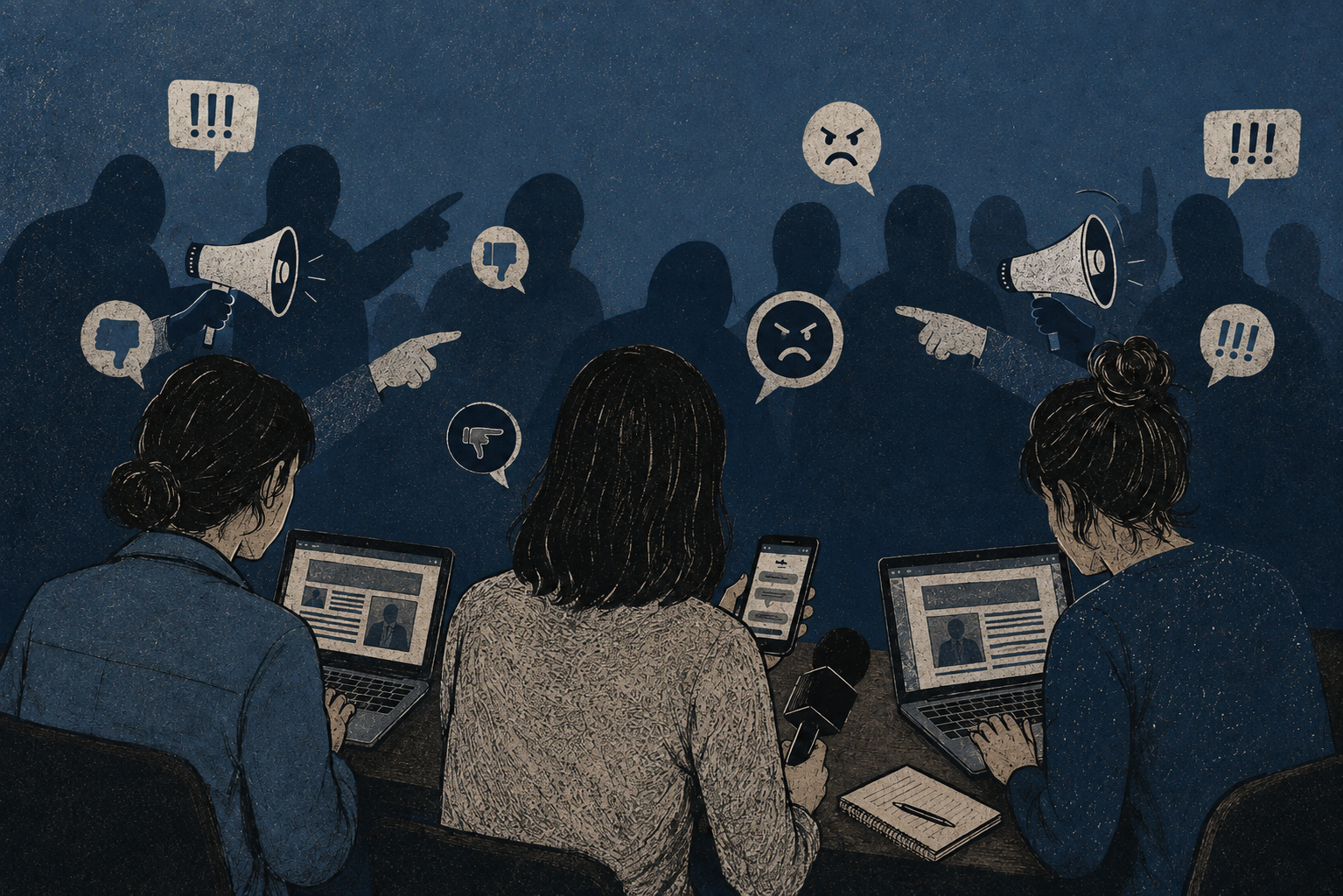
In July 2026, the Independent Journalists’ Association of Serbia (NUNS) recorded a total of 19 cases involving journalists and media workers. Two physical attacks, 14 cases of death threats and threats to the physical safety of journalists, and three cases of other threats were recorded. July was marked by serious threats against both female and male journalists. Particularly concerning is the fact that some journalists continue to be subjected to threats and smear campaigns, while this month female journalists working for local media outlets were particularly targeted.
Alarming rise in serious threats against media workers
Serious threats against journalists continued throughout July, with journalists from N1 television once again among those targeted. First, on 1 July, Branislav Šovljanski, N1 News Director and Editor, received a threat on Facebook in which, alongside his full name, the following was stated: “These degenerates and traitors will have neither peace nor a life in Serbia.”
Several days later, on 8 July, new threats were directed at the N1 newsroom in comments under an article published on the N1 website entitled “Amendments to the Resolution on Serbia – on the sonic weapon, cooperation with the Communist Party of China, suspension of funds.” Alongside numerous insults and references to N1 journalists as “Ustashas*,” a person using the pseudonym “Srbin” (“Serb”) wrote: “N1 monkeys Liars you should all be set on fire one by one so you burn in the middle of the street you Ustasha wh**s bastards (…) your skulls should be burned and you should be roasted on a spit (…) you’ll see Ustashas whether you’ll remain in Serbia and report (…) we should drive you Ustashas out forever death to liars Ustashas fraudsters fascists that’s N1.”
On 17 July, further threats were made against N1 News Director and Editor Branislav Šovljanski. In a comment under an article published on the website entitled “Tabloid spin from the front row: Ordinary protocol turned into a great honour for Serbia and Vučić,” a person using the same pseudonym, “Srbin,” issued serious threats: “N1 director we’ll f**k your children your family everything you have and we’ll f**k you slowly we’ll wait for you we’ll f**k your loved ones remember as long as there are Serbs you will be hunted we’ll f??k your ancestry you should be impaled on a stake on a spit and roasted alive you whore bastard your mother f***ed everyone nobody knows who your father is, bastard.”
A series of threats against journalists Marko Vidojković and Nenad Kulačin was also recorded. First, Marko Vidojković received a threat on Facebook on 1 July from an account named Simic Dobri, which stated: “F**k your Ustasha mother,” followed by another message: “You stinking piece of sh*t come to Serbia f**k your filthy mother you will recognise Kosovo will you sell my home my home I’ll burn you too you Ustasha c**t.” Then, on 3 July, on the social network X, new threats were made against Vidojković, who was relocated from Serbia due to persistent threats. Among other things, the messages stated: “…he’ll come back to Serbia over my d**k. I won’t let him. Now I’m not sorry that the c**t doesn’t dare stay here, let the piece of sh*t remain abroad.” Subsequent comments and messages targeted both journalists, including: “…that gang should be shaken up constantly” and “A man should beat them until they sh*t themselves… and then beat them because they sh*t themselves!” as my late father would say.
Threats against Vidojković and Kulačin were also recorded on 27 July. Under an Instagram post by the Nova.rs portal containing a clip from a programme featuring Naim Leo Beširi, Director of the Institute for European Affairs, a person using the name lesicslobodan posted hateful and chauvinistic messages: “These scum, these two pieces of sh*t should be killed, f**k their mother,” as well as: “And this little Shiptar should pay for his own.” After these threats had been reported and the public informed, the same user issued another threat: “Kill the pieces of sh*t, f**k their satanic mother. Traitors and Ustashas, die you scum.”
In July, a new wave of threats was recorded from the person behind the account Zoran Cvijanović, who had sent numerous threats to journalists, professors and activists by email and through social media messages over the previous several months. This time, the targets included Faculty of Dramatic Arts professor and media professional Ana Martinoli, who received a message at her official email address on 5 July saying: “The Black Hand has marked you, friend.” The next target was Rade Đurić, lawyer and researcher at the Independent Journalists’ Association of Serbia, who received an Instagram message stating: “Read this, the Black Hand has marked you, watch yourself, friend.” Also, on 6 July 2026, a threat was sent from the same account to the Instagram account of BIRN Serbia, targeting Executive Editor and journalist Gordana Andrić and journalist Jelena Veljković: “Notify Gordana Andrić and Jelena Veljković that the Black Hand has marked them, friend.”
The targeting and threats against journalist and President of the Management Board of the Association of Independent Electronic Media (ANEM), Veran Matić, also continued. On 28 July, he received a threat via the social network X from the account @glisha_m, which posted a photograph of Matić together with the message: “Let’s cut off the hydra’s head!” The post appeared under a clip from the programme “Bez cenzure”, in which Matić had appeared as a guest and which was shared on X. Following that threat, new threats were issued from the same account: “You are part of the hydra just like Veran Matić. WE WILL TEAR you apart! You will end up like Afghan NGOs.” According to ANEM, the person in question has been threatening various individuals, including journalists, for some time. Due to the sense of danger caused by the frequency of threats, targeting and attacks online, as well as the physical attacks he has experienced, Matić requested that the Ministry of Internal Affairs conduct a security assessment.
Serious threats and targeting of female journalists from local media
Female journalists working for local media outlets were also targeted by threats. Ahead of the Pride Caravan that was due to take place in Vranje, threats were made against the Slobodna reč portal from Vranje on 8 July via Facebook, in a comment under its report about the event. The comment read: “Listen you who write this and those who want this f*ggotry don’t try these stupid stunts in Vranje you’ll get beaten I promise you that. Nobody is stopping you from going to hotels or cornfields to parade around but here you’ll be in trouble the police must stand with respectable households and families otherwise they’ll get what’s coming to them too.”
The Bečejski mozaik newsroom and journalist Kristina Demeter Filipčev were once again targeted by online threats following the publication of a video from a Serbian Progressive Party gathering held in Bačko Gradište on 19 July. On the Facebook page of Bečejski mozaik, a user named Dušan Vračarić first accused the newsroom of “threatening murder,” and subsequently sent threatening messages: “Watch out so we don’t pay you back for your messing around. Your trousers will fall off by themselves,” and “If you show up at our polling stations, you won’t have a good time.” The editor of Bečejski mozaik felt seriously threatened by these messages and immediately reported the case to the police.
In addition to direct threats, there were also cases of serious targeting that jeopardised the safety of female journalists working for local media outlets. First, on 6 July, during the programme “Paralela” on Informer television, journalists Darija Ranković from Kolubarske and Slavica Vujanac from the Vamedia.info portal were targeted and accused, without evidence, of “bringing down the state,” “racketeering” and “blackmail,” while their photographs were displayed and they were subjected to insults about their physical appearance. Journalists were accused of “taking money from state institutions to bring down the state” because certain local public utility companies advertise on their portals. Among other things, Saša Milovanović, Director of Srpski telegraf, said that local officials “suck up to and pay protection money to these opposition media” so that they would not report about them but instead “attack Vučić.” The host then accused the journalists of going “from company to company” and “literally blackmailing and threatening people,” before calling on the competent authorities to “deal with this issue as soon as possible.”
Only two days later, on 8 July, the tabloid Informer jeopardised the safety of Mahala podcast journalist Selma Kolašinac through targeting. Informer published an article entitled “N1 joins forces with one of the blockade leaders! Here is who is leading the campaign to portray Serbs as a genocidal people,” targeting the journalist and N1 BiH television. The article alleged that “the tycoon-owned N1 television and one of the main stars and leaders of the street blockades joined forces” in an “attack on Serbia” aimed at “proving that Serbs are genocidal,” while labelling the journalist “one of the organisers of the blockades from Novi Pazar” and claiming that she had travelled to Srebrenica “directed by anti-Serbian media such as the tycoon-owned N1.”
Physical attacks and obstruction while reporting in the field
On 1 July, a Rec Media production crew from Užice, while filming a report for TV Nova near a landfill in the village of Druglići near Priboj in western Serbia, was physically prevented from filming a fire and firefighting activities in a public area. Cameraman Miloš Vulović was pushed by workers present at the scene, while the camera was repeatedly blocked in an attempt to prevent filming, and there were also physical attempts to damage property and equipment.
Attacks on journalists following the cancellation of the Pride Caravan in Pirot
While reporting from Pirot on 18 July, after the Pride Caravan in the city had been cancelled, journalists were attacked and obstructed in their work. N1 television reporter Gordana Bjeletić was first hit in the head with a tomato and subsequently threatened, while the N1 crew and other journalists were subjected to insults, intimidation and obstruction of their journalistic work.
In addition, Tampon Zona contributor Sara Stanojković and Mašina portal journalist Aleksandar Đokić were prevented from reporting freely after an individual approached them and said: “Come on, get out of here, don’t provoke. Come on, clear out, quickly.” Unknown individuals then physically approached the journalists and invaded their personal space, forcing them to move away because it was no longer possible to report safely.
Concerning pressure on freedom of expression
A criminal complaint was filed against military analyst Aleksandar Radić on suspicion that he committed the criminal offence of preparing acts against the constitutional order and security of the Republic of Serbia and the criminal offence of disclosure of classified information, in connection with the alleged use of a “sonic weapon” during the protest held in Belgrade on 15 March 2025. The Prosecutor’s Office issued a statement saying that suspicions arose following the search of Radić’s electronic devices and a forensic examination of his mobile phone. The statement also alleged that Radić, using contacts with as yet unidentified persons employed in state institutions, had obtained information classified at various levels of secrecy. The Prosecutor’s Office also requested that Radić be remanded in custody, stating that he was a fugitive and was abroad.On 22 June, Radić’s apartment and office were searched and his computer was seized. He subsequently received a summons to report to the Military Police premises on 23 June for a forensic examination of the computer. Several days later, on 26 June, Radić stated that he had left Serbia after pro-government media published video footage showing that he had been under surveillance, including footage of his minor daughter.
Radić is publicly recognised as an expert commentator on security and defence issues who has expressed his professional opinions on various topics, a right guaranteed to him by the Constitution and laws. Particularly concerning is the fact that the Higher Public Prosecutor’s Office in Belgrade, in its statement, disclosed in detail parts of Aleksandar Radić’s private communications, including correspondence with journalists and explicit references to individual media outlets. Such a practice is unacceptable, as it directly jeopardises and compromises journalistic sources and the trust between journalists and their sources, while also directly exerting pressure on and intimidating the media.
Pressure and targeting of journalists through local media and by local officials
In July, numerous cases of targeting and severe pressure against local journalists and media outlets were also recorded, including by newly established local television stations purchased or founded by companies publishing the Informer and Alo tabloids. Verbal attacks were recorded in Valjevo, Šabac and Čačak.
In the programme “Raport” on Čačak-based television station Lav Plus, which was recently acquired by Best Media Team, a subsidiary of the publishers of the Alo and Informer tabloids, a significant part of the programme was devoted to a smear campaign against local media outlets and non-governmental organisations receiving international funding. Financial reports of certain media outlets were read out on Lav Plus and linked to the so-called “colour revolution” and the organisation of student protests. The television station targeted Stojan Marković, founder of the local media outlet OzonPress, as well as local journalist Nebojša Jovanović, Mileva Malešić, founder of the Women’s Forum of Prijepolje, Verica Marinčić of IN Media, N1 journalist Danica Vučenić, and other media outlets and organisations.
In the programme “Pretres,” broadcast on television V5, which is linked to the Informer and Alo tabloids, the host made a series of false claims and insulting statements about journalist Đorđe Mijailović. Without presenting any evidence, she accused him of spreading a report in the media that a child had died following citizens’ protests in Valjevo on 16 August last year, as well as alleging that, during questioning by the police, he “started sweating and soiled himself a little because he was so frightened.”
On 14 July, Mijailović had been summoned to the police to give a statement as a citizen in connection with the alleged dissemination of disinformation and causing panic during protests in Valjevo in August last year. The content of his statement soon reached the local television station V5, where it was subsequently selectively presented and misused to publicly target him.
On Šabac-based television station “TV Mačva,” owned by an Informer subsidiary, the Podrinske portal and its editor Ivan Kovačević, as well as journalists Isidora Kovačević and Đorđe Mijailović, were seriously targeted on several occasions. False and inaccurate claims were made about their funding, while data and information published by Podrinske concerning natural disasters threatening mountains in western Serbia due to possible mining activities were misrepresented in a misleading and malicious manner.
After Žig Info Editor-in-Chief Željko Matorčević published the article “He cleared the streets of the opposition, now he is cleaning up Grocka,” concerning the career of Bojan Pitulić, Assistant to the President of the Grocka City Municipality, the article was reposted by the Instagram account bojankm2327 with the following comment directed at Matorčević: “Matorčević, you can suck the d**ks of all the Pitulićs. That’s all from me.”
Journalists have been targeted by public officials for many years, but such attacks have recently become significantly more frequent. In July 2026, the Slavko Ćuruvija Foundation recorded at least 106 verbal attacks by state officials, other government representatives and officials of the Serbian Progressive Party (SNS) against journalists and media outlets.
Two unsuccessful attempts to elect the REM Council President
On 10 July, the National Assembly of the Republic of Serbia adopted an Authentic Interpretation of Article 18, paragraph 4 of the Law on Electronic Media. The Authentic Interpretation established that the provision concerning termination of the mandate of a Council member by submitting a written resignation to the National Assembly, in which case the Council member’s mandate terminates on the date the resignation is submitted, “should be understood to mean that only a declaration of intent made after assuming the office of a member of the Council of the Regulatory Authority for Electronic Media may be considered a resignation.”
It further stated that “accordingly, a declaration of intent made after election but before taking office, that is, before actually assuming the position in the Council of the Regulatory Authority for Electronic Media, shall not be considered a resignation within the meaning of Article 18, item 4) of the Law on Electronic Media and shall have no legal effect, i.e. shall not produce the legal consequence of terminating the mandate of a member of the Council of the Regulatory Authority for Electronic Media.”
Following the adoption of this interpretation, four independent members – Dubravka Valić Nedeljković, Iva Prodanov Krajišnik, Mileva Malešić and Rodoljub Šabić – decided to take part in the work of the Council. They issued a public statement in which they noted, among other things, that the Authentic Interpretation has the force of law and that refusing to assume their positions on the REM Council would enable the authorities to portray their actions as contrary to the law, while shifting responsibility for REM’s long-standing dysfunction, the continuation of the institutional blockade and its consequences for the rule of law and Serbia’s integration process onto them, as well as onto the organisations and citizens who had advocated for the lawful functioning of REM. They added that “the authorities bear sole responsibility for the absence of a REM Council and, consequently, for REM’s failure to function.”
Two meetings of the REM Council were held in July. At the first, constitutive session held on 20 July, no President was elected because the two candidates, Mileva Malešić and Miloš Garić, each received four votes. A new session was subsequently scheduled for 30 July. At the second session, two candidates were again nominated – Miloš Garić and, after Mileva Malešić withdrew her candidacy, Dubravka Valić Nedeljković. However, once again, no President was elected. The next session is expected in the second half of August.