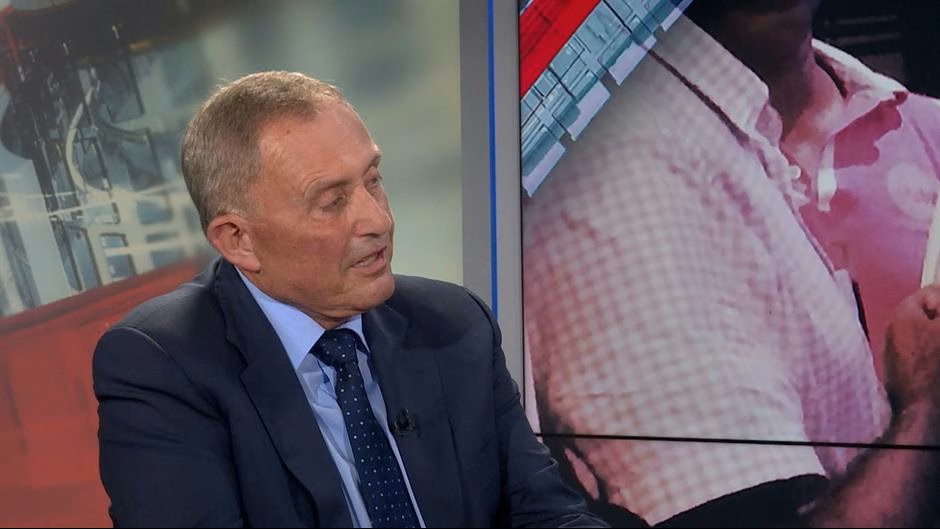
Adria News Network and former CNN journalist Brent Sadler told N1 Ljubljana that CNN founder Ted Turner was a giant in change the whole landscape of global television.
Speaking after reports of Turner’s death at the age of 87, Sadler, an award winning war correspondent, said that he first met the CNN founder after the First Gulf War in 1991 at the network’s home in Atlanta. “I didn’t know it at the time, but I was being headhunted. My work on British TV had spread across the Atlantic and was shown on CNN. They liked what I did, and Ted offered me a job, right in his office there and then, right in front of his desk that said, “Either lead, follow, or get out of the way.” That was Ted Turner’s mantra, which he had on a plaque on his desk,” he said.
Sadler: “So when he asked me if I’d like to join the 24-hour news network, I said no, and I left the office. He didn’t look particularly happy. And I went back to the UK, and my bosses in the UK said, “Brent, you made a terrible mistake. The world is going to change. There’s going to be a new wave, revolutionary wave, changing how 24-hour news would change the global broadcast media news landscape”. So my old bosses persuaded me to go across the Atlantic, and I became the first British journalist to join the CNN family,” he added.
N1: So why was Mr. Turner so important for the news business around the world? You already said he was a pioneer, a great mind. How big is the impact of what he accomplished with CNN, and then not only CNN? He was the founder of the 24-hour news cycle we know today.
Sadler: “His boundaries were limitless. He felt that news had to be told as it happened. He wanted to be in the heart of conflict, famine, natural disasters, and he wanted it to be wall-to-wall, as it’s known in the, in the trade, live breaking news.
So live breaking news became a new phenomenon worldwide. We were able to cover incredible stories, the Gulf War I, uh, the unforgettable night scope shots of the first, uh, uh, wave of attacks on the capital of Iraq, Baghdad. Mm-hmm. I was there alongside CNN. I hadn’t joined at that time, but one can’t forget the first time armchair viewers could watch a conflict, hostilities raging in a capital city in real time, and that broke the mold of everything that had gone before. So we would see anti-aircraft fire, missiles flying in, cruise missiles hitting our hotel, uh, blowing up the reception area. The kind of thing we got used to today because CNN has now been around for four decades.
So what Turner did was create something that nobody had done before. I remember… it was called Chicken Noodle Network. Why was it called Chicken Noodle Network? Because it made a lot of mistakes. It, uh, was seen as not fit for purpose by the mainstream US broadcasters of that time. Ted Turner didn’t listen. Larger-than-life character. He was known as the Mouth of the South because he’s a Southerner from the Southern States of America. He knew no boundaries.
He was a giant of his time. A pioneer, as you say, and we’re still living in the, the aftermath and the development of that cycle of 24-hour news, which now dominates our everyday lives.
N1: You mentioned January 16, 1991, was the day that viewers around the world heard the first bombs of the Gulf War in Baghdad, and CNN broadcast live from the Al-Rashid Hotel. Is that the time when mainstream US media, uh, realized that CNN, you said Chicken Noodle Network, is the one to watch out for? Absolutely.
Sadler: “The fact that you were sitting in the United States of America or the UK or any affiliate of CNN, it was still building its affiliate network, could actually see what was happening in real time. If I can just take you back in a time capsule to those days, it was extraordinary. No one had seen anything like this. And then of course, it wasn’t just in Baghdad and that conflict. It was in Chechnya, uh, where I covered the Russian invasion, uh, of the, the rebel, uh, army there, uh, against, uh, Vladimir Putin’s forces. And again, we used to take satellites and live capability across the world into Africa, famines in Somalia, US interventions in Somalia, live when US troops were coming ashore. Uh, we were right in the thick of the action and have been ever since. So CNN still stands for that unique brand of breaking news.
N1: I read the tribute, uh, Jane Fonda wrote to her ex-husband, Mr. Turner. Sshe said, “Ted was challenging, and with him, it was almost always worth it.” What is, in your opinion, the legacy of Ted Turner?
Sadler: “I think he gave journalists the freedom and the ability, uh, the generation of my journalists at that time I’m talking about, the ability to think beyond our wildest imagination of, A, places we could get to, and B, the impact we would have on the global media landscape. And that means something that was called, once upon a time, the CNN effect. CNN became so influential that others would follow. So mantras, Turner’s mantra, lead follower, get out the way. Well, that’s what used to happen. Where CNN went, others went. CNN, uh, during the, uh, the breakup of Yugoslavia was very, as you know- Mm … very active in Sarajevo, was very active in Serbia. In 1999, the bombing of Serbia, I was there reporting for CNN. Mm. At that time, I was there when the studios of RTS were bombed, and, uh, I think it was 19 civilians lost their lives. In my view, that should never have happened. It was a civilian target. It should never have happened. And, uh, there was a lot of fallout, and they still persist today. That’s an open wound still in Serbia. So I think if I look back at legacy of Ted Turner, I think one has to remember that he was such a larger than life character, that he knew no bounds himself. You know, CNN’s slogan today is, “Go beyond borders.” Mm-hmm. Well, that’s what Turner did. He went beyond all borders, created CNN, and it goes on today,” Sadler said in the interview.
Source: N1