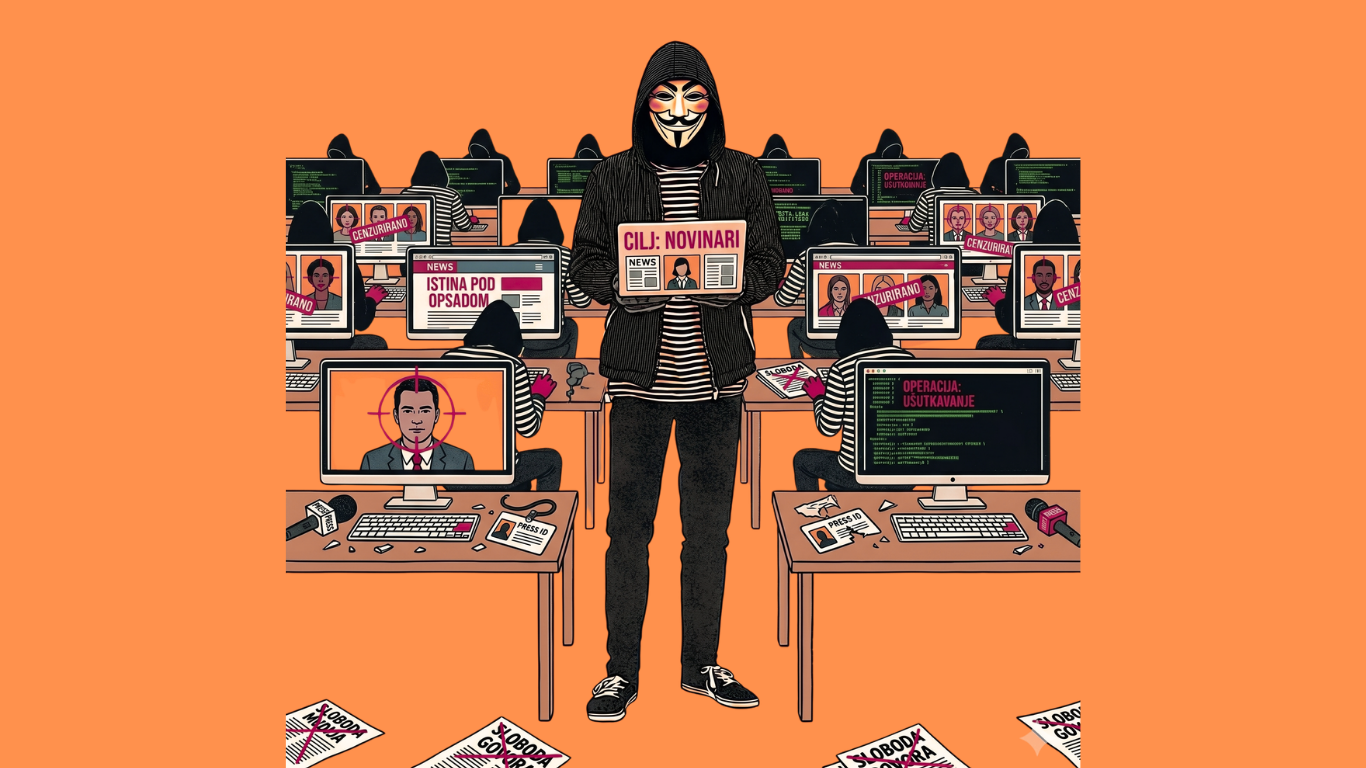
In April 2026, the Independent Journalists’ Association of Serbia (NUNS) recorded a total of 18 incidents involving journalists and media workers. Two physical attacks and six cases involving death threats and threats to the physical safety of journalists were documented, along with six other threats against journalists. In addition, two attacks against media outlets and media organizations and two other threats against media were recorded. Although a smaller number of threats and attacks against journalists was registered, this did not reduce the level of danger they face. During April, violent rhetoric directed at the media continued, while serious threats were made against journalists and media outlets. A severe and highly violent threat against a female journalist containing elements of gender-based violence was recorded, as well as serious targeting of journalists and media by high-ranking public officials in the National Assembly of the Republic of Serbia.
Threats Against Journalists Containing Gender-Based Elements
Journalists were exposed to serious threats, particularly through social media, while female journalists were targeted with threats containing gender-based elements. Journalist Miljko Stojanović received a threat on April 18 via Facebook, stating: “I’ll fu*k your mother, who are you going to arrest, you’ll get a visit soon to repeat that, you’ve been identified.”
Threats against journalists Marko Vidojković and Nenad Kulačin continued. On April 19, under a Facebook post promoting the show “DLZ sa Vidojkovićem i Kulačinom,” threats of violence and “encounters” were posted alongside brutal insults, including: “I fu*k your mother too, I hope I’ll find both of you again, fu*k both of you, I see what you’re doing to Serbia. But Vidojković, I hope I run into you. And that horse with you too. And you Vidojković, better hope you don’t run into me. I’d love to meet you. SCUMBAG,” as well as: “I hung up my gloves, I hope I run into both of you, that is find you. Fuk both of you again.” After NUNS publicly reacted and condemned the threats, new threats were posted on Instagram in comments under the statement, where individuals threatening Kulačin and Vidojković wrote: “Their Ustasha mothers should be fu*ked hahaha.”
The newsroom of Revolt was also targeted by serious threats on social media. On April 23, death threats were directed at them, some of which also included other media outlets: “Death to traitors… all of you should be killed,” as well as the direct message “Death to N1,” alongside other threats of brutal violence.
Maria Popović, editor of the portal Pravo u centar, was subjected to threats, insults, and misogynistic harassment after reporting from a rally of the Serbian Progressive Party in Lazarevac. During the event, one person filmed the journalist with a mobile phone while falsely presenting herself as an employee of a local television station, while a man standing next to her made inappropriate remarks mentioning Croatia, HRT, and similar references. After the video was published on the outlet’s Instagram page, a wave of disturbing, insulting, and misogynistic comments targeting the journalist, her sons, and her family followed. One direct threat stated: “you wh*re from Pravo u centar should be fu*ked until you shit yourself, little c*nt wh*re.”
Attacks on Journalists While Reporting From Public Events
Stefan Jeremić, editor of Palanka Info, was physically attacked in the street by a former member of the Ministry of Interior after reporting from an event marking the anniversary of the Olga Milošević Primary School in Smederevska Palanka. According to Jeremić, the same person had attacked him once before. This time, while the journalist was walking through the town center, the attacker came out of a café, approached him, first threatened, insulted, and cursed him over comments on Facebook, and then kicked him in the back. The incident occurred in front of numerous citizens and was accompanied by laughter and insults from individuals sitting with the attacker in the café.
Dangerous Targeting by High-Ranking State Officials
Several cases of serious targeting of journalists and media outlets in the National Assembly were recorded in April. Milenko Jovanov, head of the parliamentary group of the Serbian Progressive Party, referred to N1 television during a parliamentary debate as “Šolak’s propaganda-terrorist garbage,” accusing the outlet of manipulating information and inventing news. MP Marijan Rističević continued the attacks against N1 and Nova S, claiming that they were “created by psychopaths.”
Particularly concerning were the statements made by Minister of Culture Nikola Selaković regarding journalist and university professor Dinko Gruhonjić. Selaković stated that Gruhonjić was “made for something bad to happen to him,” accompanied by a series of brutal and unfounded accusations.
Attacks on the Social Media Accounts of Media Outlets
In April, new attacks against media outlets’ and journalists’ social media accounts were recorded. The accounts of the portal Razglas were shut down, while the accounts of Novi Pazar-based Sto plus Radio were blocked. In addition, the account of journalist Nikola Kočović from Novi Pazar was suspended under the explanation that he was allegedly “under 13 years old.”
Obstruction and Intimidation of a Local Media Outlet by Members and Supporters of the Ruling Party
In Kulpin, on April 29, shortly before a panel discussion on social divisions and the role of the media organized by the Storyteller newsroom, a group of members and supporters of the Serbian Progressive Party gathered at the venue. Since the venue was not located in the town center, such activity was clearly organized intentionally and represented an unacceptable form of pressure and intimidation against journalists and participants of the public event, as well as direct obstruction of their work.
SLAPP Lawsuits as a Tool for Silencing
In April, two SLAPP lawsuits were filed against two journalists and the editor-in-chief of the weekly Radar.
Journalists Vuk Cvijić and Milan Ćulibrk, authors of the article “Tatjana Vukić Threatened Me, and Six Days Later I Was Fired,” together with editor Vesna Mališić, were sued by Željko Radovanović, acting director of the Administration for the Prevention of Money Laundering. The lawsuit concerns an interview with Danijela Maletić, in which the former assistant director spoke about threats and her dismissal.
In another SLAPP lawsuit, Radar journalists Vuk Cvijić and Milan Ćulibrk, authors of the article “All the Heavyweights in One Place,” together with editor Vesna Mališić, were sued by businessman and former director of the Serbian Electricity Transmission System Nikola Petrović over allegations that they unlawfully obtained and published information claiming that Petrović paid 200,000 euros into the Vista Rica fund.
Miljko Stojanović, journalist of the local portal Glas Zaječara, has once again become the target of misdemeanor charges. On April 28, he received a summons from the Misdemeanor Court for questioning as a defendant after the Zaječar Police Department submitted requests to initiate misdemeanor proceedings for alleged violations of the Law on Public Assembly. The charges claim that Stojanović organized unregistered gatherings on July 1 and July 9, 2025, in front of the Zaječar Police Department building. However, the journalist attended these gatherings solely in his capacity as a journalist reporting on events of public interest.
Pro-Government Media Continue Targeting Individuals Critical of the Authorities
In April, the portal Novosti published an article about actress Jelena Stupljanin portraying her through an insulting, inflammatory, and dehumanizing narrative, including severe disqualifications, political labeling, and historical comparisons intended to depict her as an enemy and a legitimate target of public persecution. The article contained hate speech and rhetoric that further fueled an atmosphere of public lynching.
These are recurring patterns used by pro-government media to target individuals who think and speak critically, branding them as traitors and enemies of the state while completely disregarding professional standards and legal regulations, thereby endangering their safety. Particularly concerning is the complete lack of reaction from the competent ministry.
Escalation of Pressure on Independent Media
Pressure on independent media continued throughout April and escalated with the decision to remove N1 television director Igor Božić, made by the new director Brent Sadler. This move by the new management raised serious concerns that the changes were aimed at taking control of the outlet and undermining its independence.
Particularly alarming was the manner in which Božić was informed of his dismissal, being told that his current status within the company was “employed, but unassigned,” and being advised to work from home until further notice. Igor Božić subsequently terminated his contract by mutual agreement. Former N1 journalist Branislav Šovljanski took over the management of the N1 newsroom.
Journalists’ and media associations stated that this represented a serious signal that the authorities, in coordination with new ownership structures, had entered the final phase of establishing control over one of the last remaining pillars of independent reporting in Serbia, with broader consequences for independent journalism and media freedom.
Concerning Conduct of Authorities in Cases of Attacks on Journalists
Although more than a month has passed since attacks on journalists during local elections in 10 municipalities and cities in Serbia, the identities of the perpetrators have still not been established in cases involving serious attacks against Lazar Dinić, Ivan Bjelić, Zorica Popović in Bor, nor in attacks against Darko Galigorijević, Ivana Marsenić, and Milivoje P.
In the case of the physical attack on Večernje novosti journalist Jelena Stojković, the Basic Public Prosecutor’s Office in Vranje dismissed criminal charges for violent behavior filed against Zoran Dimitrijević, director of the public utility company “Komrad” from Vranje. The incident occurred in July 2025 while the journalist was reporting for Večernje novosti on a fire at the “Meteris” landfill in Vranje.
The Appellate Court confirmed that Saša Mirović was guilty of endangering the safety of Kurir journalist Jelena S. Spasić. The case concerns Instagram threats made in 2024, where he wrote under a post about her, among other things, that “such freaks should be burned at the stake in front of their entire family.” Although he was initially sentenced to seven months in prison, the sentence was changed to a suspended sentence with a three-year probation period. The suspect had previously been under house arrest with electronic monitoring, despite having been convicted of murder as a juvenile. At one point, he removed the ankle monitor and escaped, causing additional distress to the journalist.
Additionally, even after 19 years, there has been no progress in the investigation into the attempted murder of Dejan Anastasijević. On the night between April 13 and 14, 2007, attackers placed two bombs under the window of the room where the journalist was sleeping next to his wife.
Legislative Framework – Concerns Regarding the Conduct of Public Consultations on Laws
At the end of March and the beginning of April, the competent ministries opened public consultations on draft amendments to the Family Law and on three new laws: the Law on Weapons and Ammunition, the Law on Internal Affairs, and the Law on Personal Data Processing in the Field of Internal Affairs.
The National Convention on the European Union (NCEU) for Chapters 23 and 24 expressed concern regarding the manner in which the public consultations were conducted — formally meeting only the minimum procedural requirements, without a genuine intention to allow the public to influence the content of the laws. Citizens and the professional public were not adequately informed, while consultations began without sufficient time for preparation and were organized during holidays.
Several complex and extensive laws were considered simultaneously, making it difficult to adequately monitor and provide comments, while such practice is becoming routine, thereby undermining a transparent and inclusive legislative process.
SafeJournalists Network conference “From Evidence to Change: Safety and Position of Journalists and Women Journalists in the Western Balkans”
At the SafeJournalists Network conference “From Evidence to Changes: Safety and the Position of Journalists and Women Journalists in the Western Balkans,” held on April 29 in Belgrade, the latest findings on the position of women journalists in the region were presented, pointing to an increase in attacks, a pronounced gender dimension of threats and harassment, as well as weaknesses in institutional protection. Panel participants warned that women journalists face not only threats related to their professional work, but also attacks targeting their gender, appearance, private and family lives, while a large number of incidents remain unreported due to distrust in institutions and fear of consequences.
The conference also presented the results of the 2025 “Journalists’ Safety Index” research.
In the opening remarks, lead researcher Snežana Trpevska summarized the research findings for all countries within the SafeJournalists network, after which researchers discussed country-specific issues.
Among all the countries, Serbia recorded the largest decline as well as the lowest overall score. Smaller declines compared to 2024 were recorded in Croatia, Montenegro, and North Macedonia, while the index remained unchanged in Bosnia and Herzegovina. According to the research, the situation in Albania and Kosovo slightly improved compared to 2024.
The conference also presented two studies on the position of women in the media: a study on the position of women journalists and media workers in Serbia and the region, presented by Smiljana Milinkov, professor at the Faculty of Philosophy in Novi Sad, and the results of the Global Media Monitoring Project on the representation of women and men in news media in Serbia, presented by Snježana Milivojević, professor emerita of the Faculty of Political Sciences. Both studies show that greater visibility of women in the media has not led to genuine equality.
You can read the comprehensive conference report here.