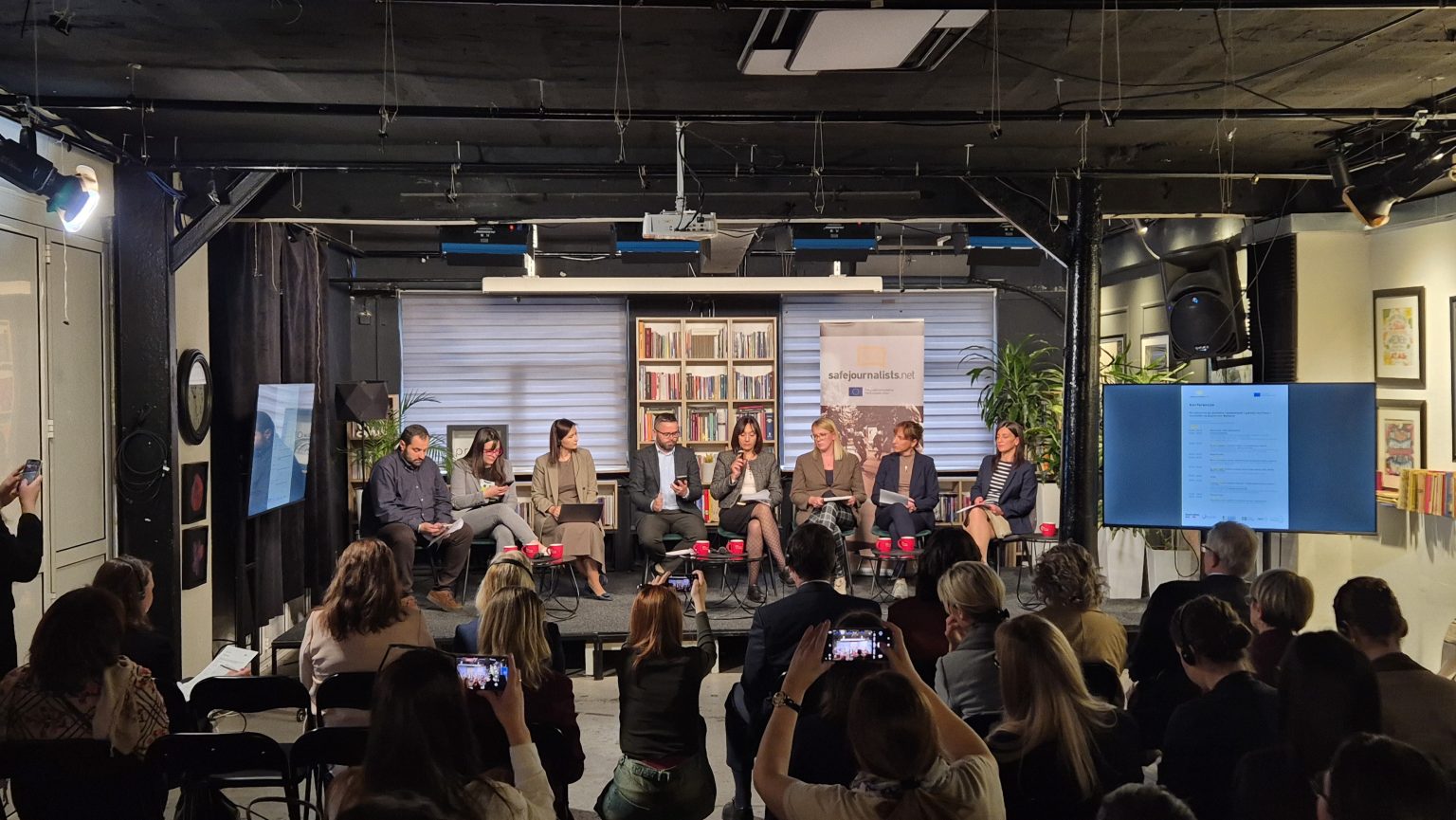
The SafeJournalists Network held the conference “From Evidence to Change: Safety and Position of Journalists and Women Journalists in the Western Balkans,” on April 29 in Belgrade, where the latest findings on the position of women journalists in the region were presented. The findings point to an increase in attacks, a pronounced gender dimension of threats and harassment, and weaknesses in institutional protection. Panel participants warned that women journalists face not only threats related to their professional work, but also attacks targeting their gender, appearance, private and family life, while a large number of incidents remain unreported due to distrust in institutions and fear of consequences.
The conference was opened by Tamara Filipović Stevanović, Secretary General of the Independent Journalists’ Association of Serbia (NUNS), Peter Truswell, Australian Ambassador to Serbia, and Plamena Halacheva, Deputy Ambassador of the Delegation of the European Union to Serbia.
Opening the conference, NUNS Secretary General Tamara Filipović Stevanović said that the safety of journalists and women journalists is not only a professional issue, but also a democratic one. She pointed out that the conference brought together journalists, researchers, experts, trade unions and partners to discuss the safety of women journalists, workplace harassment, the position of women in the media, regional indicators of media freedoms, and the development of gender-sensitive protocols in newsrooms. Recalling that the SafeJournalists Network is marking its 10th anniversary, she emphasized that over the past decade the Network has built support mechanisms, documented attacks and advocated for institutional changes, while warning that behind every number there is the concrete experience of a journalist, a woman journalist or a newsroom.
Australian Ambassador in Serbia Peter Truswell said that women journalists in the Western Balkans face disproportionate risks, including online abuse, physical intimidation, smear campaigns, gender-based violence and SLAPP lawsuits. He stressed that institutional responses to these threats are often insufficient, which makes the safety of women journalists an important issue not only for the media community, but also for democracy. “Real change requires collective responsibility. It requires institutions to respond and society as a whole to recognize the value of journalism,” Truswell said.
Plamena Halacheva, Deputy Ambassador of the Delegation of the European Union to Serbia, warned that journalists around the world are facing an increasingly broad spectrum of threats, from physical attacks, harassment and intimidation to surveillance, SLAPP lawsuits and the misuse of new technologies. She particularly highlighted the position of women journalists, who are exposed to sexist, misogynistic and often sexualized online violence, while digital threats are increasingly spilling over into physical danger. “Defending media freedom is not only about protecting journalists, but about protecting democracy itself,” Halacheva said.
The safety of women journalists is an issue of the overall media environment
Tamara Filipović Stevanović, Secretary General of NUNS, speaking on the first panel, recalled that the SafeJournalists Network continued to monitor the safety of women journalists after the adoption of the Declaration on the Safety of Women Journalists, launched in September last year. As she said, the Network had then committed itself to “tracking and monitoring the situation when it comes to the safety of women journalists, responding to such threats to their safety, and monitoring working conditions in general.”
Filipović Stevanović warned that the same pattern is repeated in most countries: the legislative framework exists, but institutional practice is lacking, while newsrooms are often not safe places for women journalists. “Women do not report incidents because of distrust in institutions, fear of further victimization and the impression that the consequences following a report will be either minor or non-existent,” she said, assessing that such a situation further discourages women journalists from seeking protection.
Almost half of the cases of attacks on women journalists in BiH contain gender-based elements
Mirna Stanković-Luković, a researcher from Bosnia and Herzegovina (BH Journalists), warned that harassment and attacks on women journalists, especially online, are the dominant pattern of pressure, and that such attacks are often strongly gendered. As she noted, “the most common form of pressure is harassment, primarily online,” while attacks include “sexualized insults, attacks on appearance and private life, and attempts to discredit professional work.” According to the data presented, almost half of the recorded cases involving women journalists contain explicit gender-based elements, showing that women journalists are targeted “not only because of what they report on, but because of who they are.”
As an important step forward, she singled out legal changes in the Federation of BiH, where in 2025 online harassment and psychological violence were recognized as criminal offences, with explicit recognition of digital platforms as a means of committing criminal offences. This, she stressed, is particularly important because “around 70 percent of attacks take place online.”
However, she assessed that individual legal advances have not yet led to systemic protection. Most media organizations, according to her, “do not have internal safety protocols” or structured support, leaving women journalists often on their own and reliant on civil society and informal support networks.
In Serbia, women journalists were targets of physical attacks, including attacks by police
Marija Babić, lawyer and researcher at the Independent Journalists’ Association of Serbia, said that women journalists in Serbia were targeted by physical attacks in a large number of cases last year. Particularly worrying, she emphasized, is the fact that in some cases the attackers were police officers. “Last year, NUNS recorded 77 cases involving attacks on journalists and women journalists by police, failure to react in cases where journalists were attacked, or unfounded detentions. Of that number, 26 were committed against women journalists,” Babić said.
She also pointed to the problem of underreporting of threats, especially among women journalists working in local communities. As she noted, in addition to distrust in institutions, local women journalists often fear that reporting a case will expose them to additional consequences in the communities where they live and work. She particularly highlighted the fact that a larger number of online attacks are directed at women than at men.
Babić also referred to a decline in institutional action when it comes to attacks on women journalists. “Last year, there was a conviction in only one case involving attacks on women journalists,” Babić said, adding that impunity remains one of the key problems.
In Montenegro, more than half of the recorded attacks involved women journalists
Marijana Camović Veličković, a researcher at the Trade Union of Media of Montenegro, said that during 2025 women journalists received threatening and harassing messages and public comments on their private social media profiles and by email, while four cases contained gender-based elements. Camović Veličković particularly pointed to long-lasting cases of police protection. “In Montenegro, we have two cases in which women journalists have had police protection for years, while the cause on the basis of which they received that protection has not been resolved,” she said. Until March 2025, she added, a third woman journalist also had police protection, but it was discontinued not because the reasons for protection had ceased, but because the police did not have enough officers available for that purpose.
Speaking about the state’s response, Camović Veličković said that the police and prosecution had initiated proceedings against attackers and that four cases had so far received a judicial outcome through first-instance judgments before the misdemeanor court. The highest sentence imposed was nine months in prison for endangering safety, in a case in which a woman journalist was told: “Be careful that you don’t get a bullet.” However, she warned that problems remain unresolved. “There has been progress in that cases are being resolved more quickly, but the problem is that there are still a large number of cases, while nothing is happening in unresolved cases,” Camović Veličković said.
Cases of threats against journalists in Kosovo are beginning to be treated as a priority
Xhemajl Rexha said that the Association of Journalists of Kosovo seeks to provide protection to all journalists, with particular attention to the safety of women journalists, who are often exposed to additional forms of pressure. As he noted, a network of women journalists was established within the association two years ago, so that women colleagues could have an additional space for mutual support, discussion and response to the problems they face. Rexha stressed that the protection of women journalists is not only an issue concerning women in the profession, but “a joint fight for basic human rights and the protection of media freedoms,” in which male allies also play an important role.
He also pointed to the position of journalists from different ethnic communities, especially Serbian colleagues from northern Kosovo, who, he said, were also exposed to threats during 2025 because of their reporting. As a positive development, he cited a new strategy under which cases involving journalists are beginning to be treated as a priority. “We are beginning to see positive signs in the resolution of these cases,” Rexha said, singling out the example of a proceeding in which a man who threatened a group of journalists in a courtroom, including one woman journalist, was convicted within 45 days.
In Albania, pressures on women journalists are systemic, not only physical
Blerjana Bino, a researcher from Albania, also assessed that attacks on women journalists in that country are not directed only at their professional work, but often extend to their private and family life, as well as to their role in society and public debate. As she stated, the risk for women journalists in Albania is most often not direct physical violence, but is “systemic, structural and deeply embedded in the ecosystem of how the media function.” According to her, online harassment, misogynistic attacks, coordinated smear campaigns, sexualized language and threats involving family members aim to intimidate women journalists, delegitimize their work and push them out of the public space and journalism.
Bino stated that during 2025, 13 cases directly targeting women were recorded, with a total of 15 victims, but warned that research, focus groups and interviews show that the real number of cases is much higher, because many attacks are normalized and not reported. She particularly pointed out that at the beginning of 2026, a shift toward more structured patterns of pressure in the digital, political and professional environment had been observed. These patterns, she said, operate together with political pressure, SLAPP lawsuits, smear tactics and weak institutional responses. “Online and traditional attacks are more visible, but they operate together with political pressure, SLAPP lawsuits, smear tactics and weak institutional responses,” Bino emphasized.
Women journalists are attacked both as journalists and as women
Monika Kutri of the Croatian Journalists’ Association assessed that attacks on women journalists in Croatia almost always also have a gender dimension. “Journalists are always attacked as journalists, while women journalists are always attacked as women,” Kutri said. As she explained, women journalists are not attacked only because of the work they do; such attacks almost always include comments about their appearance, age, children or private life.
She said that in Croatia last year, including threats directed at newsrooms, a total of 30 threats and attacks were recorded, but warned that this number does not reflect the real scale of the problem. “I think that is not even a third of what is really happening, because people do not report,” Kutri said, adding that many journalists perceive attacks as part of the job and report them only when threats become seriously life-threatening. She particularly pointed out that last year the Croatian Journalists’ Association began paying more attention to violence and pressure within newsrooms. “We realized that women journalists are actually very often victims within newsrooms as well,” she said.
Speaking about the prosecution of cases, Kutri said that the police usually do their part of the job, but that problems arise at the level of the prosecution and the courts. According to her, the prosecution often assesses that there are no elements of a criminal offence, while court proceedings drag on.
In North Macedonia, laws exist, but swift reaction and institutional coordination are lacking
Milan Spirovski of the Association of Journalists of Macedonia from North Macedonia warned that one of the key problems is the normalization of attacks and threats directed at women journalists. He also noted that threats on social networks are often not reported because women journalists believe that “the threat will pass after three days.” According to the findings for 2025, gender-based online harassment, digital violence and coordinated attacks with gender-based rhetoric represent the most serious threats to women journalists in North Macedonia.
He emphasized that these attacks are not isolated incidents, but “a structural and persistent pattern that directly affects women journalists’ ability to work freely and safely.”
Spirovski stressed that the problem is not the complete absence of laws, but their weak implementation and insufficient institutional coordination. He pointed to slow, fragmented and reactive responses by institutions, as well as a low level of trust among women journalists in the system.
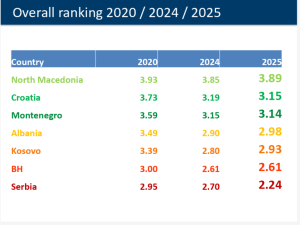
Journalists’ Safety Index: Serbia records the largest decline in the region
The results of the research “Journalists’ Safety Index” for 2025 were also presented at the conference.
First, lead researcher Snežana Trpevska summarized the research results for all countries of the SafeJournalists Network, after which researchers spoke about country-specific features.
Of all the countries, Serbia recorded the largest decline, as well as the lowest score. Compared to 2024, Croatia, Montenegro and North Macedonia recorded smaller declines, while the index remained the same in Bosnia and Herzegovina. According to this research, the situation in Albania and Kosovo is slightly better than in 2024.
Pressures in Albania are systemic, but often invisible in statistics
Blerjana Bino explained that Albania appears better than other countries in the region in some indicators because physical violence and unlawful detentions of journalists are not a systemic problem there. However, she warned that this does not mean that journalists and media workers operate in a safer or more enabling environment. “The nature of the pressure is different – it is more implicit, indirect, but more systemic and largely normalized over time as something that comes with the profession,” Bino said.
According to her, journalists in Albania face long-term pressure through political interference, economic dependence, editorial control and increasingly technology-facilitated violence.
Speaking about data collection, Bino emphasized that institutions still do not have a standardized record-keeping system, which leads to discrepancies between data from the police, the prosecution and civil society.
Croatia: Police record cases, the prosecution remains the weak link
Monika Kutri said that the police in Croatia record all cases reported to them, but that their conduct is not uniform across the country. She recalled that the protocols signed by the Croatian Journalists’ Association and the Trade Union of Croatian Journalists with the police partly stemmed from the work of the SafeJournalists Network and earlier research that documented key problems. “We had documented data showing what our problem was, and that was one of the major advantages,” Kutri said, adding that the situation is good at the national level, but that there are still many problems at the local level.
She also pointed out that the Croatian Journalists’ Association receives only statistical data from institutions, without explanations of which specific cases they refer to, making it difficult to compare those data with their own database. She singled out the work of the prosecution as the biggest problem because, as she said, the efficiency of the system declines when a case reaches that stage, especially in cases of threats. “There is a high threshold for the criminal offence of threat, and it is difficult to prove that a journalist was genuinely endangered in such a case,” Kutri said, adding that the prosecution does not even respond to research inquiries, but states that it does not have a special department dealing with journalists.
Montenegro: A new protection mechanism has begun to function, but institutionalization is needed
Marijana Camović Veličković said that toward the end of last year the Government of Montenegro adopted a decision to establish a working group for the safety of journalists, consisting of representatives of the police, the Supreme State Prosecutor’s Office, the Trade Union of Media, the Government’s General Secretariat, as well as a lawyer and a psychologist. The mechanism is designed so that, after an attack, the chair of the working group is contacted, who then informs the police and the prosecution, while journalists are immediately provided with free legal and psychological assistance. “Since the establishment of this mechanism, there have been nine calls, so it has begun to function,” Camović Veličković said.
She emphasized that the goal for this year is for the working group to find a way to institutionalize the mechanism, that is, to make it a permanent body and a budgetary unit in Montenegro’s budget, rather than something dependent on the will of the Government. According to her, only minimal funds are currently involved, and the mechanism mostly relies on the capacities of the Trade Union of Media. “We have also established a free SOS line for victims of attacks, and we would like that system to be institutionalized,” Camović Veličković said.
Kosovo: Talks with institutions have led to concrete progress
Xhemajl Rexha said that in Kosovo, discussions with the police, prosecution and courts on the protection of journalists had in previous years mostly been conducted informally, but that these contacts had over time led to concrete progress – the appointment of persons responsible for cases of attacks on journalists within the police and prosecution. As he noted, the Association of Journalists of Kosovo now has a contact person in the prosecution office in Pristina whom it can address directly, although the mechanism remains largely informal. “We want to do things quickly, to be able to call them, and they are very responsive,” Rexha said, adding that it is important that representatives of institutions have begun to treat cases involving journalists more seriously.
As a major success, he singled out the strategy adopted in January, under which the Kosovo Prosecutorial Council for the first time provided in a written document for priority handling of cases involving journalists.
North Macedonia: Contact points have accelerated the response, but old cases remain unpunished
Milan Spirovski said that the association puts daily pressure on the prosecution and the Ministry of Interior to improve communication and institutional reaction in specific cases of attacks on journalists. As he noted, North Macedonia has a system of contact points in the prosecution and the Ministry of Interior with whom they are in regular communication. “The pressure from our association contributed to these cases being resolved in record time,” Spirovski said, referring to two serious physical attacks from last year in which institutions acted ex officio.
However, Spirovski warned that the main problem is impunity in older cases. According to him, since 2014 there have been 35 cases, of which only around 15 percent have had a judicial outcome. “That is very little,” he assessed. He added that, at the initiative of the association, the Ministry of Interior announced in January 2026 the establishment of a National Committee for the Safety of Journalists and Media Workers, while a working group on the anti-SLAPP directive was formed with the Government, given the trend of an increase in such lawsuits.
BiH: First steps toward prosecuting online violence
Maja Radević from Bosnia and Herzegovina (BH Journalists) said that amendments to the Criminal Code last year for the first time enabled the criminal prosecution of violence committed through digital technologies, that is, online violence, through provisions relating to psychological violence. As she explained, any abuse that violates another person’s psychological integrity is punishable, with penalties ranging from six months to five years in prison. “In Republika Srpska, there is still no single law that would allow online violence to be prosecuted,” Radević said, adding that such cases are prosecuted on the basis of other legal provisions.
Speaking about the first case resolved on the basis of the new legal provision, Radević emphasized that the perpetrator was arrested not because of explicit threats against women journalists, but because of months-long public degradation, brutal insults and swear words on social networks, which his followers further shared, creating a viral effect and additional insulting comments. She warned that in part of the public and in some media the case was wrongly presented as a restriction of freedom of speech or the introduction of a verbal offence. “This entire case says a lot about how unprepared we are as a society to deal with online violence, or how unaware we are of the consequences that such violence can cause,” Radević said, adding that women journalists do not report almost half of such cases because they perceive them as an expected consequence of their work.
Đurić: Mechanisms are no guarantee without independent institutions
Rade Đurić from NUNS assessed that in Serbia the system for protecting journalists has never truly functioned in practice, even though it looked good on paper. As he said, the problem is not only the existence of regulations, but their implementation, the interpretation of threats and attacks, and the lack of sensitivity among police and prosecutors. “The situation is very well regulated on paper, and then everything falls apart and you realize that there is such a legal vacuum in the interpretation of what constitutes a threat and what constitutes an attack,” Đurić said, warning that hundreds of criminal complaints have been dismissed in previous years.
He emphasized that the existence of mechanisms is not in itself a guarantee of protection, especially under conditions of political pressure, selective application of regulations and increasingly frequent cases of journalists being detained. According to him, the number of recorded cases is not final because many incidents are not reported or NUNS had no insight into them, while the real number could be significantly higher. “The existence of any mechanism is absolutely no guarantee,” Đurić said, stressing the need for a complete separation of influence between branches of power, serious training for prosecutors and police, and an understanding of the role of journalists and the consequences that threats and attacks leave behind.
More women in the media, but not more equality
Two studies on the position of women in the media were presented at the SafeJournalists conference: a study on the position of women journalists and women media workers in Serbia and the region, presented by Professor Smiljana Milinkov of the Faculty of Philosophy in Novi Sad, and the results of the Global Media Monitoring Project on the representation of women and men in the news in Serbia, presented by retired Professor Snježana Milivojević of the Faculty of Political Sciences. Both studies show that a greater presence of women in the media has not led to real equality.
The research presented by Professor Smiljana Milinkov of the Faculty of Philosophy in Novi Sad shows that a greater representation of women in the media has not led to genuine equality in newsrooms. Women are more present in the profession, but they still do not have equal influence over editorial decisions, advancement and working conditions. The findings indicate that violence, discrimination and job insecurity are not isolated incidents, but part of a broader system in which sexism and harassment are often normalized through “jokes,” comments about appearance, exclusion of women from important topics, and discouragement of those who try to report violence. Women at the beginning of their careers, freelancers and women media workers with insecure contracts are particularly vulnerable.
When it comes to Serbia, the research shows that although women make up a significant part of newsroom staff, their position, salaries and influence on editorial policy remain less favorable than those of men. Women journalists are exposed to threats, physical attacks, online violence, sexist comments and sexual harassment, with some of the harassment taking place within newsrooms themselves, by colleagues or superiors. Attacks and harassment are most often not reported due to distrust in institutions and internal procedures, fear of consequences for employment, but also because such experiences have for too long been treated as something usual in the profession. The research therefore points to the need for additional education, support and empowerment of women media workers, as well as the creation of newsroom environments in which violence and discrimination are discussed openly, rather than through a culture of silence.
The research presented by retired Professor Snježana Milivojević of the Faculty of Political Sciences, within the Global Media Monitoring Project, shows that the media world has changed significantly, but that the position of women in the news is changing very slowly. Although women make up half of the population, they still occupy a considerably smaller share of visibility in the media space, especially in the roles of experts and actors in political, economic and international topics. The findings indicate that women are more often present through personal experience, lay knowledge or topics associated with the private sphere, while areas of power and decision-making remain predominantly male. A particular problem is that news stories that challenge gender stereotypes remain rare, while the digital environment is becoming a space of accelerated growth of misogyny and gender-based violence that spills over into the physical world.
When it comes to the profession itself, the research shows that a larger number of women journalists does not automatically mean equality in the media system. Women are highly present in reporting and entry-level positions, but their influence decreases at higher levels of decision-making, indicating the existence of a “glass ceiling” and horizontal segregation in newsrooms. Professor Milivojević identified the need for a “reset” and more radical changes across the entire media system as a key recommendation – from regulatory bodies, management boards and public service broadcasters to education, content production and the protection of women journalists. The recommendations include measures for the safety and well-being of women journalists, support for content that affirms gender equality, and a stronger response to online misogyny, sexism and gender-based violence.

Supported by the Australian Embassy in Serbia through Direct Aid Program.
This content was produced with the support of the Australian Embassy in Serbia through Direct Aid Program. The views and opinions expressed herein are those of the authors and do not necessarily reflect the official views of the donor.