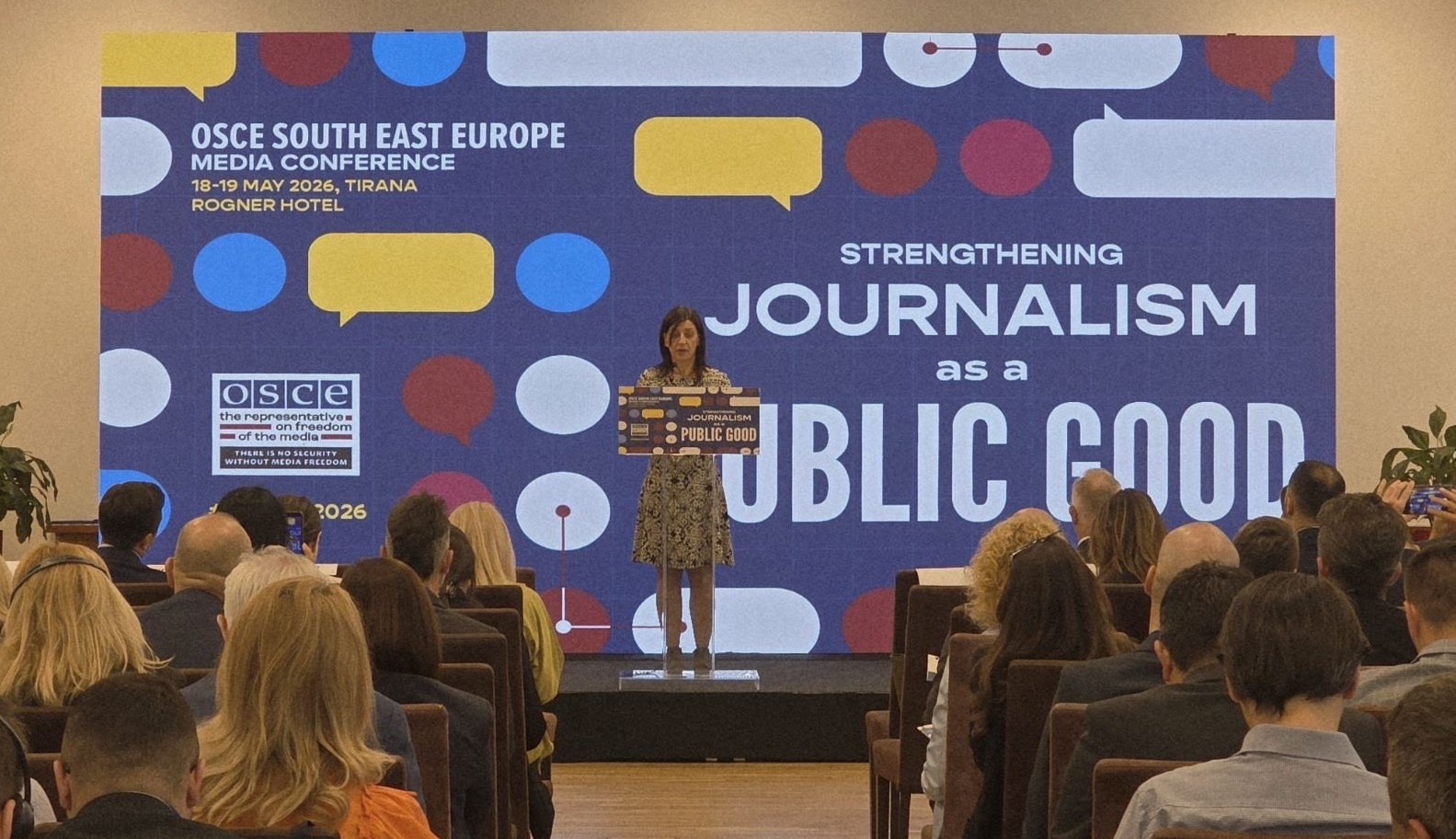
“How did the system collapse? I believe that this very question best illustrates where Serbia stands today when it comes to the safety of journalists. What we are witnessing are not isolated incidents. This is not a temporary deterioration of the situation. What we are facing is a collapse of the mechanisms that are supposed to prevent attacks, protect journalists, investigate threats, and ensure accountability,” emphasized Tamara Filipović Stevanović, General Secretary of Independent Journalists’ Association of Serbia, at the two-day OSCE Conference “Strengthening Journalism as a Public Good”.
According to her, what we are witnessing are not isolated incidents, nor is it a temporary worsening of the situation.
Read the full speech below:
Safety of Journalists in Serbia: Current Trends and Patterns
Good afternoon,
It is an honour to speak today not only as the Secretary General of the Independent Journalists’ Association of Serbia, but also on behalf of many journalists in my country who continue to do their work under growing pressure, fear and uncertainty.
I titled this speech after one question that was raised at our regional conference when Serbia was discussed: How did the system collapse?
I believe that this question best captures where Serbia stands today when it comes to the safety of journalists. Because what we are witnessing is not a series of isolated incidents. It is not a temporary deterioration. It is the collapse of mechanisms that are supposed to prevent attacks, protect journalists, investigate threats and ensure accountability.
This is also reflected in the 2025 Journalists’ Safety Index. The Index measures four areas: process, prevention, legal framework and actual attacks. Serbia has the lowest score in the Balkans: 2.24 on a scale from 1 to 7. On that scale, 1 represents a country where journalists are killed or disappear, while 7 represents a country of stability where journalists can work free from pressure. Scores between 2 and 3 fall within the negative domain. We have been measuring this since 2020, and unfortunately Serbia has never crossed the threshold of 3. For two years we came close to it, then we dropped back to the middle of the 2 range, and now, regrettably, we are moving closer and closer to 1.
The broader data confirm the same trend. The Independent Journalists’ Association of Serbia, within the SafeJournalists network, recorded 131 cases in 2024 and 313 cases in 2025, including 113 actual attacks and 124 death threats. In the first four months of 2026 alone, NUNS recorded 118 incidents, including 38 actual attacks. International monitoring shows the same deterioration. Mapping Media Freedom recorded 208 cases in Serbia in 2025, placing Serbia at the very top in Europe by the scale of documented risk for journalists.
There are several patterns behind these numbers.
First, violence has intensified, and it has become more physical, more direct and more public. A particularly disturbing moment came on the local election day at the end of March this year. The level of violence against journalists that day was unprecedented. Multiple obstructions and physical attacks against journalists were documented in municipalities across Serbia while they were reporting in the public interest and were clearly identified as members of the press.
And yet, nearly two months later, in the six most serious cases involving physical attacks on journalists, including attacks so severe that, based on the testimonies of the journalists who survived them, they may be described as attempted killings, the perpetrators still have not been identified. The first steps taken, especially by the prosecution, seemed encouraging to us as a community. We still hope these cases will reach a judicial outcome. But hope cannot replace accountability. When attacks of this gravity remain unresolved for weeks and months, the message sent to journalists is devastating.
Second, the police have increasingly become a source of danger for journalists, rather than a source of protection. This is one of the most serious changes in the Serbian context. We are no longer speaking only about passive failure to act. We are speaking about situations in which police officers are present during attacks and do not intervene, and also about cases in which police themselves use force against journalists covering protests and public events. According to prosecutorial data, in 2024 there were 64 cases involving journalist safety, and in 34 of them the police failed to act on prosecutors’ orders. In 2025, the prosecution recorded 140 cases, and in 50 of them the police did not proceed in accordance with prosecutorial instructions. This is why we say clearly: police have become one of the key sources of risk for journalists in Serbia.
Third, attacks do not begin in the street. They begin in language. Serbia has seen a massive expansion of smear campaigns, discrediting and dehumanising rhetoric directed at critical journalists and media. According to data collected by the Slavko Ćuruvija Foundation, from 1 August 2025 to 31 March 2026 there were at least 1,257 verbal attacks by senior state officials against critical journalists and media outlets. At least 64 public officials participated in such attacks. Journalists and media were labelled as traitors, foreign mercenaries, terrorists, fascists and enemies of the state.
These campaigns are not confined to tabloids or fringe actors. They are amplified on television stations with national coverage and by the highest officeholders in the country. One of the most recent and most disturbing examples is the targeting of Veran Matić through the film produced by the Centre for Social Stability, widely broadcast on pro-government television channels, as part of a broader propaganda and stigmatisation campaign that seriously endangers his safety.
Gender-based violence is also an essential part of the picture and it must not be overlooked. In Serbia, women journalists are increasingly targeted with threats containing misogynistic and sexualised elements, particularly on social media. They are insulted, degraded and threatened not only as professionals, but as women, and very often their children and family members are dragged into the abuse as well. Its purpose is not only to intimidate, but to shame, exhaust and push them out of the public space.
Fourth, legal pressure remains a serious tool for silencing journalists. SLAPP lawsuits continue to be used as a form of intimidation and exhaustion. The number of newly recorded SLAPP cases was lower in 2025 than in previous periods, and NUNS documented six new such cases during the year. But this did not mean the pressure disappeared. On the contrary, in April this year alone we again recorded two cases with the characteristics of SLAPPs, directed against the newsroom of Radar and against the award-winning investigative journalist Vuk Cvijić.
It is important to stress that Vuk Cvijić is not only a target of SLAPPs. He is also one of the journalists in Serbia most frequently exposed to physical attacks. And for those attacks as well, no one has been held accountable to this day. That fact alone says a great deal about the state of impunity in Serbia.
Another growing threat comes from digital surveillance. Spyware is now a real danger: there has already been one confirmed compromise and at least three unsuccessful attempts to target journalists’ phones. Criminal complaints have been filed, but there is still no epilogue. This adds another layer to the climate of insecurity in which journalists in Serbia are forced to work.
And impunity is, in fact, the key word. Last year, despite the highest number of recorded cases since systematic monitoring began, only three convictions were secured for attacks on journalists. At the same time, many cases remained in the evidence-gathering phase, while around 30 criminal complaints were dismissed, more than half of them through official notes that effectively prevent injured parties from using legal remedies. When journalists see that attackers are not punished, that threats are normalised, and that institutions react slowly or selectively, the result is predictable: fear, self-censorship and deep mistrust in the system.
The same pressure exists in the digital sphere more broadly. Online threats have become routine. Coordinated bot campaigns, fake reporting of journalists’ accounts, hacking attempts and DDoS attacks against media outlets increasingly serve to obstruct reporting and limit the reach of independent media. These pressures are particularly dangerous because they combine intimidation with censorship and are often difficult to trace and sanction.
So when we ask, how did the system collapse, the answer is this:
It collapsed when public officials began targeting journalists instead of protecting them.
It collapsed when police started to pose a threat instead of ensuring safety.
It collapsed when prosecutors opened cases, but justice did not follow.
It collapsed when smear campaigns became normalised.
And it collapsed when impunity became expected.
This is why the safety of journalists in Serbia is not a narrow professional issue. It is a democratic indicator. It tells us whether institutions still function in the public interest. It tells us whether the rule of law exists in practice. And it tells us whether citizens will continue to have access to reliable information.
What is needed now is not more declarative support. What is needed is action. Immediate identification and prosecution of those who attack journalists. Clear institutional accountability for police inaction and police violence. Stronger protection from online threats, spyware and abusive lawsuits. And an end to the public stigmatisation of journalists by those in power.
And let me end with one important fact.
Despite all of this, journalists in Serbia continue to work. They work in survival mode, but they continue to work professionally, courageously and with remarkable quality. This week, we presented awards for investigative journalism and journalism in the public interest. And the jury itself said that it had difficulty making the shortlist, because in the last ten years there have rarely been so many strong and important journalistic works. That says something essential about the profession in Serbia today: even under immense pressure, journalists continue to deliver work of the highest public value.
Because journalists in Serbia are still doing their work. But they are doing it in an environment where the cost of reporting is becoming dangerously high. And no democratic society can afford to accept that as normal.
Thank you.