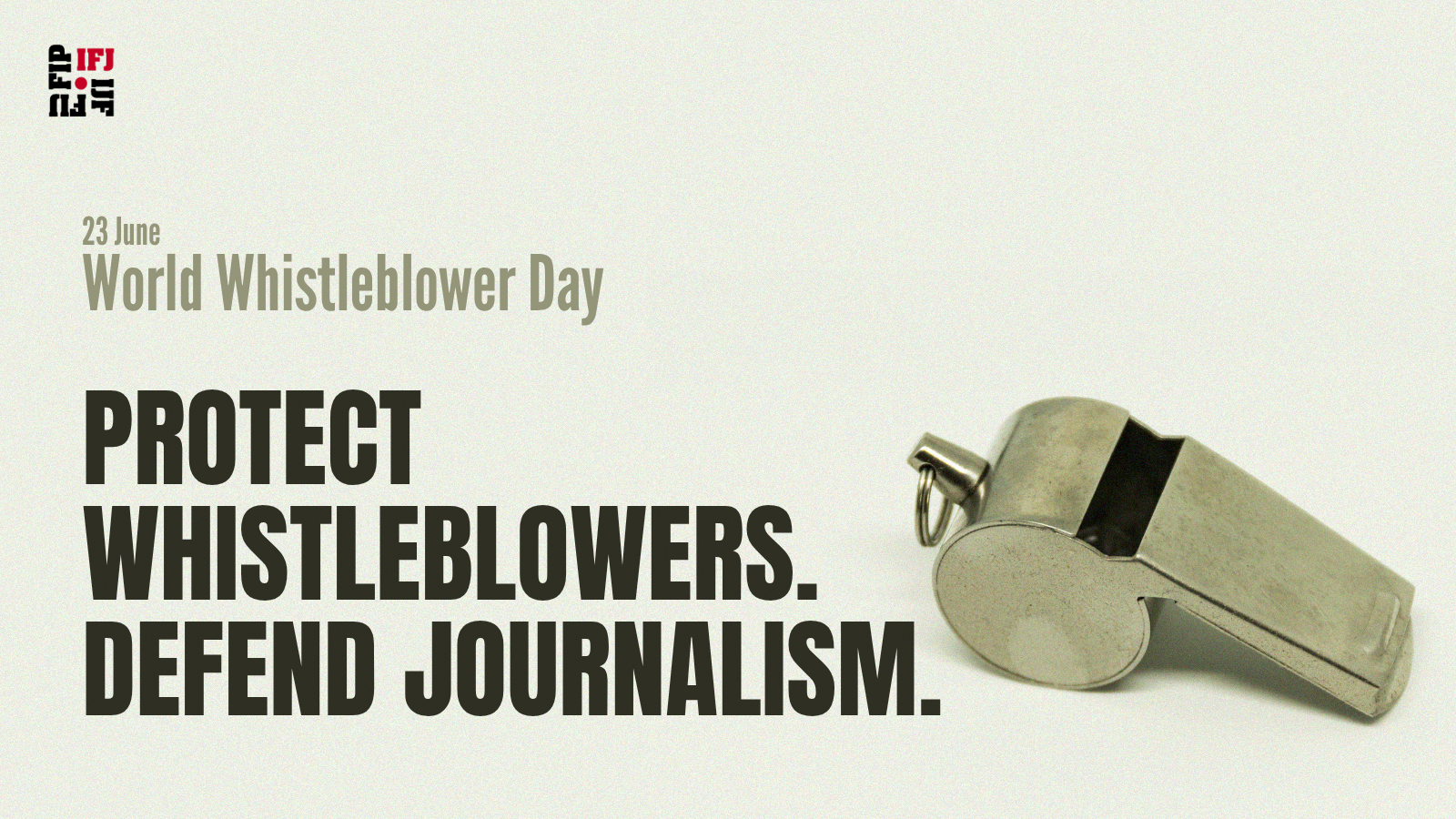
To mark World Whistleblower Day on 23 June, the International Federation of Journalists (IFJ), the world’s largest organisation of journalists, demands stronger legislation to protect those who provide information to journalists in the public interest.
The costs of acting as a whistleblower and informing journalists of matters of public interest can be high. This is seen in a number of well-known cases, from IT Specialist Edward Snowden and the NSA surveillance disclosures in 2013, to engineer Satyendra Dubey’s revealing of rampant corruption within the Golden Quadrilateral highways network in India in 2002, to government health inspector Daniel Gouveia Teixeira’s role in Brazil’s Operation Weak Flesh/Carne Fraca in 2017, and Australian military lawyer David McBride’s involvement in the Afghan leaks in 2014. People who speak up about any perceived wrongdoing stand the risk of losing their job or they may experience retaliation, prosecution, financial and psychological strain, imprisonment or even die as a result.
Yet in order to support journalists’ investigations and hold the powerful to account, whistleblowers must be able to expose corruption, fraud, mismanagement and any other misconduct that threaten citizens’ rights, health and safety, the environment and the rule of law.
The 2003 UN Convention against Corruption (UNCAC) states that each Member State “shall consider” adopting legislation to provide “protection against any unjustified treatment for any person who reports in good faith and on reasonable grounds to the competent authorities any facts concerning offences” established in accordance with the Convention. However, across the globe there is little legislation in full force to support those who bravely act as sources for journalists.
The IFJ urges national governments worldwide to adopt solid legislation to protect whistleblowers. Such legislation should at a minimum aim to:
- remove barriers to safely report directly to competent authorities,
- apply to all economic sectors,
- protect the confidentiality of those who speak up,
- protect whistleblowers against dismissal, harassment, discrimination and other forms of retaliation.
IFJ President Zuliana Lainez said: “Whistleblowers are key allies of journalists and democracy. Without courageous individuals willing to speak up, many of the abuses, corruption scandals and threats to public health and human rights that journalists expose would remain hidden. We call on governments to move beyond symbolic commitments and adopt robust, effective laws that guarantee confidentiality, protect whistleblowers from retaliation, and ensure they can report wrongdoing safely and enable journalists to report the truth. Protecting whistleblowers is not only about defending individuals – it is about safeguarding the public’s right to know and holding power to account.”
Credit: IFJ