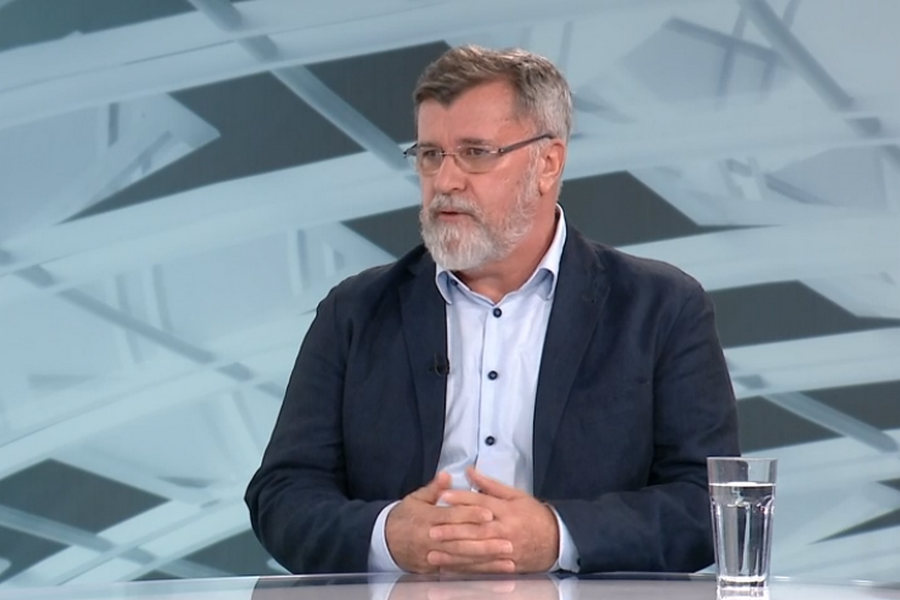
In Serbia, the systematic destruction of one journalist’s reputation has surpassed even the authoritarian playbook. In the 2.0 version, character assassination is a dangerous and breakneck scenario at the gates of the European Union, while Brussels looks the other way. The Independent Journalists’ Association of Serbia (NUNS) and Journalists’ Association Serbia (UNS), which are affiliated with the International Federation of Journalists (IFJ), have repeatedly raised concerns about threats against journalist Veran Matić and demanded that his safety be guaranteed.
On 17 June, Veran Matić —founder of Radio and TV B92, IPI World press freedom hero and the person to whom Serbian journalists have turned for decades when they have been attacked—, was filming a public meeting in front of the Serbian Parliament, when an individual slapped the phone out of his hand.
It didn’t help when Matić said he was a journalist. His phone was only returned, when Dorđe Prelić — the former leader of the notorious Alcatraz football fan group and one of those convicted of the 2009 killing of French football fan Brice Taton— ordered it to be returned. Prelić then told Matić that the B92 show Insider had “ruined his life”. (This is about a programme that exposed the criminal activities of football supporters’ groups)
In an atmosphere of total impunity for crimes against journalists, where daily threats and the stifling of free speech are commonplace, and the media is under threat, Veran Matić understood Prelić’s words as any professional journalist would: He understood them as a threat from which potentially dangerous action could result. Words as a warning and a prelude to an attack.
Escalating threats against journalist Veran Matić
For months, Matić has been subjected to continuous targeting and discreditation campaigns on pro-regime television and via more than 30 websites, as well as on different social media platforms such as Facebook, Instagram and X. Insults and threats are left under posts mentioning his name.
The security staff of the Serbian Parliament allegedly did not witness the incident. That is, until Matić reported the attack. Only then did the pro-regime media tabloids: Informer, Alo and Novosti, published images from the Assembly’s security camera, claiming that they are proof that Matić was the attacker.
After a series of smear campaigns in pro-regime media, under Matić’s photo on X it was written that “Let’s cut off the head of the hydra“. Soon, a new wave of messages followed that he should be hanged, sacrificed publicly, with questions about where he lives.
Since the beginning of the year, Matic and his family members have received dozens of death threats. He has been subjected to hundreds of insults and lies on social networks. He has been insulted and threatened on the street, and has been pushed aside in an alleged “accident”.
The president of the Association of Independent Electronic Media (ANEM) became a target for abuse after President Aleksandar Vučić suggested on a tabloid TV show that everyone convicted as a result of Matić’s involvement in the Permanent Working Group for the Safety of Journalists should have their files cleared and that Matić should apologise to them and perhaps even buy them a nice bottle of wine.
The climax of the campaign was a propaganda film of the Center for Social Stability, which branded Matić as a foreign agent who “sold out” Kosovo —Kosovo declared independence in 2008, Serbia does not recognise it. The film was broadcasted on two national pro-regime broadcasters, and promoted by more than 25 pro-regime portals.
The state’s response to this shameless aggression is that the court in the northern city of Novi Sad refused to make an injunction against the film.
Even when the post by Centre for Social Stability (on X and Instagram) stated: “If any of you see Veran Matić in the next month or two, tell him he is not the only (pseudo) journalist who grew a beard and that he should be a bit more patient—the continuation is coming soon…”, in Serbian context a clear message that Matić would suffer the same fate as the murdered Serbian Prime Minister Zoran Đinđić and journalists Slavko Ćuruvija and Milan Pantić, the rule of law remained absent.
Anyone who lived in Serbia at the end of the last century would understand the implications of this message. It is a brutally direct death threat.
Journalists forced to relocate
The reactions of the Ministry of Internal Affairs to Matić’s criminal complaints are indecent. Especially bearing in mind that Serbia has witnessed a widespread and systematic pattern of attacks and vilification of journalists over an extended period of time.
In July 2026, the Independent Journalists Association of Serbia, which is affiliated with the IFJ and the EFJ, recorded 19 cases of attacks and threats against journalists. The Slavko Ćuruvija Foundation, an NGO working to advance media freedom in Serbia and named after a slain journalist, recorded 106 verbal attacks by state officials. According to the official records of the Supreme Public Prosecutor’s Office, in the past two and a half years, only twelve out of 271 recorded threats and attacks against journalists have resulted in final court judgments.
Among others, many female journalists in various Serbian cities received death threats, threats of sexual violence and online misogynistic campaigns by pro-regime media due to their reporting.
Furthermore, in the last two years six journalists were forced to leave the country. Matić helped each of them.
In 1989, Matić and his colleagues, founding Radio B92, referred to the Universal Declaration of Human Rights as their founding document. In 1991, police broke into the B-92 newsroom, and five years later the station bypassed censorship by putting the signal on the BBC with satellite support. During the NATO bombing in 1999, Matić was arrested, and the media was forced to work from “secret” locations. He responded by switching the signal to Romania and Bosnia. A clandestine one in Belgrade, switched on when the ruthless Serbian ruler Slobodan Milošević fell.
Due to his incredible contribution to investigative journalism, the show Insider, which was broadcast on B92, was under 24-hour police protection from 2011 to 2016.
In 2013 he initiated the Commission for the Investigation of Murders of Journalists, demanding that the murders of journalists be investigated and prosecuted.
Many international and regional organisations that defend media freedom spoke out about the attack on Veran Matić. The IFJ and EFJ, filing an alert with the Council of Europe Platform, SafeJournalists demanded prosecutions, IPI, RSF and MFRR, concluded after their March mission to Belgrade that further escalation is dangerously likely.
The OSCE media freedom representative, Jan Braathu, called the Centre’s movie a direct death threat. The office of EU Enlargement Commissioner Marta Kos stated that it is very worrying that Matić work exposes him to attacks. The European Parliament condemned the violence in October 2025.
Despite these reactions, nothing has changed.
Impunity in Serbia is not a judicial “backlog.” It is a state policy, and every unpunished threat is an invitation for the next criminal attack.
Veran Matić spent thirty-seven years making sure someone reacted when a journalist in the country was attacked. When the attacks against Matić come from the sharp claws of the regime and its acolytes, who will insure his safety?
This article has been written by investigative journalist Jelena L. Petković. She has been working for many years on combating impunity for crimes against journalists and has over many years conducted research into the killing and disappearance of journalists in Kosovo. She has conducted interviews with more than 200 interlocutors: relatives, colleagues, acquaintances and members of international missions, disclosing new information on the disappearances and killings
Source: IFJ