11 April 2026 marks twenty-seven years since the unpunished murder of Slavko Ćuruvija, a prominent Serbian journalist and the publisher of Dnevni Telegraf and Evropljanin. As the Latin phrase goes, ‘Fiat justitia ruat caelum’: ‘Let justice be done, though the heavens fall’. But what can we say when there is no justice and the sky has fallen on everyone in Serbia? We are living in a state of criminal anarchy and unprecedented violence.
Slavko Ćuruvija, a steadfast fighter for the truth during the darkest hours of Serbian modern history, a period written in the blood of Slobodan Milošević’s regime, was gunned down and killed. He was shot from the back, just a step away from his home, in central Belgrade, on 11 April 1999, Orthodox Easter, amidst the NATO bombing campaign against Yugoslavia.
According to the information leaked from the secret police file, ‘Ćuran’, – Ćuruvija – was followed by 27 members of the State Security Service in three shifts, until just before his death.
In a trial that began only in 2015, former members of the State Security Service, Radomir Marković, Milan Radonjić, Ratko Romić and Miroslav Kurak, were sentenced to a total of one hundred years in prison. However, they were exonerated and released in 2024 by the Court of Appeal in Belgrade.
Today, the victim is being persecuted as a criminal. Three of the former defendants are now suing the Slavko Ćuruvija Foundation (SĆF), due to their public response to the acquittals. At the hearing held before the Second Basic Court in Belgrade, these former members of the notorious system claimed that SĆF’s response caused them mental distress, damaged their reputation, honor and violated their human rights.
However, in February 2024, lawyer Aleksandar Olenik, pointed out that the one of the Court of Appeal judges who voted for the acquittal is the wife of the former head of the VI Department of the State Security Service at the time of Ćuruvija’s killing, and was associated with the wife of Slobodan Milošević.
The fight for justice continues
However, at the beginning of 2026, the Supreme Court in Belgrade unanimously ruled that the Court of Appeal had violated the law in favour of the defendants. The Court of Appeal had presented some ‘completely unclear’ or ‘contradictory’ conclusions, which did not align with the statements of some of the prosecutions’ most important witnesses, nor with the key material evidence. This included the analysis of data from mobile phone base stations regarding the conversations the defendants had immediately, before and after the murder of Slavko Ćuruvija.
Slavko Ćuruvija’s daughter, Jelena, and the Slavko Ćuruvija Foundation submitted disciplinary charges against three Court of Appeal’s judges (two of whom are retired) to the Supreme Council of the Judiciary, and presented an initiative to the Constitutional Court to reconsider legal provisions that do not allow an appeal against an overturned acquittal, even when it is determined that it was passed in violation of the law, as is the case here.
Justice hit the Serbian judicial wall. There is no possibility of appeal against an acquittal that was found to have been made on faulty premises.
The sky has fallen once more. There is 100 percent impunity for past murders of journalists, and almost the same level of impunity for attacks against journalists today.
“Free journalism in Serbia is no longer possible,” Slavko Ćuruvija told the US Congress in Washington in 1998. This statement was both accurate at the time and prophetic for the future.
Journalists are under attack
Serbia tops the list for the highest number of impunity cases for the murder of journalists, as well as the highest number of physical assaults against journalists in 2025, according to the IFJ Killed list report.
“Serbia is one of the most dangerous places in Europe for journalists”, assessed the partner organisations of the Media Freedom Rapid Response (MFRR) Mechanism and the Platform of the Council of Europe for the Promotion of the Protection of Journalism and the Safety of Journalists, after completing a two-day fact-finding mission to Serbia in March 2026.
The database of the Independent Journalists Association of Serbia (NUNS), an affiliate to the IFJ and the EFJ, recorded an alarming number of 383 attacks, threats and instances of pressure against journalists in Serbia in 2025. The majority of these occurred in relation to the year-and-a-half-long protests by students and citizens against corruption and crime, and calling for elections. The police either attacked journalists themselves or simply failed to protect them when they witnessed assaults.
The year 2026 began with an even worse wave of violence and attempted censorship. In March alone, NUNS noted 30 incidents against journalists.
In January 2026, the Slavko Ćuruvija Foundation recorded at least 160 verbal attacks (twice as much as in December 2025) on critically oriented media and journalists by the highest state and party officials in Serbia. This figure increased to 171 in February and peaked at 186 in March.
The climax came on “Bloody Sunday”, 29 March, the day of local elections in Serbia. Journalists were beaten and tortured while doing their job, and scenes of their bloodied and broken heads symbolised the ‘democratic elections’.
Photojournalist Zorica Popović was kicked in the stomach twice by masked men. ‘Revolt’ journalist Lazar Dinić was chased to a nearby river, where he was tortured by masked attackers. They beat him, threatened him with an axe and forced him to shout, ‘Aca is president’, in reference to the current president and former minister of information at the time of Slavko Ćuruvija’s murder, Aleksandar Vučić. Lazar had to undergo surgery.
To this day, the attackers have not been charged.
Today’s Serbia is reminiscent of the late 1990s
TV N1, Nova, the weekly Radar and the daily Danas, are by far the special targets of the ruling Serbian Progressive Party. Thirteen prominent Serbian non-governmental organisations, along with many others, fear that the regime will succeed in taking over the last remaining beacons of free media in Serbia.
Journalist Veran Matić, who is the president of the Commission for the Investigation of Murders of Journalists in Serbia, and a leading advocate for bringing the perpetrators of Ćuruvija’s murder to trial, is being singled out for “special attention” by pro-government media. A gruesome ‘documentary’ broadcast on pro-government TV channels with national broadcasting licenses branded Matić a traitor of the worst kind and placed a target on his forehead. Prior to his murder in 1999, Slavko Ćuruvija was the target of similar smear campaigns.
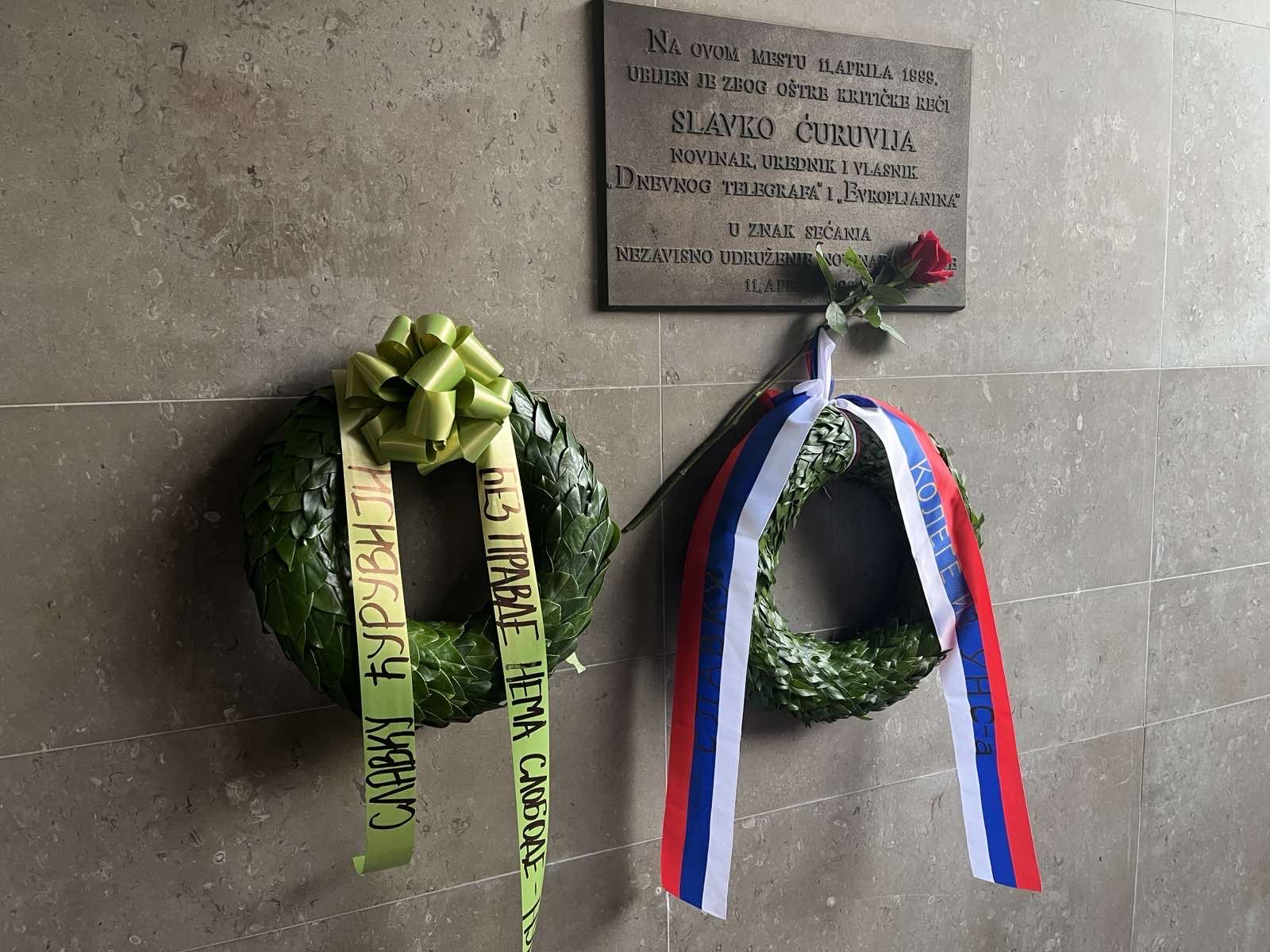
On 11 April, as the campaign against him continued, Matić laid a wreath at the spot where Slavko Ćuruvija was killed, together with representatives of the Journalists Association of Serbia (UNS) and the Independent Journalists Association of Serbia (NUNS).
“Even today, there are attempts to murder journalists and beat them up to prevent them from reporting. Just as there was an attempt to close Dnevni Telegraf in 1998 and 1999, N1 is now the same target. We must stand in solidarity as a community and protect ourselves from what may happen next. After an attempted murder comes a murder,” Matić pointed out.
When the heaven of justice falls, what remains is an eerie black hole that sucks up every fragment of hope, humanity, protection.
Solidarity is the only thing we have left to cling to. But for how long?
This article has been written by investigative journalist Jelena L. Petković. She has been working for many years on combating impunity for crimes against journalists and has over many years conducted research into the killing and disappearance of journalists in Kosovo. She has conducted interviews with more than 200 interlocutors: relatives, colleagues, acquaintances and members of international missions, disclosing new information on the disappearances and killings.
Source: IFJ